Fungal Infection Treatment: Complete Doctor’s Guide for Indian Practitioners & Patients (2026)
1. Understanding Fungal Infections: Types, Causes, and Why They Spread
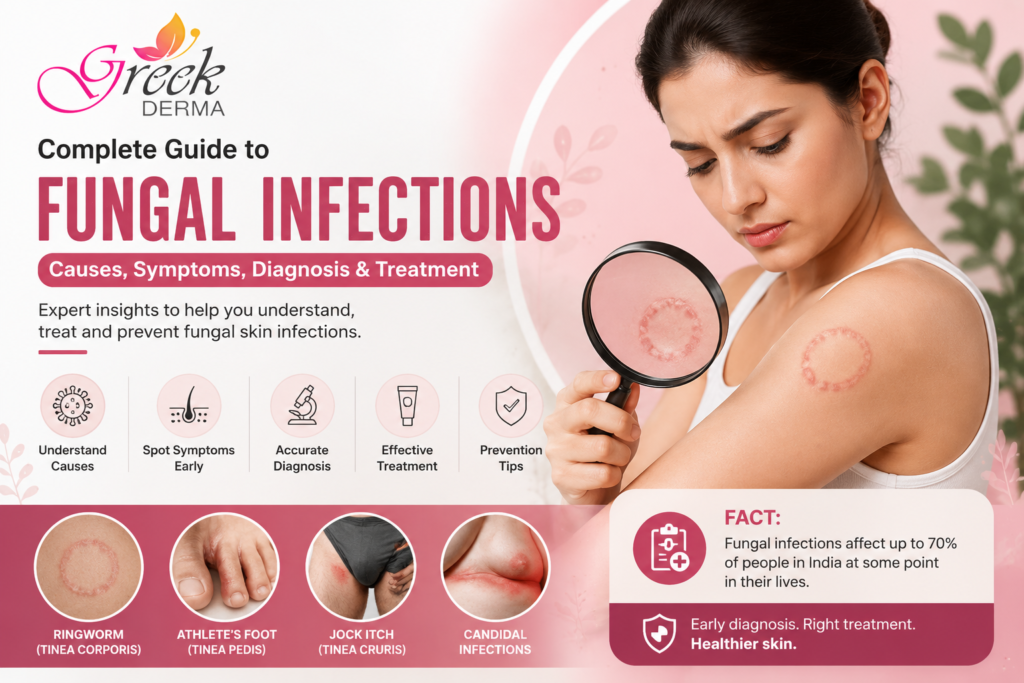
Fungal infections of the skin are incredibly common in India—affecting an estimated 70% of the population at some point in their lives. Yet most people don’t understand why they happen or how they differ from bacterial infections.
A fungal infection isn’t caused by bacteria. It’s caused by living fungi—organisms that belong to the same family as mushrooms and mold. These fungi thrive in warm, moist environments, which is why India’s tropical climate creates ideal conditions for them to flourish.
The fungi that cause skin infections belong to three main groups:
Dermatophytes are the most common culprits. These fungi specifically target dead skin cells, hair, and nails. The scientific names you’ll see on medical reports are Trichophyton, Microsporum, and Epidermophyton. These organisms cause ringworm, athlete’s foot, jock itch, and scalp infections.
Yeasts, particularly Candida albicans, prefer moist body areas. They’re responsible for vaginal yeast infections, oral thrush, and infections in skin folds where sweat accumulates.
Non-dermatophyte molds are less common but harder to treat. They occasionally cause nail infections and are usually associated with environmental exposure.
Here’s what makes fungal infections spread so easily: fungi reproduce through microscopic spores. These spores are incredibly durable—they can survive outside the body for over a year. When someone with a fungal infection shares a towel, walks barefoot in a communal shower, or shares clothing, those spores land on another person’s skin. If that skin is warm and moist, the spores germinate and the infection begins.
This is why fitness centers, swimming pools, locker rooms, and even shared bedding are hotspots for fungal transmission.
2. Recognizing Fungal Infection Symptoms: What Doctors Check For
The challenge with fungal infections is that patients often self-diagnose and self-treat incorrectly. They see a red, itchy rash and assume it’s a simple skin irritation. By the time they see a doctor, the infection has often spread deeper.
Ringworm (Tinea Corporis) starts as a small red patch that expands outward in a circular pattern. The center often clears, leaving a “ring” that gives the infection its name. Don’t let the name fool you—there’s no worm involved. Patients report itching and a slight burning sensation. The rash can appear anywhere on the body, but common sites are the trunk, arms, and groin.
Athlete’s Foot (Tinea Pedis) typically begins between the fourth and fifth toes. Patients describe intense itching, burning, and stinging. The skin becomes white, macerated (softened and peeling), and cracks easily. Left untreated, blisters form and the infection can spread to the sole and heel, creating what dermatologists call “moccasin distribution”—where the entire foot sole becomes dry, scaly, and thickened.
Jock Itch (Tinea Cruris) appears in the groin and extends down the thighs. Unlike simple chafing, a fungal infection creates a well-defined border between the infected and healthy skin. The rash has a reddish-brown color and is intensely itchy, especially after exercise or in humid conditions. Men are far more susceptible than women.
Candidal Infections in skin folds look different—they’re bright red with satellite pustules (small red bumps) around the edges. These occur in the groin, under breasts, between fingers, and in other moist body areas. Patients describe burning rather than itching as the primary symptom.
The key diagnostic sign doctors look for is the clear demarcation line—the boundary between infected and healthy skin is sharp and distinct. This is different from bacterial rashes, which tend to have fuzzy edges.
3. Medical Diagnosis: How Dermatologists Identify Fungal Infections
Experienced dermatologists can often diagnose a fungal infection from clinical appearance alone. But to confirm the type of fungus and ensure proper treatment, doctors perform two key tests:
KOH Mount Microscopy involves taking skin scrapings from the affected area, treating them with potassium hydroxide (KOH) solution, and examining them under a microscope. The KOH dissolves skin cells and reveals fungal structures. This test takes 15 minutes and confirms whether a fungus is present.
Fungal Culture is ordered when the KOH is positive or when initial treatment fails. The doctor collects skin, hair, or nail material and sends it to a laboratory where the fungus grows over 2-4 weeks. Culture identifies the exact species, which helps select the most effective antifungal medication.
Wood’s Lamp Examination uses ultraviolet light to detect certain fungal infections. Some fungi fluoresce under Wood’s lamp (though most don’t), making it a quick screening tool.
The reason diagnosis matters: not all fungal infections are treated the same way. A fungal infection in the groin might require different medication than one on the scalp. And misdiagnosis—treating a fungal infection with corticosteroid cream, for example—actually worsens the condition by suppressing the immune response while the fungus continues growing.
4. Prescription Antifungal Creams: How They Work
Antifungal medications work by disrupting the fungal cell membrane or inhibiting enzymes the fungus needs to survive. The mechanism depends on the drug class.
Azoles (including miconazole, clotrimazole, ketoconazole, and luliconazole) block ergosterol synthesis—a crucial component of fungal cell membranes. Without ergosterol, the fungal cell membrane becomes unstable and the cell dies. Azoles are broad-spectrum, meaning they work against multiple fungal species.
Allylamines (such as terbinafine and naftifine) work differently. They inhibit squalene epoxidase, an enzyme that prevents proper cell wall formation in fungi. This causes the fungal cell to rupture.
Morpholines like amorolfine interfere with sterol synthesis, disrupting the fungal cell structure from within.
Each drug class has advantages. Azoles work on a wide range of fungi but require 2-4 weeks of treatment. Allylamines like terbinafine work faster—often clearing infections in 2 weeks—but are more expensive.
The most important principle doctors follow: antifungal monotherapy wins over combination creams. A simple antifungal cream (containing only an azole or allylamine) is far more effective than combination creams that mix antifungals with corticosteroids or antibiotics. The reason is straightforward—combination products dilute the active antifungal ingredient, reducing its effectiveness.
5. Best Antifungal Creams for Different Types of Infections
For Ringworm and General Body Fungal Infections:
Clotrimazole 1% cream is the first-line choice. It’s effective, affordable, and available over-the-counter. Apply it 2-3 times daily for 4 weeks, extending the treatment 2 weeks beyond when the rash visibly clears.
For patients who don’t respond to clotrimazole or have extensive involvement, terbinafine 1% cream offers faster results—typically clearing infections in 2-3 weeks. The downside is cost, but efficacy is higher.
In India, dermatologists prescribe creams like DAZFLU (luliconazole 1%) or DAZKET-XX for more stubborn infections involving multiple dermatophytes or infections with secondary bacterial involvement. These multi-component formulations address both the fungal and inflammatory component simultaneously.
For Athlete’s Foot:
Terbinafine cream is preferred because the infection is often deeper and more resistant. Apply it once daily to the affected area for 2-4 weeks. If infection extends to nails (fungal nail infection/onychomycosis), oral terbinafine tablets become necessary—topical creams don’t penetrate nails adequately.
For acute flare-ups with severe inflammation and blistering, dermatologists recommend CONISOL cream (clobetasol propionate + salicylic acid), which combines an antifungal with a potent steroid to reduce inflammation while treating the fungus. This addresses both symptoms and the root cause.
For Jock Itch:
This area is tricky because the skin is sensitive and humidity is high. Miconazole 2% cream works well and causes less skin irritation than other options. Apply 2-3 times daily for 3-4 weeks.
For severe cases with maceration and secondary bacterial infection, DAZKET-XX cream (which contains ketoconazole, clotrimazole, and clobetasol) prevents both fungal spread and bacterial superinfection. This is particularly useful in Indian summer months when sweat and humidity exacerbate the condition.
For Candidal Skin Infections:
Clotrimazole or miconazole creams are first-line. The key difference from dermatophyte infections: candidal infections require shorter treatment (10-14 days) and attention to moisture control—keeping the area dry is as important as the medication.
For recurrent candidal infections in skin folds, doctors recommend SOFRALEM cream (fradimomycin + chlorocresol), which combines antifungal activity with antibacterial properties to prevent secondary infections common in these moist areas.
6. Treatment Duration and Expected Results
This is where patient education is critical. Many patients stop treatment as soon as the visible rash clears—which is precisely why fungal infections recur so frequently.
Week 1-2: The rash begins to improve. Itching decreases. Patients feel they’re cured and stop treatment.
Week 3-4: The visible rash is gone, but the fungus is still present in deeper skin layers.
Week 5-6: If treatment was stopped early, the fungus re-grows and the patient reports the infection returned.
The correct approach: continue treatment for at least 2-4 weeks after visible cure. This ensures the fungus in deeper skin layers is completely eliminated.
For nail infections (onychomycosis), treatment duration is much longer—6-12 weeks for fingernails and 12-16 weeks for toenails. Topical creams alone rarely work for nail infections; oral antifungal tablets are required.
Expected timeline:
- Day 1-3: Itching begins to decrease
- Day 7-10: Visible improvement in rash appearance
- Week 3: Rash is largely resolved
- Week 4-6: Continue treatment to eliminate residual fungus
- Week 8+: Complete clinical cure; low recurrence risk
7. Why Over-the-Counter Steroids Make Fungal Infections Worse
This is the most critical mistake patients make: they use corticosteroid creams or combination creams containing steroids.
Here’s what happens: steroids reduce inflammation, so the itching stops and the rash becomes less red—temporarily. The patient thinks they’re cured. But steroids actually suppress the local immune response, allowing the fungus to grow deeper into the skin. The result is a more extensive, deeper infection that’s harder to treat.
Combination creams like “antifungal + steroid” are tempting because they provide quick symptom relief. But they’re inferior to antifungal monotherapy. The steroid dilutes the antifungal concentration and actually works against the cure.
Doctor’s rule: Never treat a suspected fungal infection with a corticosteroid cream. If the patient has been using one, the infection is likely deeper than it appears.
8. Prevention Strategies: Stop Infections Before They Start
For patients with recurrent fungal infections, prevention is more effective than repeated treatment.
Moisture Control: Fungi need moisture. After showering, dry thoroughly—especially between toes, in the groin, and under skin folds. Change out of wet clothes immediately. Wear breathable cotton socks and underwear.
Footwear: Avoid tight, non-breathable shoes. Alternate shoes to allow them to dry completely between uses. Wear flip-flops in communal areas (gyms, pools, locker rooms).
Personal Hygiene: Don’t share towels, nail clippers, or combs. Wash these items regularly in hot water.
Environmental Control: Keep shower areas and bathrooms dry. If someone in the household has a fungal infection, clean bathroom surfaces with antifungal solutions.
Dietary Support: Some evidence suggests zinc and vitamin D deficiency increases fungal infection risk. Ensure adequate nutrition.
Nail Care: Keep nails short and dry. Trim them straight across, not curved. If nails are thick or discolored, see a dermatologist early—early nail infection treatment prevents deep involvement.
9. When to Refer Patients to Specialists
Most fungal infections are straightforward and respond well to topical treatment. But certain situations require specialist referral:
- Nail infections (especially toenails): Require systemic antifungal therapy. Refer to dermatologist for confirmation and treatment planning.
- Scalp infections: Topical treatment alone is insufficient. Systemic therapy plus specific medicated shampoos are needed.
- Widespread infections: If fungal infection covers >2% of body surface area, systemic therapy is more effective.
- Failure to respond: If infection hasn’t improved after 4 weeks of correct antifungal therapy, refer for culture and species identification.
- Immunocompromised patients: HIV/AIDS patients, those on immunosuppressive therapy, or with uncontrolled diabetes need specialist management.
- Recurrent infections: More than 3 infections in a year suggests underlying predisposition or improper initial treatment.
10. FAQ: Doctors and Patients Ask
Q: How long does fungal infection treatment take?
A: 2-4 weeks for topical treatment of body and groin infections. Nail infections require 6-16 weeks of oral medication.
Q: Can I use a fungal infection cream on my face?
A: With caution. Face skin is more sensitive. Use lower concentrations (0.5-1%) and avoid potent agents. Clotrimazole 1% is generally safe; terbinafine can irritate. Don’t use on eyelids.
Q: Is fungal infection contagious?
A: Yes, highly contagious. Spores spread through direct contact, shared towels, and contaminated surfaces. Treatment should begin immediately to prevent spread to family members.
Q: Should I cover the infection with a bandage?
A: No. Fungi thrive in warm, moist, dark environments. Keeping the area open and dry accelerates healing.
Q: Can fungal infections turn into something serious?
A: In healthy individuals, superficial fungal infections rarely become serious. However, diabetic patients and immunocompromised individuals are at risk for deeper tissue invasion. Any sign of spreading redness, warmth, swelling, or fever requires immediate medical attention.
Q: What’s the difference between jock itch and a rash from chafing?
A: Fungal jock itch has a sharp, well-defined border. Chafing rash is diffuse with no clear border. Fungal infections have satellite pustules (small bumps) around the edges. Chafing doesn’t.
Q: If I stop treatment early and the infection returns, will it be harder to treat?
A: Not if you restart proper antifungal therapy. The fungus doesn’t develop resistance to topical antifungals in the same way bacteria develop antibiotic resistance. But incomplete treatment allows deeper skin penetration, making it feel more stubborn.
Q: Are natural remedies like tea tree oil effective?
A: Tea tree oil has mild antifungal properties, but clinical evidence for monotherapy is weak. It can be a supplement to prescription antifungals but shouldn’t replace them.
Q: Can I get fungal infections from pets?
A: Yes, some fungal infections are zoonotic. If your patient has ringworm and owns a cat or dog with skin lesions, both should be evaluated.