All posts by admin_d3e66d

Derma PCD Pharma Franchise in Mohali-Greekderma

Derma PCD Pharma Franchise in Mohali – Products, Monopoly & Business Guide 2026-27

Derma PCD Pharma Franchise in Mohali-Greekderma

Overview:

Mohali has grown into an important commercial and healthcare market in Punjab and the wider Chandigarh Tricity region. New residential sectors keep coming up, clinics and pharmacies are multiplying, and people are paying a lot more attention to skin and hair care than they used to — all of which makes this region worth a look for anyone exploring the Derma PCD Pharma Franchise in Mohali.

A dermatology-focused PCD franchise means exactly what it sounds like: entrepreneurs, pharma distributors, medical reps, or any other eligible professional can build a business around specialised derma and skincare products without ever having to set up their own manufacturing unit.

But picking a partner just by comparing prices, or going with whoever has the fattest catalogue, doesn’t really work here. Product quality, local demand, monopoly terms, documentation, manufacturing standards, stock availability, investment requirements, and ongoing franchise support all need a proper look before you commit — skip that homework and you’ll pay for it later.

This 2026-27 guide explains how a Derma PCD Franchise in Mohali works, which product categories are worth considering, how monopoly rights are generally structured, and what entrepreneurs should verify before choosing a dermatology franchise company.

Why Is Mohali a Growing Market for Derma PCD Pharma Franchise Business?

Mohali, officially Sahibzada Ajit Singh Nagar, is a key part of the Chandigarh Tricity region. Its expanding residential and commercial development, its connectivity with Chandigarh and Panchkula, and its established healthcare ecosystem all make it relevant for pharmaceutical distribution and marketing businesses.

Dermatology itself is a fairly wide specialised segment — skin, scalp, hair, hygiene, and a handful of related healthcare needs all sit under one umbrella. That’s exactly why a franchise entrepreneur here isn’t stuck depending on a single formulation; the market can support several product categories at once.

A Dermatology PCD Franchise in Mohali can potentially target areas within Mohali as well as the surrounding markets, though that’s subject to the franchise company’s territory policy and applicable business requirements.

Market potential shouldn’t be mistaken for guaranteed sales, though. Study your own territory, competition, healthcare network, product demand, and running costs before you put any money in.

What Is a Derma PCD Pharma Franchise, and How Does It Work in Mohali?

PCD commonly refers to Propaganda Cum Distribution. In a pharmaceutical franchise arrangement, a pharma company works with independent franchise associates for the marketing and distribution of its products within an agreed territory.

A Derma PCD Pharma Franchise applies this model specifically to dermatology and related products.

The company usually takes care of manufacturing or sourcing, branding, packaging, and supply, while the franchise associate builds the market through their local distribution and professional network.

Someone interested in Mohali would typically pick a target territory first, then approach a derma PCD company to check what’s available.

Once the product portfolio and commercial terms have been compared, the entrepreneur can select products, go through monopoly terms where applicable, complete the paperwork, and place an initial order.

The exact arrangement varies from company to company, so always read the franchise terms before you start.

Who Can Start a Derma PCD Pharma Franchise in Mohali?

Pharmaceutical distributors, wholesalers, medical representatives, pharma marketing professionals, existing franchise operators, and other eligible entrepreneurs interested in the dermatology segment can all consider this business.

Prior pharmaceutical market experience genuinely helps here — the business involves understanding products, managing inventory, building professional relationships, planning territories, and keeping an eye on demand.

New entrepreneurs can explore the model too, but they should get familiar with the licensing requirements and commercial structure before investing.

Having an existing network among dermatologists, healthcare professionals, pharmacies, or distributors can help with market development — but it’s not a guarantee of results on its own.

Why Consider Greek Derma for the Derma PCD Pharma Franchise in Mohali?

Greek Derma operates in the dermatology-focused PCD franchise segment and can be considered by entrepreneurs comparing options for a Derma PCD Pharma Franchise in Mohali.

Its dermatology focus gives franchise associates room to explore multiple skin and hair care categories under one specialised portfolio.

Before entering into any arrangement, prospective partners should still verify the latest product catalogue, manufacturing information, applicable certifications, pricing, monopoly availability, promotional inputs, and commercial terms directly with the company.

Specialised Dermatology Product Portfolio:

A specialised portfolio helps franchise associates stay focused on one defined market instead of juggling unrelated therapeutic segments.

Greek Derma’s product categories include creams, ointments, gels, face washes, sunscreens, lotions, soaps, shampoos, hair-care products, baby-care products, and other dermatology-focused formulations.

Pick the right portfolio based on local requirements — not by simply maxing out the number of products you carry.

Quality-Focused Product Range:

Quality should sit right at the top of your checklist when picking a derma franchise partner.

Look at product information, composition, packaging, manufacturing details, batch information, and quality documentation before placing any significant order.

Greek Derma presents its portfolio as quality-focused and references recognised manufacturing and quality standards in its company information. Even so, prospective franchise associates should verify the latest applicable documents for whatever products they intend to market.

Monopoly-Based Franchise Opportunities:

Greek Derma provides franchise opportunities that may include monopoly-based arrangements, depending on territory availability and company policy.

For entrepreneurs seeking a Monopoly Derma PCD Franchise in Mohali, the first step should be checking whether the preferred area is currently available.

Make sure the geographical area, covered products, purchase conditions, duration, and other monopoly terms are documented in the franchise agreement — not just discussed verbally.

Professional Product Packaging:

Packaging matters a lot for dermatology and skincare portfolios specifically — it supports product identification, protection, handling, storage, and how professional the brand looks on a shelf.

While comparing products, check pack sizes, labelling, batch information, manufacturing and expiry details, and how suitable the packaging is overall.

Good-looking packaging can support branding, sure, but it should never stand in for product quality and proper documentation.

Marketing & Promotional Support:

PCD companies often provide promotional inputs to help franchise partners present their portfolio to the market.

Depending on the company’s current policy and franchise package, this can include product literature, visual aids, product cards, brochures, MR bags, digital creatives, samples where permitted, and other materials.

Confirm exactly what’s included in your arrangement rather than assuming it matches the standard package.

Franchise Partner Assistance:

Once the franchise is up and running, ongoing communication becomes genuinely important.

Support can include product information, ordering assistance, stock-related communication, promotional inputs, and updates on the available portfolio.

Before finalising a company, understand not just what’s promised at onboarding, but what assistance is actually available once regular business begins.

Derma Product Categories Available for PCD Franchise in Mohali

Product selection is a critical part of building a Derma PCD Franchise in Mohali. A broad catalogue gives you choice, sure — but your final portfolio should reflect actual local demand, not what looks impressive on paper.

Dermatology Creams:

Cream-based formulations are an important category within dermatology portfolios.

Compare them on intended use, composition, pack size, pricing, product information, and how they stack up against the competition.

Ointments & Gels:

Ointments and gels add further dosage forms to a dermatology portfolio.

Don’t treat every topical product as interchangeable — understand the intended category and target market behind each formulation.

Face Wash Products:

Face washes are a staple in modern skincare portfolios.

Different formulations target cleansing, oily skin, acne-prone skin, sensitive skin, or other specific needs, so select them according to the market you’re actually building.

Sunscreen Range:

Sun-protection products can be a meaningful part of a dermatology-focused portfolio.

When comparing sunscreens, look at formulation type, SPF positioning, packaging, pack size, pricing, and the intended consumer segment.

Any SPF or protection claims should match up with proper product information and supporting documentation — don’t take label claims at face value.

Lotions:

Lotions can cover moisturising, skincare, scalp, or other dermatology-related uses depending on formulation.

They complement creams, gels, and other topical products well within a diversified portfolio.

Medicated & Skincare Soaps:

Soap-based products add another category to a derma franchise portfolio.

Formulations and intended uses differ quite a bit here, so understand the positioning and product information before you start marketing them.

Shampoo & Hair Care Range:

Dermatology portfolios frequently stretch beyond skin care into scalp and hair care.

Shampoos and related products help a franchise associate build out a broader dermatology portfolio while covering different market needs.

Hair Serums & Oils:

Hair serums and oils pair naturally with shampoos and other scalp-care products.

Compare formulations, positioning, pricing, packaging, and local competition before adding these to your range.

Baby Care Products:

Baby-care dermatology products form a more specialised, sensitive segment where product selection and quality checks matter even more.

Entrepreneurs interested in this category should carefully review product documentation, intended use, manufacturing information, and labelling before committing.

Dermatology Tablets:

Some dermatology portfolios include oral dosage forms too.

These require appropriately professional marketing and should be handled in line with their regulatory classification and applicable requirements.

How Does Monopoly Derma PCD Franchise Work in Mohali?

A monopoly franchise generally gives an associate defined marketing or distribution rights for agreed products within a specified territory.

It doesn’t mean other dermatology brands or pharmaceutical businesses are shut out of that market entirely.

Territory-Based Monopoly Rights:

Under a territory-based arrangement, the franchise company may allocate a defined geographical area to one franchise associate, subject to the agreement.

For Mohali, this could mean a city, a locality, an adjoining market, or another clearly defined territory.

Confirm the exact boundaries before you place an order.

Product or Division-Based Rights:

In some arrangements, exclusivity applies only to selected products or a specific division rather than the company’s entire catalogue — and this distinction matters more than it might seem.

An entrepreneur should ask whether monopoly rights cover all Greek Derma products selected for the territory or just a particular range within it.

Important Terms to Verify Before Taking Monopoly Rights:

Before accepting monopoly rights, check the exact geographical boundaries, product coverage, agreement duration, minimum purchase requirements if any, renewal terms, payment conditions, and termination clauses.

Verbal promises should never replace clear, written commercial terms.

How to Choose the Best Derma PCD Pharma Franchise Company in Mohali?

The best Derma PCD Pharma franchise company in Mohali really depends on the entrepreneur’s target market, budget, product requirements, and business model — there’s no one-size-fits-all answer.

Here are the factors that make the comparison more objective.

Check the Dermatology Product Portfolio:

Review whether the company’s products actually match your intended market.

Don’t pick a company just because it lists hundreds of products — portfolio relevance beats catalogue size, every time.

Verify Manufacturing & Quality Standards:

Ask where the products are manufactured and what quality systems are in place.

Find out whether manufacturing happens through owned facilities, associated units, or third-party arrangements.

Review Certifications and Product Documentation:

If a company refers to ISO, GMP, WHO-GMP, or similar standards, ask for current documentation supporting the claim.

Also go through appropriate product and manufacturing information before finalising your portfolio.

Confirm Monopoly Territory Availability:

Check your preferred Mohali territory before committing significant capital.

Also confirm whether the exclusivity covers your complete product portfolio, selected products, or just one division.

Compare Product Pricing & Commercial Terms:

Weigh pricing alongside taxes, freight, minimum order requirements, payment terms, promotional inputs, and other costs.

Don’t calculate the business’s potential from headline margins alone.

Check Stock Availability and Supply:

Regular supply becomes important once products start generating repeat demand.

Ask about stock management, normal dispatch procedures, repeat orders, and how the company handles temporary shortages.

Evaluate Marketing & Franchise Support:

Compare the actual, practical support different companies offer.

Product literature, promotional materials, product information, order assistance, and clear communication all add up to smoother day-to-day franchise operations.

How Much Investment Is Required for a Derma PCD Franchise in Mohali?

There’s no universal fixed investment for starting a Derma PCD Pharma Franchise in Mohali.

It depends on the number of products you select, opening stock quantity, pricing, target territory, minimum order requirements, promotional spend, transportation, storage, and working capital.

A franchise starting with a tight, focused portfolio will obviously need a different budget than one launching dozens of products across multiple derma categories.

Split your budget into initial inventory and working capital right from the start — working capital covers repeat orders, transport, marketing, credit cycles, and other running costs, so don’t sink your entire budget into opening stock.

Documents & Licences Required to Start a Derma PCD Pharma Franchise

Documentation depends on exactly how the business is structured.

Common business documents include PAN, identity proof, address proof, banking details, business registration information, and GST registration where applicable.

Relevant pharmaceutical licences may be required for businesses that stock, sell, or distribute regulated pharmaceutical products.

Since requirements vary with business activity and current regulations, confirm the exact requirements with the appropriate licensing authority or a qualified professional before you start operations.

How to Select the Right Derma Products for the Mohali Market

Product selection should be built on real market information, not assumptions.

Understand Local Product Demand:

Study which dermatology categories generate regular demand within your target market.

Your existing network and actual market enquiries are usually the best source of insight here.

Analyse Existing Competition:

Review which product categories and brands already have a strong presence.

Competition doesn’t automatically rule out a category, but it does influence pricing and how you’d enter the market.

Start with a Focused Product Portfolio:

Rather than ordering everything available, start with a manageable selection that matches your target market.

This makes inventory and working-capital management a lot easier in the early phase.

Monitor Repeat Product Demand:

Initial sales alone don’t tell you whether a product has real, sustainable demand.

Track repeat orders, inventory movement, enquiries, and market feedback closely.

Expand the Range Based on Market Response:

Once certain categories show consistent demand, bring in additional products gradually.

This keeps your portfolio expansion evidence-based rather than a guessing game.

General PCD Pharma Franchise vs Derma PCD Pharma Franchise in Mohali

A general PCD franchise typically covers products from multiple therapeutic segments, whereas a Derma PCD Pharma Franchise in Mohali concentrates primarily on dermatology, skin, scalp, and related product categories.

A general portfolio gives you broader market coverage.

A specialised derma portfolio, on the other hand, lets entrepreneurs build deeper knowledge and relationships within one particular segment.

Neither model wins outright.

A pharma professional with an established dermatology network may find specialisation the better fit, while someone with a broader distribution network might prefer going general.

Base the decision on market access, experience, capital, product demand, and competition — not on which sounds more impressive.

How to Start a Derma PCD Pharma Franchise in Mohali – Step-by-Step Process

Starting systematically cuts down on avoidable commercial mistakes.

Step 1 – Research the Mohali Derma Market

Study local demand, healthcare infrastructure, existing distributors, competition, and product categories before you shortlist a company.

Step 2 – Select Your Target Territory

Decide which area you can realistically manage.

A well-defined territory generally works better than trying to cover a large region without the resources to actually service it.

Step 3 – Shortlist a Derma PCD Company

Compare companies on products, manufacturing information, documentation, commercial terms, stock availability, monopoly policies, and support.

Step 4 – Select Suitable Derma Products

Choose products according to local demand, competition, pricing, and your existing professional network.

Step 5 – Check Monopoly Availability

Ask whether your target territory is currently available and what conditions apply to exclusivity.

Step 6 – Review Pricing and Commercial Terms

Understand product rates, minimum order quantities, payment terms, freight, taxes, promotional inputs, and any other applicable costs.

Step 7 – Complete Required Documentation

Arrange the applicable business documentation and licences before you begin operations.

Step 8 – Place the Initial Product Order

Start with a portfolio and quantity that actually matches your market research and working capital.

Avoid loading up on excessive initial inventory just to feel like you have a bigger catalogue.

Step 9 – Develop Your Local Market

After launch, keep tracking product movement, repeat demand, customer feedback, competition, and inventory — and use that information to refine and expand the portfolio over time.

Areas to Consider for Derma PCD Pharma Franchise in Mohali

Entrepreneurs interested in the Mohali region can evaluate SAS Nagar/Mohali, Kharar, Zirakpur, Dera Bassi, Kurali, and surrounding markets, depending on their business network and the company’s franchise structure.

These markets differ quite a bit in size, competition, customer profile, and healthcare ecosystem — so pick a territory based on actual market reach, not simply the largest area on the map.

Importantly, listing an area here doesn’t mean monopoly rights are currently available there. Confirm exact territory availability with Greek Derma before entering into an agreement.

Benefits of Starting a Specialised Derma PCD Franchise in Mohali

Specialisation lets an entrepreneur put all their resources behind one clearly defined therapeutic segment.

A focused dermatology portfolio tends to make product knowledge, inventory planning, professional networking, and market positioning noticeably easier to manage.

It also lets franchise associates offer complementary categories — creams, face washes, sunscreens, shampoos, lotions, soaps, gels, and hair-care products — all within one focused portfolio.

The actual benefits still come down to the products selected, territory, company, market demand, and execution.

Common Mistakes to Avoid When Choosing a Derma Franchise Company

Choosing a company purely because it advertises high margins is one of the most common mistakes out there.

Beyond that, avoid picking products without real market research, accepting verbal monopoly commitments, skipping past quality documentation, ordering excessive opening stock, overlooking freight and running costs, and signing without actually reading the franchise agreement.

Another trap: assuming a bigger product catalogue automatically means a better opportunity.

A carefully chosen portfolio of relevant products is usually far easier to manage than a large catalogue full of slow-moving inventory.

Is a Derma PCD Pharma Franchise in Mohali Profitable?

A Derma PCD Pharma Franchise in Mohali can offer real commercial potential — but there’s no fixed or guaranteed profit attached to it.

Actual profitability depends on purchase pricing, sales volume, product mix, competition, market demand, operating expenses, transportation, promotional costs, credit management, stock movement, and how well the entrepreneur develops the territory.

Don’t confuse gross product margin with net profit.

Transport, marketing, unsold inventory, credit cycles, and general business operations all eat into what the franchise operator actually takes home.

A realistic business plan should weigh revenue, gross margin, operating expenses, inventory turnover, and working capital together — not in isolation.

Future Scope of Dermatology Franchise Business in Mohali

Dermatology and personal-care markets keep evolving as consumers get more engaged with skin, hair, scalp, sun protection, and personal-care needs.

Mohali’s position within the Chandigarh Tricity region makes it a genuinely relevant market for businesses operating in specialised healthcare segments.

For franchise entrepreneurs, future opportunities are likely to come from specialised product portfolios, better distribution, professional market development, and shifting consumer needs.

Wider market growth, though, doesn’t guarantee individual business success on its own.

Sustainable performance will keep depending on product relevance, quality, pricing, supply reliability, market relationships, inventory management, and competition.

Final Checklist Before Selecting a Derma PCD Pharma Franchise Company

Before finalising a franchise partner, verify the dermatology product portfolio, manufacturing arrangements, quality documentation, applicable certifications, product information, pricing, monopoly territory, written franchise terms, minimum order requirements, payment conditions, stock availability, supply process, promotional support, packaging, applicable licences, opening inventory, working capital, and after-sales business assistance.

Compare more than one option wherever you can.

A franchise decision should rest on documented business information — not promotional claims alone.

Conclusion – Choosing the Right Derma PCD Franchise Partner in Mohali

Starting a Derma PCD Pharma Franchise in Mohali can be a genuine opportunity to build a specialised pharmaceutical business around dermatology, skincare, scalp-care, hair-care, and related product categories.

But successful business planning starts with due diligence.

Understand Mohali’s local market, select appropriate products, verify manufacturing and quality information, check monopoly territory conditions, compare pricing, keep enough working capital in reserve, and review the franchise terms carefully before investing.

Greek Derma can be considered by entrepreneurs looking for a specialised derma portfolio and franchise opportunities in the Mohali region. Prospective partners should still confirm the latest product catalogue, applicable documentation, commercial terms, and exact availability of their preferred territory before finalising the partnership.

The right franchise partner is ultimately one whose products, business terms, supply capabilities, quality approach, and territory structure actually match your specific market requirements.

Frequently Asked Questions

Q.1 Which is the best Derma PCD pharma franchise company in Mohali?

There’s no single company that’s objectively the best for every franchise entrepreneur. Compare derma companies on product portfolio, manufacturing information, quality documentation, monopoly terms, pricing, stock availability, supply reliability, and franchise support. Greek Derma can be included among the specialised derma companies evaluated for Mohali.

Q.2 How can I start a Derma PCD Pharma Franchise in Mohali?

Start by researching the Mohali dermatology market, selecting a target territory, comparing derma PCD companies, choosing relevant products, verifying documentation, checking monopoly availability, reviewing investment and commercial terms, and completing the applicable business requirements before placing your first order.

Q.3 How much investment is required for a Derma PCD Franchise in Mohali?

There’s no universal fixed amount. Investment varies with the number of products, opening stock, company pricing, minimum order conditions, marketing expenditure, territory, transport, storage, and working-capital requirements.

Q.4 Are monopoly rights available for Derma PCD Franchise in Mohali?

Some derma PCD companies offer monopoly-based arrangements subject to territory availability and company policy. Greek Derma’s availability for a specific Mohali territory should be confirmed before finalising an agreement.

Q.5 Which derma products are suitable for a PCD franchise business?

That depends on your local market. Common categories include dermatology creams, ointments, gels, face washes, sunscreens, lotions, soaps, shampoos, hair-care products, baby-care products, and other dermatology formulations.

Q.6 What documents are required for a Derma PCD Pharma Franchise?

Common business documents include PAN, identity and address proof, banking information, business details, GST registration where applicable, and relevant pharmaceutical licences where required. Exact requirements depend on the nature of the business and current regulations.

Q.7 How do I choose a reliable derma PCD pharma company?

Evaluate the company’s product range, manufacturing arrangements, applicable certifications, quality documentation, pricing, supply system, monopoly policy, stock availability, promotional support, and written commercial terms. Verify important claims before investing.

Q.8 Does Greek Derma provide monopoly franchise opportunities?

Greek Derma operates in the derma PCD franchise segment and offers monopoly-based franchise opportunities subject to its current policies and territory availability. Prospective partners should confirm the exact territory and applicable terms before proceeding.

Q.9 Which areas can be targeted for a Derma PCD Franchise around Mohali?

Depending on your distribution network and territory availability, areas such as SAS Nagar/Mohali, Kharar, Zirakpur, Dera Bassi, Kurali, and surrounding markets can be evaluated. Mentioning these locations doesn’t mean monopoly rights are currently available — confirm availability with the company directly.

Q.10 Is a Derma PCD Pharma Franchise profitable in Mohali?

It can have real commercial potential, but profits are never guaranteed. Actual results depend on product demand, purchase pricing, sales volume, competition, operating expenses, credit management, stock turnover, territory development, and overall business execution.
 

Top 10 Derma PCD Pharma Franchise Companies - Greek Derma

Top 10 Derma PCD Pharma Franchise Companies in India – Products, Monopoly, Franchise Support & Business Opportunities 2026-27

Top 10 Derma PCD Pharma Franchise Companies - Greek Derma
Overview:

India’s dermatology and skincare space has quietly become one of the more active corners of the pharma market. People are simply more aware now — of skincare routines, hair care, hygiene, and dermatological conditions — and that awareness has pushed demand up across the board. Naturally, entrepreneurs, distributors and pharma professionals have started looking closely at the Derma PCD Pharma Franchise model as a way in. A Derma PCD Pharma Franchise in India lets an eligible partner work with an established dermatology company and market its products in an agreed territory. Some agreements also include monopoly rights, promotional help, product information and supply support — though that varies from company to company. Here’s the thing though: picking a partner on price alone is usually a mistake. Product range, quality, documentation, territory, commercial terms, supply consistency, and franchise support — all of it needs a proper look before you sign anything. This guide covers the derma franchise business end to end: popular Derma PCD Pharma Franchise products, what investment actually looks like, monopoly arrangements, documentation, and how to evaluate the Top 10 Derma PCD Pharma Franchise Companies in India for 2026-27.

What is a derma? Benefits and Importance of Derma Products?

“Derma” gets used loosely in this industry to mean dermatology — skin, hair, and nails. In business terms, a derma portfolio usually blends dermatology-specific formulations with everyday skincare or hair-care products. And derma products matter precisely because people’s needs are all over the place. Some want basic cleansing, moisturising, and sun protection. Others need something formulated for a specific dermatological issue, used the way a professional actually recommends. For a franchise, that breadth is an opportunity — you’re not stuck in one narrow lane; you can build a portfolio that covers several formats and market needs at once.

What exactly is a derma?

At its root, “derma” just means skin. But in the franchise world, Derma PCD Pharma Franchise has come to mean something more specific: a business built almost entirely around dermatology, skincare and related categories. So it’s different from a general pharma franchise in one key way — the focus stays narrow. One segment, done properly, instead of a dozen therapeutic categories spread thin.

Why Is the Derma PCD Pharma Franchise Market Growing in India?

A few things are pushing the dermatology PCD Pharma franchise space forward right now. Skincare routines have gone mainstream. Sun protection, hair care, and grooming — people are spending on all of it, and more dermatology clinics have opened up to meet that demand. Product awareness has simply caught up. Portfolio diversity plays a role too. A derma company might sell creams, lotions, gels, cleansers, sunscreens, shampoos, soaps, serums, tablets, and capsules — one specialised range, but wide enough to hit several market needs at once. And for entrepreneurs, there’s an obvious appeal in the PCD model: no manufacturing setup required. You focus on distribution, relationships, territory, and sales — and source the products from a company that’s already built the infrastructure.

Best Top 10 Derma PCD Pharma Franchise Companies in India – 2026-27 Updated List

India’s dermatology market includes several companies providing skincare products and franchise opportunities. Entrepreneurs comparing Derma PCD Pharma Franchise Companies in India should consider product range, quality standards, monopoly availability, pricing, supply, documentation and business support before selecting a company.

1. Greek Derma – Leading Derma PCD Pharma Franchise Company

Greek Derma is a specialised Derma PCD Pharma Franchise Company in India offering a diverse range of dermatology, skincare and hair-care products. Its portfolio includes creams, ointments, gels, lotions, face washes, sunscreens, soaps, shampoos, hair serums, oils and other derma formulations.

The company provides monopoly-based Derma PCD franchise opportunities subject to territory availability and applicable terms. Greek Derma also focuses on quality-oriented products, professional packaging, reliable product supply and franchise partner support.

Entrepreneurs looking to build a specialized dermatology business can consider Greek Derma for its focused derma portfolio, monopoly opportunities and marketing support. Prospective partners should confirm current product availability, territory rights and commercial terms before starting.

Major Products Offered by Greek Derma

BRAND NAME COMPOSITION
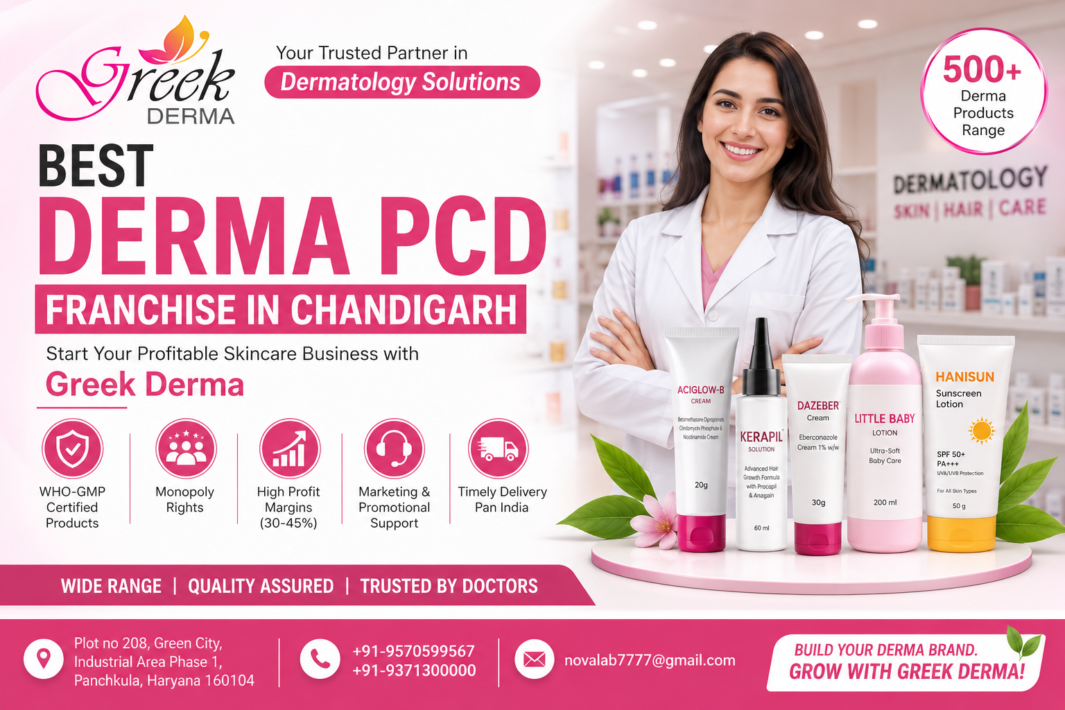
ACIGLOW-A Gel Clindamycin Phosphate + Adapalene Gel
KERAPIL Solution Procapil + Burgeon + Burgeon Up + Anagain + Baicapil Solution
NOVAXDIL-F Solution Minoxidil 5% w/v + Finasteride 0.1% w/v Topical Solution
ACIGLOW-B Cream Betamethasone 0.10% w/w + Clindamycin 1.0% w/w + Nicotinamide IP
DAZKET Soap Ketoconazole 2% Soap
DAZEBER Cream Eberconazole 1% w/w Cream
GREEK DAZ N CARE SPF 50 Broad Spectrum Sunscreen SPF 50
CIPTOSS-XL Cream Ciprofloxacin Hydrochloride + Metronidazole Benzoate + Terbinafine Hydrochloride + Clobetasol Propionate

2. Scot Derma

Scot Derma is a dermatology-focused pharmaceutical company providing derma franchise opportunities. Its portfolio includes multiple skincare and dermatology formulations such as creams, gels, lotions and other related products. Entrepreneurs can evaluate the company based on its current product range, territory availability, pricing and franchise terms.

3. Cafoli

Cafoli is another company that can be considered while researching dermatology and skincare franchise opportunities in India. Before partnering, franchise seekers should review its latest derma product portfolio, manufacturing information, quality documentation, monopoly availability and commercial conditions.

4. Certiderma

Certiderma focuses on dermatology, skincare and hair-care products. Its portfolio covers different skincare requirements and dosage forms. Entrepreneurs interested in a specialized derma business can compare its products, quality information, pricing, territory availability and current PCD franchise policies.

5. Green Derma

Green Derma operates within the dermatology and skincare pharmaceutical segment. Franchise entrepreneurs can evaluate the company based on the relevance of its product portfolio to their local market, along with manufacturing information, product quality, monopoly conditions, supply availability and franchise support.

6. Derma Essentia:

Derma Essentia sticks to dermatology and skincare — that’s its whole lane — and it promotes PCD franchise opportunities across India. Before you sign anything, check the current product range, manufacturing standards, territory-based franchise terms, pricing, and promotional support.

7. Dazzle Healthcare:

Dazzle Healthcare covers several pharmaceutical categories under its PCD Pharma Franchise offering, and dermatology plus personal care fall somewhere in that mix. If the derma range is what interests you, look at current products, territory availability, quality documentation, pricing, and franchise support first.

8. Novalab Group:

Novalab Group spans multiple pharmaceutical segments and runs PCD franchise opportunities across them. For anyone building a derma-focused business specifically, though, compare its current dermatology product range, manufacturing information, monopoly terms, supply capabilities, and commercial conditions rather than assuming the general offering fits.

9. Intas Pharmaceuticals:

Intas is an established name, with products across multiple therapeutic segments including dermatology. But its business and distribution structure isn’t quite the conventional monopoly-based PCD model — so verify current franchise or distribution options directly before you count on it working that way.

10. Coniak Lifesciences

Coniak Lifesciences operates in PCD Pharma Franchise and pharmaceutical business segments with products across multiple dosage forms. Entrepreneurs looking specifically for derma products can evaluate its current dermatology portfolio, product quality information, monopoly availability, pricing and franchise terms.

What Makes Greek Derma a Preferred Choice for a Derma PCD Franchise?

A franchise deal is more than a purchase order. Portfolio relevance, territory, quality systems, promotional resources, and — honestly, just how well the company communicates — all shape whether a partner actually succeeds in their market. Greek Derma brings a dermatology-focused portfolio together with real franchise opportunities and partner support. That combination is exactly why it’s relevant if you’re exploring the derma segment specifically.

Specialised Dermatology Product Portfolio:

Working with a specialised company has one clear upside: focus. Greek Derma’s official range covers sunscreens, soaps, shampoos, ointments, lotions, hair care, face washes, baby care, and a mix of dermatology formulations on top of that. That variety means a franchise partner isn’t stuck relying on just one or two product formats to build the business.

Monopoly-Based Franchise Opportunities:

Greek Derma offers monopoly-based franchise deals in select locations. A Monopoly Derma PCD Franchise in India generally hands a partner defined territory rights — but always subject to the company’s policies and the contract terms. Confirm territory availability before you invest anything; monopoly rights are location-specific and don’t apply blanket-wide.

Quality-Focused Product Range:

Quality isn’t optional in dermatology — these products touch skin directly or address specific dermatological needs, so there’s not much room for shortcuts. Greek Derma says its products come from certified facilities following pharma quality standards. Still, franchise applicants should ask for and check the actual certificates and documentation for whatever they plan to sell.

Marketing & Promotional Assistance:

Good promotional support genuinely helps a new partner get the range moving faster. Greek Derma states that partners can get visual aids, brochures, MR bags, sample kits and branding material as part of franchise support. What exactly you get depends on the arrangement — confirm it before finalising terms.

Franchise Partner Support:

Support doesn’t stop after the first order lands. Product info, order coordination, territory conversations, promotional guidance — a partner needs all of that on an ongoing basis. Greek Derma highlights dedicated franchise and customer support as part of the deal. Still, get the exact scope of that support in writing before signing.

How to Find the Right Derma Pharma Franchise Company in India

Finding the right Derma Pharma franchise company in India means doing the homework — not just going with whoever quoted the lowest price first. Compare potential partners on product, quality, financial and operational grounds, not just one of those.

Check Product Quality and Portfolio Diversity:

Go through the company’s full product list. A solid derma portfolio usually includes topical products, cleansers, moisturisers, sunscreens, hair-care items and relevant oral formulations. Look at compositions, pack sizes, packaging, positioning — and whether any of it actually matches what your target market wants.

Verify Manufacturing Standards & Certifications:

Don’t take promotional claims at face value. Ask for the actual manufacturing and quality documents — manufacturing licences, GMP-related paperwork, product permissions, whatever’s relevant to the products and arrangement. Then verify those documents independently. Don’t just file them away unread.

Understand Monopoly Rights and Territory Terms:

“Monopoly” needs to be defined in writing, not just promised over a phone call. Ask: Which district, city or territory gets allocated? Is exclusivity product-wise or territory-wise? Is there a minimum purchase commitment? Under what conditions can exclusivity change? How long does the agreement actually run? Clear written terms save you from arguments later.

Compare Pricing, Investment and Business Potential:

A cheaper purchase price doesn’t automatically translate into better margins. Weigh purchase price, taxes, freight, promotional spend, market selling price, expected margins, payment terms and inventory needs together — not as separate line items you check off one by one. The right commercial structure works for both sides, not just one.

Review Stock Availability & Supply Support:

No repeat business happens if the product simply isn’t there when a customer wants it. Ask about stock availability, dispatch timelines, order processing, minimum order quantities, and how well the company actually communicates before you commit.

Check Marketing and Promotional Assistance:

Find out exactly what’s on offer — brochures, visual aids, sample covers, bags, digital creatives — and whether it’s free, paid, or tied to a minimum order size.

Popular Derma PCD Pharma Product Categories in India

A well-diversified range of Derma PCD Pharma Franchise Products lets a partner cover multiple market segments without juggling several suppliers.

Creams, Gels & Ointments:

Topicals are the backbone of most dermatology portfolios. Different compositions target different skin needs. Greek Derma, for example, carries several cream formulations across different dermatology-focused compositions.

Face Washes & Cleansers:

Cleansers are a skincare-routine staple. Formulations exist for oily skin, acne-prone skin, dry skin, and sensitive skin — the works. Greek Derma lists a salicylic acid foaming face wash in its range, for instance.

Sunscreens & Skincare Products:

Sun protection and general skincare form their own big category — gels, creams, moisturising formulas, and specialised skincare products. Greek Derma’s SPF 50 PA+++ sunscreen gel, built around zinc oxide and titanium dioxide, is one example from its portfolio.

Lotions & Moisturisers:

Lotions and moisturisers cover daily skincare and specific dermatological needs both — and they round out a topical portfolio nicely.

Hair Care & Shampoos:

Hair care has basically merged with the broader dermatology market at this point. Shampoos, hair serums, and scalp-care formulations — all fair game for a derma partner looking to expand past skin-only products.

Tablets & Capsules:

Some portfolios include oral products where it makes sense. Greek Derma, for instance, carries L-glutathione and vitamin C tablets. These should be marketed strictly according to their approved indications and labelling — not stretched beyond what’s actually claimed.

Why Start a Derma PCD Pharma Franchise Business in India?

A Derma PCD Pharma Franchise suits pharma distributors, marketing professionals, and entrepreneurs who want a focused product category rather than a scattershot approach. The upside: a focused market segment, an established portfolio to work with, multiple product categories under one roof, room for territory-based operations, and — sometimes — company marketing support. It also cuts down the need for your own manufacturing setup, which is a real cost saver. But let’s be honest — it’s still a business, and businesses carry risk. Sales and profit depend on demand, product choice, competition, running costs, how well you develop your territory, and plain execution.

Understanding Monopoly Rights in a Derma PCD Pharma Franchise

A Monopoly Derma PCD Franchise in India typically means the company gives a partner defined marketing or distribution rights within an agreed area. But what “monopoly” actually covers changes from company to company — it’s not a standard, fixed term. Which is exactly why applicants shouldn’t lean on verbal assurances. Territory lines, purchase requirements, duration, conditions — get it all down in writing.

How Does Territory-Based Monopoly Work in the Derma Franchise Business?

Say a company hands a district to one partner. Depending on the deal, they might not appoint another partner selling the same products in that same territory. The partner then works that area — builds it out, grows it. But territory deals often come with strings attached: sales targets, minimum purchases, and product-specific conditions. Read the fine print before you accept a monopoly offer.

How to Start a Derma PCD Pharma Franchise Business – Step-by-Step Process

Starting a derma PCD pharma franchise in India isn’t complicated if you follow it in order.

Step 1: Research the Derma Market:

Understand your target market first. Local demand, dermatologist presence, competitor brands, common product categories, customer segments, distribution channels — get a real picture before picking products.

Step 2: Select a Reliable Franchise Company:

Shortlist based on product portfolio, documentation, quality, commercial terms, supply, and franchise support. Not marketing claims.

Step 3: Choose Your Preferred Territory:

Pick somewhere you already know or can realistically build relationships in. Then check if it’s actually available for franchise or monopoly rights.

Step 4: Select the Right Product Portfolio:

Don’t pad the opening order just to hit some arbitrary number. Start with what your market actually needs, then grow the range based on real demand.

Step 5: Complete Required Documentation:

Submit whatever’s required — identity documents, business details, GST registration, drug licence documentation where applicable.

Step 6: Understand Commercial & Monopoly Terms:

Before any payment goes out, nail down pricing, taxes, freight, payment terms, minimum orders, monopoly conditions, replacement policies, promotional support. Get the important stuff in writing — every time.

Step 7: Place Your Initial Order and Start Promotion:

Once terms and documentation are settled, place your opening order. Then get to work — structured market development through the right channels, staying compliant with promotional and regulatory rules as you go.

Investment Required to Start a Derma PCD Franchise in India

There’s no single number that applies to every Derma PCD Pharma Franchise — anyone who tells you otherwise is oversimplifying. It depends on how many products you pick, quantities, categories, territory, minimum order requirements, taxes, logistics, and your marketing budget. Instead of just asking “what’s the minimum investment,” build an actual budget: opening stock, taxes, freight, promotional costs, operating expenses, working capital — add it all up. Working capital especially matters, because repeat orders and running costs tend to show up before market payments fully come in. Get a current quotation directly from the franchise company before making any financial call.

Documents & Licences Required for a Derma PCD Franchise

What you’ll need varies with your business structure, the products involved, and state-level regulations. Commonly required documents include: Drug licence, where applicable GST registration PAN Aadhaar or other identity/address proof Firm or company details Bank and billing information Franchise or monopoly agreement Since requirements shift by state and situation, confirm your exact obligations with the right authority or a qualified professional before you start.

What Support Should You Expect From a Derma PCD Franchise Company?

The kind of support a franchise company offers makes a real difference to how smoothly things run day to day. A genuinely professional derma pharma franchise company in India should spell out exactly what’s included in the partnership — not leave it vague.

Product & Sales Support:

Partners need access to updated product info, compositions, and pack details — the basics required to actually understand and sell the portfolio.

Promotional Materials:

Brochures, visual aids, product literature, sample material, bags, digital creatives — what’s included depends entirely on the arrangement.

Territory Assistance:

The company should be upfront about whether your requested location is even available and what conditions are attached to territory or monopoly rights.

Order & Dispatch Support:

Smooth order processing and honest communication about stock and dispatch timelines — this is what actually lets a partner plan inventory properly.

Product Information & Updates:

Partners should hear about it whenever products, packaging, pricing, or the portfolio itself changes. No surprises.

Process of Derma PCD Pharma Franchise in India

The General Derma PCD Pharma Franchise process, in short: Market Research → Company Shortlisting → Product Evaluation → Territory Confirmation → Documentation → Commercial Discussion → Agreement → Initial Order → Promotion → Repeat Business For Greek Derma specifically, start by contacting the company, discussing your preferred location, going through the available derma portfolio, and understanding the monopoly and support terms before moving forward.

Key Factors to Check Before Partnering With a Derma PCD Company

Look at both sides — product and business — before finalising anything. Check the product portfolio, manufacturing arrangements, certifications, documentation, product availability, packaging quality, pricing, payment terms, dispatch system, monopoly policy, and promotional support. And don’t skip communication quality. A company can have a great product list on paper and still cause headaches later through poor communication or patchy supply. The right partner balances all of it — quality, commercial sense, and support you can actually count on.

Common Mistakes to Avoid When Choosing a Derma Franchise Company

Picking a company purely because it’s cheapest is a classic mistake. So is accepting monopoly rights without getting the territory terms in writing. Ordering a huge opening portfolio without checking local demand first is another one people fall into. Ignoring certifications, skipping stock checks, not calculating actual operating costs, assuming a franchise guarantees profit by default — all common, all avoidable. Bottom line: a successful franchise needs a reliable company on one side and real effort from the partner on the other. Neither alone gets you there.

Derma PCD Franchise vs General Pharma Franchise – What’s the Difference?

A Derma PCD Pharma Franchise stays focused on dermatology, skincare, hair care and related products — that narrow focus is basically its identity. A general pharma franchise spreads wider — general medicine, gastroenterology, orthopaedics, paediatrics, gynaecology, and more, all under one portfolio. Which one’s better really comes down to your existing network and what you’re trying to build. Got strong connections with dermatologists, cosmetologists, skincare professionals, or derma-focused distributors? A specialised Dermatology PCD Pharma Franchise in India probably fits better. Network spread across multiple specialities instead? A general pharma portfolio might open more doors.

Is a Derma PCD Pharma Franchise the Right Business Opportunity for You?

It probably suits you if you already understand your local pharma market, can build (or already have) a relevant distribution network, and you’re willing to put in time developing your territory. It’s especially worth it for professionals who’d rather focus on one specialised dermatology portfolio than juggle a dozen unrelated therapeutic categories. If Greek Derma looks like a fit, the next real step is simple: review its current product portfolio and talk directly to the company about territory, monopoly conditions, and commercial terms. At the end of the day, the best opportunity isn’t the one with the biggest catalogue or the lowest price tag — it’s the one where product-market fit, quality, commercial sense, territory potential, and long-term support actually line up with what you’re trying to build.

Conclusion:

Dermatology offers a genuinely specialised path for entrepreneurs and pharma professionals interested in skincare, hair care, and related products. But building a sustainable Derma PCD Pharma Franchise in India takes real diligence — not just picking a name off a top-10 list. Product quality, portfolio diversity, manufacturing standards, documentation, pricing, territory terms, supply capability, and promotional support — all of it needs a proper look before you commit. Greek Derma is one solid option for anyone after a dermatology-focused franchise partner. Its portfolio spans skincare, hair care and dermatology categories, and the franchise setup includes select monopoly opportunities plus promotional support. Before you decide anything final, discuss your location, verify the documentation, check the latest product list and quotation, and get every commercial condition clear.\

Frequently Asked Questions About – Derma PCD Pharma Franchise in India:

Q.1 What is a Derma PCD Pharma Franchise?

Ans. Simply put, it’s an arrangement where a pharma or dermatology company lets a partner market and sell its derma products within a set area, under agreed commercial terms. The company keeps the manufacturing; you handle the ground game.

Q.2 How can I start a Derma PCD Pharma Franchise in India?

Ans. Start with the market, not the paperwork. Understand your target area, shortlist a few companies, dig into product quality and documentation, pick a territory, get the monopoly and commercial terms straight, then finish documentation and place your first order.

Q.3 What products are available in a derma franchise?

Ans. Pretty much the full skincare spectrum — Derma PCD Pharma Franchise Products typically span creams, gels, ointments, face washes, cleansers, sunscreens, lotions, moisturisers, soaps, shampoos, hair-care items, and sometimes tablets or capsules too.

Q.4 What is a Monopoly Derma PCD Franchise in India?

Ans. It’s defined marketing or distribution rights for a partner within a set territory — but always subject to whatever the company’s written terms actually say. Don’t assume; read the contract.

Q.5 How much investment is required for a Derma PCD Pharma Franchise?

Ans. Honestly, there’s no fixed number here. It shifts with the company, your opening product list, quantities, territory, taxes, freight, marketing spend, working capital — a dozen variables. Get a current quotation before you decide anything.

Q.6 What documents are required for a derma franchise?

Ans. GST registration, PAN, identity and business documents, and a drug licence where it applies — though the exact list depends on how your operation is set up. Best to confirm directly rather than assume.

Q.7 How do I choose the best derma pharma franchise company in India?

Ans. Look past the rankings. Product quality, portfolio range, manufacturing standards, certifications, supply reliability, pricing, monopoly terms, promotional support, and — this one gets overlooked — how well they actually communicate.

Q.8 Does Greek Derma provide monopoly franchise opportunities?

Yes, in selected locations across India. Just confirm territory availability and the exact terms directly with the company before you finalise anything — don’t go on assumption.

Q.9 What promotional support does Greek Derma provide?

Ans. The company states it offers visual aids, product brochures, MR bags, sample kits, and branding materials. What you actually get can vary by order or territory, so it’s worth confirming directly rather than assuming it’s standard across the board.

Q.10 Why choose a specialised dermatology PCD pharma franchise in India?

Ans. Because focus tends to beat breadth here — one dermatology portfolio, done well, rather than a dozen unrelated categories stretched thin. Especially useful if your market network already leans toward derma anyway.

Derma PCD Pharma Franchise Company in Panchkula - Greek Derma

Derma PCD Pharma Franchise Company in Panchkula – Products, Monopoly & PCD Business Guide 2026

Derma PCD Pharma Franchise Company in Panchkula - Greek Derma Search for a Derma PCD Pharma Franchise Company in Panchkula, and you’ll get dozens of results in seconds — half of them near-identical websites promising “huge margins” and “pan-India monopoly”, whatever that’s supposed to mean. Panchkula genuinely has become a hub for this, though, and not by accident. It sits right next to Chandigarh, has decent warehousing and road connectivity into Punjab, Haryana and Himachal, and land costs less than doing the same thing out of Chandigarh proper. So the real question isn’t whether a Derma PCD Pharma Franchise in Panchkula is a good idea — it usually is — it’s which company is actually worth signing with. That’s what this guide is for: how the model works, what a real Derma Pharma Franchise Company in Panchkula should have on the table, and where Greek Derma fits in.
What Is a Derma PCD Pharma Franchise, and How Does It Work?

PCD — Propaganda Cum Distribution. A manufacturer gives you the rights to sell its products in a defined area under its brand name. You handle the groundwork: doctor visits, chemist relationships, local promotion, and distribution. You’re not running a factory. You’re not sitting through QC audits. Someone else already did that part; you’re building the sales layer on top of it. For a Dermatology PCD Pharma Franchise Panchkula business, that usually means a range — creams, sunscreens, face washes, tablets — under one brand, with the company handling packaging, promotional material and product training. You bring the legwork. They bring the product line and the paperwork.

Why Panchkula Is Worth the Investment

A few honest reasons this region works for a Derma PCD franchise in Panchkula:
  • Rising skin awareness — People aren’t just treating skin issues anymore, they’re maintaining skin health. That’s a shift, and it’s driving repeat prescriptions.
  • Low saturation, high potential — Compared to metro cities, Panchkula still has open territories where a franchise partner can build real monopoly rights instead of fighting five other reps for the same clinic.
  • Better margins than general pharma — Derma products typically carry stronger margins than standard pharma lines, partly because they’re less commoditized.
  • Tricity spillover — Panchkula franchise partners often end up naturally covering pockets of Chandigarh and Mohali too, which stretches your territory value.
None of this guarantees success on its own. It just means the ground is fertile what you build on it depends on the company you partner with.

Why Choose a Derma PCD Pharma Franchise Company in Panchkula?

Three things, really. A base close to Chandigarh’s medical and dermatology market. Solid connectivity for stockists across the north. And it’s cheaper to run from here than from Chandigarh itself — which is exactly why so many pharma marketing offices have quietly moved their base to Panchkula over the last several years. Then there’s the category. Skin problems don’t disappear when money gets tight, not the way a lot of discretionary spending does. Pigmentation, acne, dandruff, fungal infections, and sun damage — these keep coming back all year, regardless of season or sentiment. A derma product in Panchkula business rides on that repeat demand in a way plenty of other therapeutic categories simply can’t.

What to Check Before Picking a Derma PCD Company in Panchkula

We’ll be blunt: a lot of companies in this space look identical on paper. Here’s what actually separates a good derma franchise company in Panchkula from a risky one.
  1. Certifications that are real, not decorative WHO-GMP, ISO, and DCGI approval should be verifiable, not just mentioned in a footer. Ask for documentation. A serious Derma PCD Company in Panchkula won’t hesitate to share it.
  2. Product range depth, not just breadth “200+ products” sounds impressive until you realize half of them overlap. Look for range across acne care, anti-fungal, anti-aging, hair care, and sunscreen categories that actually match what dermatologists prescribe daily.
  3. Monopoly rights, clearly defined Get the territory boundaries in writing. Vague promises of “exclusive rights” that aren’t documented tend to fall apart the moment the company signs a second partner nearby.
  4. Marketing and promotional support Visual aids, MR bags, sample kits, visiting cards, product literature — this stuff isn’t optional extra, it’s what your field reps use every single day.
  5. Transparent pricing and margins If a company won’t discuss actual investment numbers upfront, that’s a signal, not a formality.

What Derma Product Categories Should a Franchise Company Offer?

Anyone selling three creams and calling it a “derma range” isn’t serious about the segment. Here’s what should actually be on the list.

Creams, Gels, Lotions & Ointments:

The backbone of the whole line — anti-fungal creams, moisturising lotions, acne gels, and scar and pigmentation ointments. This is what doctors prescribe most, so depth here matters more than anywhere else in the portfolio.

Face Washes & Cleansers:

Salicylic acid washes, neem-based cleansers, and options for sensitive skin. These sell themselves at the chemist counter once a customer likes one — no fresh prescription needed for a repeat buy.

Sunscreens & Skincare Range:

Non-negotiable in North India. SPF 30 through SPF 50+, gel and cream bases, and tinted variants if you can get them. And the sales curve isn’t gentle — it spikes hard from March to August, then drops off.

Hair Care & Shampoos:

Anti-dandruff shampoos, hair fall solutions, and ketoconazole-based formulas. Hair loss complaints have climbed noticeably in the last few years, and this category has climbed right along with them.

Tablets & Capsules:

Antihistamines, biotin and hair-growth supplements, and oral antifungals. Small category by volume, but it’s what lets you offer a doctor a complete prescription instead of sending them elsewhere for the oral component.

Greek Derma vs the Usual Franchise Pitch

At Greek Derma, we didn’t want to be another name on a directory listing. Our approach to the Derma PCD franchise in Panchkula partnerships is built around a few things we actually stand behind:
  • Dermatologist-tested formulations across acne, pigmentation, anti-fungal, and hair care segments
  • WHO-GMP and ISO-certified manufacturing, documentation shared on request
  • Clearly mapped monopoly territories within Panchkula and surrounding Tricity zones
  • Full promotional kit — visual aids, samples, diaries, MR bags — provided at onboarding
  • Transparent investment structure discussed before you sign anything
We’re not claiming to be the only good option in Panchkula. We’re saying: compare us properly, ask the hard questions, and you’ll see where we stand.

How the Franchise Process Actually Works

  1. Initial inquiry — You reach out, we understand your target area and business goals.
  2. Territory discussion — We map out available monopoly zones in Panchkula so there’s no overlap.
  3. Product portfolio review — You pick the segments that match local prescription trends.
  4. Investment and agreement — Terms, pricing, and margins are laid out clearly before signing.
  5. Onboarding and support — Promotional material, product training, and supply chain setup begin.
Most partners are operational within a few weeks of finalizing the agreement.

Documents You’ll Need as a First-Time Investor

If you’re new to this, the paperwork catches most people off guard. Before you approach any Derma PCD Company in Panchkula, keep these ready:
  • Drug License (Wholesale or Retail, as applicable) — mandatory to legally distribute pharma/derma products
  • GST registration — needed for billing and invoicing
  • PAN card and ID proof — standard KYC for the franchise agreement
  • Bank account details — for the security deposit and ongoing transactions
  • Shop/office address proof — some companies verify your operating location before finalizing territory
A genuine derma franchise company in Panchkula will guide you through this rather than just handing you a checklist and walking away.

What Does It Actually Cost?

Numbers vary by company and product range, but here’s a rough breakdown new investors should budget for with a Derma PCD franchise in Panchkula:
Cost Head Typical Range
Security deposit Varies by company, usually refundable/adjustable
First order (initial stock) Company-dependent, based on product range chosen
Promotional kit Often included or partially subsidized
Working capital (first 2-3 months) Recommended buffer, separate from stock cost
Always ask for these numbers in writing before signing — a company that hesitates to break this down is a company you should think twice about.

Red Flags to Watch For

New investors lose money not because the derma business is risky, but because they skip due diligence. Watch out for:
  • Companies that pressure you to sign within a day or two
  • No physical manufacturing address or unverifiable certifications
  • Verbal-only promises about monopoly rights
  • No clarity on return/replacement policy for damaged or expired stock
  • Unusually low product pricing with no explanation — often a sign of compromised quality
If a Derma PCD company in Panchkula ticks any of these boxes, pause and dig deeper before moving forward.

A Quick Reality Check

Investing in a derma franchise company in Panchkula isn’t a guaranteed win button. It works when the company backing you actually delivers on-time supply, real promotional support, and margins that make sense on paper and in practice. It doesn’t work when you sign with the first name that shows up on a Google search and hope for the best. Take your time. Ask for references. Talk to existing partners if you can. A Derma PCD company in Panchkula worth your investment won’t mind the scrutiny if anything, they should welcome it.

How to Choose the Best Derma Franchise Company in Panchkula

Most people rush this bit, and most people who rush it end up regretting the decision within six months. Slow down for these.

Check Manufacturing & Quality Certifications:

WHO-GMP and ISO aren’t just stickers for the brochure — they mean documented, repeatable quality processes. Ask to see the actual certificates. Not a mention on the website. The certificate.

Evaluate the Derma Product Portfolio:

Count the real SKUs, not the marketing number. Fifteen genuinely well-formulated products beat sixty, where half are the same cream repackaged under a different name.

Verify Monopoly Rights:

Probably the single biggest factor in whether this business turns a profit. Get the territory boundary written into the agreement — district or tehsil level — before you commit a rupee.

Compare Pricing and Business Terms:

Look at PCM, minimum order quantity and payment terms together, not one at a time. A slightly costlier product with a genuinely exclusive territory beats a cheap one where three other franchisees are working your streets too.

Check Promotional & Marketing Support:

Visual aids, MR bags, sample strips, doctor reminder cards — not extras. This is what actually gets a new derma brand in front of a prescribing doctor in the first place.

Evaluate Stock Availability and Delivery Support:

Run out of your best-selling sunscreen in May, and that season’s revenue is just gone — no making it up later. Ask about average dispatch time and whether the company actually keeps buffer stock before peak months hit.

Monopoly Derma PCD Franchise in Panchkula

Monopoly means no other franchise partner of the same company is competing in your territory. Simple to say, and it’s the one clause that decides whether you’re profitable in year one or still struggling in year three. Any company offering a genuine Derma PCD Pharma Franchise Company in Panchkula opportunity will put that boundary in writing, in the agreement — not just say it out loud on the sales call and hope you don’t ask again later.

Why Choose Greek Derma for the Derma PCD Franchise in Panchkula?

Specialised Dermatology Product Portfolio:

Greek Derma sticks to derma and hair care instead of stretching across ten unrelated categories just to pad a catalogue. Creams, sunscreens, face washes, hair care, and derma tablets — built for this segment, not bolted on as an afterthought.

Quality-Focused Manufacturing:

Every product comes off a GMP-certified line. That matters the day a doctor asks a hard question about a product you’re representing.

Monopoly-Based Franchise Opportunities:

Territory is defined clearly, partner by partner. You’re building your own market in Panchkula and around it — not sharing it with someone else carrying the same catalogue two streets over.

Marketing & Promotional Support:

Visual aids, literature, MR bags, and sample kits are ready before your first doctor visit, so you’re not designing your own promotional material from a blank page.

Reliable Supply and Partner Assistance:

Stock planning is built around actual seasonal demand, particularly sunscreens and anti-fungals, where a badly timed stock-out costs real money.

Panchkula-Based Business Presence:

Being headquartered here means faster coordination across Haryana, Punjab, Himachal and Chandigarh’s tri-city belt — shorter dispatch times and a team that actually knows this market instead of running it off a spreadsheet from somewhere else.

Who Can Start a Derma PCD Pharma Franchise in Panchkula?

No pharmacy degree required. No prior industry background either, strictly speaking. Most partners come from one of a few backgrounds — existing distributors adding a derma line, medical reps who’ve spent years selling for someone else and finally want their own business, chemists who know their local market cold, or first-timers with capital and enough patience to build doctor relationships from zero. What you actually need: a valid drug licence, GST registration, and enough working capital to cover the first order plus a few slow months while the business finds its footing.

Investment Required for a Derma PCD Pharma Franchise in Panchkula

Varies by company and territory size, but as a working range, most derma PCD franchises in this belt start somewhere between ₹50,000 and ₹200,000 for the initial setup — first stock order, registration, and starter promotional material. Bigger, monopoly-based territories sit toward the higher end. Ask for a written breakdown before you pay anything. A single lump-sum figure with no itemisation is a red flag, not a convenience.

Conclusion:

At the end of the day, picking a Derma PCD Pharma Franchise Company in Panchkula comes down to three things that actually matter — a genuine monopoly on paper, a manufacturer with real GMP-backed quality, and a product range deep enough to keep a doctor prescribing from you instead of switching brands next season. Everything else — the brochures, the promises on the phone call, the “huge margin” claims — is just noise until it’s written into the agreement. Panchkula’s location does the rest of the work for you; the tri-city connectivity and the steady, recurring nature of skin and hair complaints make this one of the more forgiving categories to build a long-term pharma business in, provided you start with a partner who’s willing to put the terms in writing rather than just in conversation.

FAQs

Q1. What is the minimum investment for a Derma PCD franchise in Panchkula?
Answers: It varies by company and product range, but most derma franchises in this region start in the mid five-figure range. Ask for a detailed breakup before committing.
Q2. Do I get monopoly rights with a derma franchise company in Panchkula?
Answers: Reputable companies, including Greek Derma, offer defined monopoly territories — get it documented in your agreement, not just promised verbally.
Q3. What certifications should a derma PCD company in Panchkula have?
Answers: Look for WHO-GMP, ISO, and DCGI approvals at a minimum. These aren’t optional extras — they’re baseline requirements for product safety and market credibility.
Q4. How long does it take to start after signing with a Derma PCD franchise in Panchkula?
Answers: Typically a few weeks, depending on how quickly product training and initial stock supply are arranged.
Q5. Can a Panchkula-based franchise also cover Chandigarh and Mohali?
Answers: Often yes, depending on how the territory is mapped — worth clarifying this during the territory discussion stage. Derma PCD Company in Panchkula, Derma PCD franchise in Panchkula, Derma Franchise Company in Panchkula, Derma PCD franchise in Panchkula
Q.6 Which is the best derma franchise company in Panchkula?
Answers: No single universal answer — it depends on your budget and territory. But look for GMP-certified manufacturing, real monopoly rights, and a focused product range. Greek Derma checks all three for partners working in and around Panchkula.
Q.7 How can I start a derma PCD Pharma franchise in Panchkula?
Answers: Contact the company with your preferred territory, review the product list and pricing, confirm monopoly availability, sign the agreement, and place your first order.
Q.8 What investment is required for a derma franchise?
Answers: Typically ₹50,000 to ₹200,000 to start, depending on territory size and the first stock order.
Q.9 Does Greek Derma provide monopoly rights?
Answers: Yes — territory is defined per partner, so two franchise holders aren’t fighting over the same area.
Q.10 What derma product categories are available?
Answers: Creams, gels, lotions, ointments, face washes, cleansers, sunscreens, hair care, shampoos, tablets and capsules.  
Multani Mitti skincare essentials

Multani Mitti Face Wash with Kesar, Turmeric & Sandalwood: The Complete Guide to Oil-Free, Glowing Skin

Multani Mitti skincare essentials

Somewhere between your grandmother’s kitchen shelf and today’s crowded skincare aisle, multani mitti has quietly stayed relevant for one simple reason — it actually works. Long before serums and 10-step routines became the norm, Indian households were mixing Fuller’s Earth with turmeric, saffron and sandalwood to keep skin clean, calm and glowing.

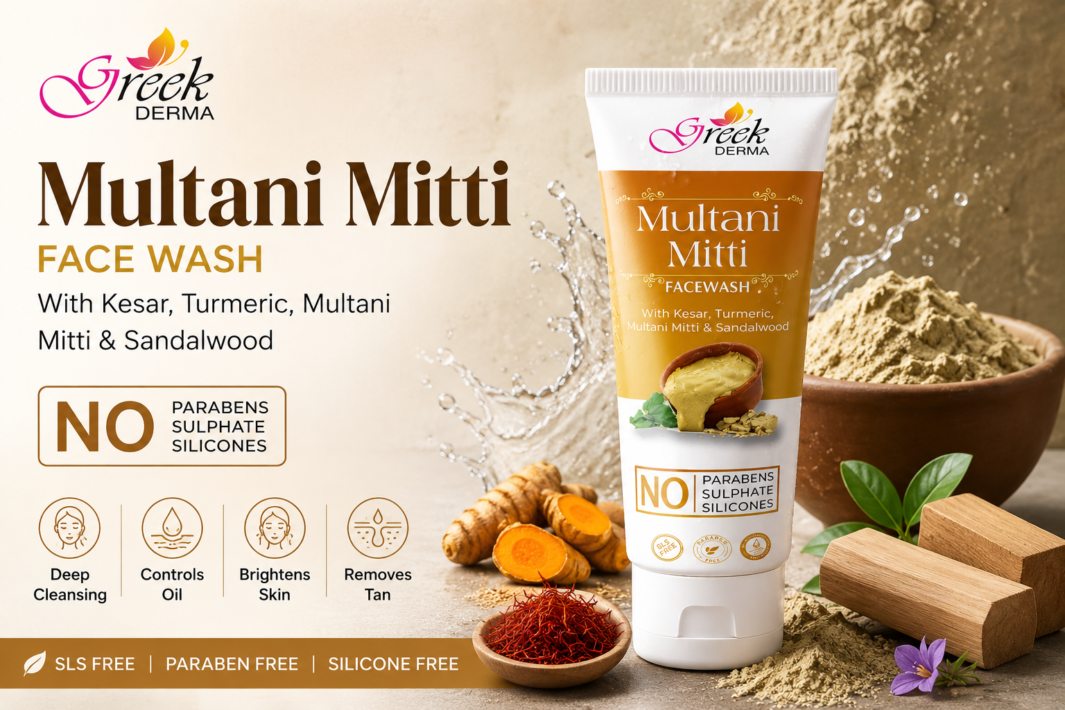
Greek Derma’s Multani Mitti Face Wash with Kesar, Turmeric & Sandalwood brings that same combination into a daily, wash-off format — no mixing, no mess, no waiting around for a face pack to dry. This guide walks through what the product actually does, who it’s meant for, and how to fit it into a daily skincare routine, along with the science and Ayurvedic reasoning behind each ingredient.

What Makes This Face Wash Different

Most face washes clean your skin and stop there. This one is built around four ingredients that Indian skincare has trusted for generations, each doing a specific job:

  • Multani Mitti (Fuller’s Earth) — the deep-cleansing, oil-absorbing base of the formula
  • Kesar (Saffron) — known for soothing irritation and helping even out skin tone
  • Turmeric — rich in antioxidants, helps calm inflammation and brighten dull skin
  • Sandalwood — cooling and antioxidant-rich, supports radiance and helps with tan

And just as important as what’s in it is what’s left out. This face wash is formulated without parabens, sulphates, or silicones, and is SLS-free — meaning it cleanses without stripping your skin’s natural moisture barrier the way harsher, chemical-heavy face washes often do.

Multani Mitti: The Original Deep-Cleansing Clay

Multani mitti gets its name from Multan, the city it was traditionally sourced from, and it has been part of Indian beauty rituals for centuries — including its use in traditional ubtans before weddings. What makes it effective isn’t tradition alone though; the clay has genuine oil-absorbing and mineral-rich properties that work particularly well for people dealing with excess sebum, clogged pores or occasional breakouts.

When used in a face wash rather than a dry powder pack, multani mitti gets the added benefit of daily consistency. Instead of an occasional deep-clean mask, you get gentle oil control and pore-cleansing built into your regular routine — without the dryness that can come from using raw multani mitti packs too often.

Kesar (Saffron): Calming and Brightening

Saffron has long been valued in Ayurveda for its soothing properties, and in this formulation, kesar helps calm skin that’s prone to redness or irritation while supporting a more even, radiant tone over time. It’s a delicate ingredient, which is part of why it works so well in a gentle, daily-use face wash rather than a harsher treatment product.

Turmeric: Skin’s Everyday Antioxidant

Turmeric’s active compound, curcumin, is widely recognized for its anti-inflammatory and antioxidant properties. In a face wash, this translates to a formula that helps calm minor redness and supports a brighter-looking complexion with regular use — without the yellow staining people sometimes worry about with raw turmeric masks, since the concentration in a wash-off formula is far gentler and rinses clean.

Sandalwood: Cooling, Toning, and Tan-Fighting

Sandalwood is one of the most trusted ingredients in Indian skincare for a reason — it has a naturally cooling effect on the skin and is often used specifically to help with sun tan and uneven tone. Combined with multani mitti’s cleansing action, sandalwood in this face wash supports the skin in gradually looking less tanned and more even, especially with consistent daily use through the summer months.

Who Should Use This Face Wash

This Multani Mitti Face Wash is best suited for:

  • Oily and combination skin — the clay base helps manage excess sebum without over-drying
  • Skin prone to occasional acne or breakouts — the deep-cleansing action helps keep pores clear
  • Sun-exposed or tanned skin — sandalwood and turmeric support gradual tan reduction
  • Anyone wanting a paraben, sulphate and silicone-free daily cleanser — a cleaner formulation choice for sensitive or reactive skin
  • Both men and women — the formula isn’t gendered and works well as a shared household face wash

If you have very dry or highly sensitive skin, it’s worth doing a patch test first and following up with a light moisturizer after washing, since clay-based cleansers can feel slightly tightening on drier skin types.

How to Use Multani Mitti Face Wash for Best Results

  1. Wet your face with lukewarm water to open up pores slightly.
  2. Take a small amount of the face wash on your palm.
  3. Gently massage onto your face and neck in circular motions for 30–45 seconds.
  4. Rinse thoroughly with water and pat your skin dry — don’t rub.
  5. Follow up with a light, non-comedogenic moisturizer, especially if you have combination or dry-prone skin.

Use it twice daily — once in the morning and once at night — for consistent oil control and cleansing. For visible tan-reduction results, most users notice a gradual improvement over 3–4 weeks of regular use.

Multani Mitti Face Wash vs Regular Face Wash vs DIY Face Pack

Factor Regular Chemical Face Wash DIY Multani Mitti Face Pack Greek Derma Multani Mitti Face Wash
Cleansing Action Often strips natural oils Deep but can over-dry with frequent use Balanced, daily-safe cleansing
Convenience High Low — needs mixing, waiting, drying time High — ready to use, wash-off format
Ingredient Safety Frequently contains parabens/sulphates 100% natural but inconsistent quality Paraben-free, sulphate-free, silicone-free, SLS-free
Tan & Brightening Support Rare, needs separate product Yes, with turmeric/sandalwood added manually Built-in with kesar, turmeric, sandalwood
Daily Use Suitability Yes, but may irritate over time Not recommended daily Formulated safe for twice-daily use

The advantage of a formulated face wash over a raw DIY pack is consistency — you get the same ratio of active ingredients every single time, without guessing how much turmeric will stain or how long to leave a paste on.

How to Remove Sun Tan Naturally with This Face Wash

Tan removal is one of the most common reasons people search for a multani mitti-based product, especially in a country where sun exposure is a year-round concern. Here’s how to build a simple tan-management routine around this face wash:

  1. Morning cleanse — use the face wash after any sun exposure the previous day to help lift surface tan gradually.
  2. Always follow with sunscreen — no face wash can undo tanning if you’re not protecting your skin during the day. Multani mitti and sandalwood support the skin’s recovery process, but prevention matters just as much.
  3. Be consistent, not aggressive — daily gentle use works better for tan reduction than scrubbing harder or using it more than twice a day.
  4. Pair with hydration — tanned skin often needs extra moisture, so don’t skip your moisturizer even if your skin feels oily.

Frequently Asked Questions

1. Is this Multani Mitti Face Wash suitable for daily use? Yes, it’s formulated for twice-daily use — morning and night — as part of a regular cleansing routine.

2. Will this face wash dry out my skin? It’s designed to cleanse without stripping natural moisture, but if you have very dry skin, follow up with a light moisturizer after each wash.

3. Can men use this face wash too? Yes, the formula isn’t gender-specific and works well for both men and women dealing with oily skin, tan, or occasional breakouts.

4. Does this face wash help with acne? Multani mitti’s oil-absorbing properties can help manage excess sebum, which is often linked to breakouts, though it isn’t a medical acne treatment. For persistent or severe acne, consult a dermatologist.

5. Is it safe for sensitive skin? The formula is paraben-free, sulphate-free and silicone-free, which makes it gentler than many chemical-heavy face washes, but sensitive skin users should still patch test before regular use.

6. How long does it take to see tan-reduction results? Most users notice gradual improvement in skin tone and tan over 3 to 4 weeks of consistent, twice-daily use.

7. Can I use this face wash if I have oily skin only in the T-zone? Yes, it works well for combination skin too — you can focus slightly more product on oilier areas like the forehead, nose and chin.

8. What’s the difference between this and a plain multani mitti powder? A powder needs to be mixed into a paste and left on for several minutes, which can over-dry skin if used daily. This face wash delivers the same core benefits in a milder, wash-off format safe for everyday use.

9. Does turmeric in this face wash stain the skin yellow? No, the turmeric concentration in a wash-off formula is much gentler than raw turmeric paste and rinses off completely without staining.

10. Is this product tested and safe for regular use? Yes, it is formulated without parabens, sulphates and silicones, and is SLS-free, making it a cleaner daily-use option compared to many mainstream face washes.

Final Thoughts

Multani mitti earned its place in Indian skincare the old-fashioned way — by actually working, generation after generation. Greek Derma’s Multani Mitti Face Wash with Kesar, Turmeric & Sandalwood takes that same trusted combination and makes it usable every single day, without the mixing, waiting, or mess of a traditional face pack.

Whether you’re managing oily skin, dealing with sun tan, or simply want a cleaner, paraben-free daily face wash, this formula brings together four ingredients that Ayurveda and modern dermatology both agree on — deep cleansing, calming, brightening, and tan support, all in one bottle.

Premium skincare care and trust

Derma PCD Franchise Company in Bihar – Why Greek Derma Is the Right Partner in 2026

Bihar is changing fast. Cities like Patna, Gaya, Muzaffarpur, and Bhagalpur are growing, awareness about skin and hair health is rising, and people are spending on good dermatology products like never before. That is exactly why a derma PCD franchise in Bihar has become one of the smartest businesses to start in East India right now.

Premium skincare care and trust

At Greek Derma, we build quality skin and hair care products that doctors trust and patients love. If you are planning to start your own derma distribution business in Bihar, this guide answers everything you need — in simple, honest language.

Let us go through it, step by step.

Derma PCD Franchise in Bihar – The Full Picture

When people ask us about a derma PCD franchise in Bihar, they usually come from a few backgrounds. Some are former medical representatives who worked in derma and now want their own business. Some are chemists who see how fast skincare sells. Others are fresh entrepreneurs who noticed dermatology is booming and want in.

Bihar suits all of them, and here is why. The state has a huge, young population, growing cities, and — importantly — a market that is still less crowded than the metros. That means less competition and more open territory for a distributor who moves early.

A derma PCD (Propaganda Cum Distribution) franchise means you get the rights to sell a company’s skin and hair care products in a fixed area under their brand. You do not run a factory. You focus on building relationships with dermatologists, skin clinics, and chemists while the company handles manufacturing and quality.

Dermatology is special because it is high-repeat and high-margin. A patient on a skincare routine buys the same face wash, cream, and sunscreen every month. That repeat demand is what makes a derma franchise so steady and profitable — and in a growing market like Bihar, that base keeps expanding.

To see the products you would be distributing, browse our full product range. It shows the segments you can cover from day one.

Partnering with an established, certified company means you get proven products, reliable supply, and real support even though we are reaching you across states. Learn more on our about us page.

Derma PCD Franchise in Patna – The Capital Advantage

Patna is the beating heart of Bihar’s healthcare, which makes a derma PCD franchise in Patna especially attractive. The city has the state’s biggest concentration of dermatologists, skin clinics, hospitals, and quality pharmacies.

Patna patients are increasingly aware. They follow skincare routines, ask for brands, and are willing to invest in products that work. For a distributor with a certified, well-packed range, this is fertile ground.

As the capital, Patna also acts as your gateway to the rest of Bihar. Once you establish a strong base here, expanding into surrounding districts becomes far easier because doctors and chemists across the state look to Patna trends.

Greek Derma supplies franchise partners with a wide, professionally packed range that suits Patna’s quality-conscious market. Our documentation, packing, and dispatch systems are built to serve partners reliably wherever they are.

The Patna market rewards professionalism. Dermatologists notice packaging, ingredients, and consistency. When you supply certified products in premium packing, you fit right into what this market expects.

If Patna is your target, we are ready to back you with quality and support. Explore our product range and connect through our contact page.

Start in the capital, build your reputation, and let it carry you across the state.

Skin Care Products Franchise in Bihar – The Segment That Never Slows Down

A skin care products franchise in Bihar is one of the most reliable businesses you can build, because skincare is now a daily habit, not a luxury — even in Tier 2 and Tier 3 towns. Face washes, moisturisers, sunscreens, anti-acne creams, and anti-fungal ointments move every single day.

The reason skincare works so well is repeat demand. Once a dermatologist puts a patient on a product, that patient keeps buying it. You are not chasing one-time sales; you are building a base that pays month after month.

Bihar’s climate adds to the demand. Hot, humid summers drive sales of sunscreens, anti-fungal products, and oil-control face washes. Dry winters push moisturisers and creams. There is a skincare need in every season.

Greek Derma manufactures a wide range of skin care products across cosmetic and therapeutic categories, all made under strict quality standards and packed professionally so doctors and patients trust what they see.

For a new franchise partner in Bihar, skincare is the perfect starting point. Dermatologists and even general practitioners prescribe these products constantly. Supply the common needs of clinics in your area reliably, and you build steady income fast.

Start with a focused, fast-moving range and expand as you grow. See what sells on our product range page and plan your opening catalogue around it.

Cosmetic PCD Franchise – Beauty Meets Business

A cosmetic PCD franchise taps into India’s booming beauty and grooming market, and Bihar is very much part of that wave. Beyond medical skincare, there is huge demand for brightening creams, anti-ageing serums, lip care, and daily beauty essentials.

The cosmetic segment carries strong brand value and attractive margins. Customers who trust a beauty product stay loyal, and they are often willing to pay a premium for visible results.

For a distributor, cosmetics complement your medical derma range perfectly. You serve the same dermatologists, skin clinics, and beauty-conscious chemists, but you widen your basket and increase your average order value.

Greek Derma helps partners build a balanced portfolio mixing therapeutic derma products with cosmetic lines. This balance protects your business — if one category slows in a season, another picks up.

Bihar’s beauty market is growing as awareness rises and incomes climb, especially among the young population. Being early in your territory with a strong cosmetic range gives you a real edge over competitors who stick to medical products only.

Explore how a mixed portfolio could work for you on our product range page, then reach out via our contact page. A wider basket means a stronger business.

Third Party Derma Manufacturing – When You Want Your Own Brand

Not everyone wants to distribute under someone else’s name. Some entrepreneurs want their own brand on the product. That is where third-party derma manufacturing comes in.

In third party (contract) manufacturing, the company produces skin and hair care products for you under your own brand and label. You own the brand identity. The factory handles production, quality, and compliance. It is the ideal route for people who already have a marketing network in Bihar and want to build their own name.

Greek Derma offers third party manufacturing for creams, ointments, lotions, face washes, sunscreens, serums, and more — all made with quality ingredients and proper documentation. The whole arrangement runs on clear, legally binding contracts that protect both sides.

The difference between a PCD franchise and third party manufacturing comes down to ownership. In PCD, you sell under the company’s brand. In third party, you build your own. Many smart entrepreneurs start with PCD to learn the Bihar market, then move to third party once they are confident.

Getting your products manufactured by an established certified unit means you skip the huge cost and risk of building your own factory while still owning your brand.

If you already have a network and dream of your own brand, we should talk. Start that conversation on our contact page and read our about us page to understand our capability first.

Monopoly Derma Franchise in Bihar – Protecting Your Hard Work

The biggest fear of any new distributor is competition from within. You spend months building relationships with dermatologists, and then the same company hands the same products to someone in the next town. A monopoly derma franchise in Bihar removes that fear completely.

Monopoly rights mean you — and only you — sell that company’s products in your agreed area. No internal competition. No price wars with your own colleagues. Your effort stays your reward.

This matters even more in Bihar, where districts are large and territories are still opening up. A clear monopoly over a district or cluster of towns can be extremely valuable as the market grows around you.

At Greek Derma, monopoly rights are a core part of how we work. The territory is defined clearly in the agreement. Whether it is a single district or a wider zone depends on your investment and reach, but the principle never changes: your area is protected.

This protection changes how you run the business. Because you are the only seller, you can invest confidently in doctor relationships, sample distribution, and long-term brand building. You are never scared that a colleague will undercut you tomorrow.

We put these terms in writing so there is no confusion later. Always read the agreement carefully so you understand your territory, pricing, and rights before committing to any company.

Monopoly rights turn a job into a real business asset you own and grow.

Sunscreen, Cream and Ointment Range – The Everyday Heroes

A strong sunscreen, cream and ointment range is the backbone of any derma distribution business in Bihar. These are the products dermatologists prescribe every single day, across every season.

Bihar’s hot, humid climate makes sunscreens a year-round seller — sun protection is now a daily habit, not a summer-only thing. Moisturising creams are prescribed for dry skin and countless conditions. Ointments treat fungal infections, which are very common in humid weather, plus wounds and inflammations. These are high-volume, high-repeat products.

Greek Derma manufactures a comprehensive range of sunscreens (across SPF levels), creams, lotions, and ointments — both cosmetic and therapeutic. Each product is made under strict quality control and packed to appeal to doctors and patients alike.

For a new franchise partner, this range is where your reliable monthly income comes from. Skin clinics and dermatologists need these products constantly. Supply them dependably and you build a loyal base that keeps paying.

As your business grows, you layer specialised products — serums, anti-acne kits, hair solutions — on top of this stable foundation. But the everyday creams and sunscreens keep your cash flow healthy meanwhile.

See the full list on our product range page and plan which items to push first. Start with what sells daily, then build outward.

WHO-GMP Derma Company – Why Certification Is Non-Negotiable

If there is one thing you must never compromise on, it is certification. A WHO-GMP derma company follows globally recognised Good Manufacturing Practices — meaning products are made in clean, controlled, quality-checked conditions.

Why does this matter to you as a distributor in Bihar? Because your name is on the line every time a product reaches a patient’s skin. Skincare touches sensitive areas — a quality issue can cause real harm and destroy the trust you built over years. Certification is your protection.

GMP standards cover everything — raw material sourcing, hygiene in the production area, equipment cleaning, staff training, batch documentation, and testing before release. When a company holds proper certification, it is telling you every product passed through a disciplined system.

Greek Derma manufactures its formulations under strict quality guidelines with dedicated quality control. Our products go out in professional packaging that protects the formulation and appeals to the medical fraternity.

For a franchise partner, certified products sell themselves more easily. Dermatologists ask about quality and ingredients. When you can answer confidently, closing a deal becomes far simpler — and in a trust-driven market like Bihar, that reputation spreads fast.

Never start a franchise with a company that hesitates to show its certificates. To verify ours, reach out through our contact page and read more on our about us page. Certification is safety for the patient and peace of mind for you.

Ayurvedic and Herbal Skincare Franchise – Riding the Natural Wave

India’s love for natural products runs especially deep, and an ayurvedic and herbal skincare franchise taps into demand that keeps climbing across Bihar’s towns and villages.

Herbal face washes, ayurvedic creams, natural hair oils, and chemical-free skincare appeal to a huge and growing base of customers who prefer natural options — a preference that is particularly strong in smaller towns and rural markets. For a distributor, this segment widens your basket without changing your customer base.

The margins in the herbal segment are often attractive because these products carry strong brand value and loyal repeat buyers. Once a customer trusts a natural product, they rarely switch.

At Greek Derma, we help partners build a diversified portfolio that mixes modern derma products with ayurvedic and herbal lines. This balance future-proofs your business as more customers move toward natural choices.

Being early in your territory with a good herbal range gives you a genuine edge, especially in Bihar’s Tier 2 and Tier 3 towns where natural products enjoy deep trust.

Explore how a mixed portfolio could work for your area on our product range page, then connect via our contact page. A balanced catalogue is a resilient one.

Hair Care Products Franchise – The Segment Everyone Needs

A hair care products franchise rounds out any derma business, because hair problems are as common as skin problems. Hair fall, dandruff, thinning, and scalp conditions affect a massive share of the population, and demand only grows.

Anti-hair-fall serums, medicated shampoos, hair oils, and scalp treatments are prescribed by dermatologists and trichologists every day. Like skincare, hair care is a high-repeat category — patients on a hair routine keep buying month after month.

Greek Derma manufactures a range of hair care products across therapeutic and cosmetic categories. From medicated anti-dandruff shampoos to nourishing serums and oils, our range covers what clinics actually prescribe.

For a franchise partner in Bihar, adding hair care to your skincare range is an easy win. You are already visiting the same dermatologists and chemists — offering hair solutions simply increases your order value per visit.

Hair care also opens doors to salons and trichology clinics in growing cities like Patna, Gaya, and Muzaffarpur, expanding your customer base beyond traditional medical channels.

Combine skin, cosmetic, and hair care lines for a complete offering that makes you the go-to supplier in your area. See the full catalogue on our product range page.

Best Derma Franchise Company in Bihar – What “Best” Actually Means

Everyone claims to be the best derma franchise company in Bihar. So how do you separate real companies from the noise? Do not go by tall claims — go by checkpoints.

Here is what actually defines a good derma franchise partner:

Documented quality. Certificates should exist and be shown. Batch records, testing reports, proper packing — none of these are optional.

Monopoly rights in writing. A good company protects your territory. Without real monopoly, your effort gets diluted.

Reliable supply across states. A company serving Bihar must have a dispatch system that delivers on time, every time. Consistency beats big promises.

A wide, useful range. Skin, cosmetic, hair, herbal — you want products doctors in your area actually prescribe.

Honest support. Promotional material, visual aids, sample support, and a team that picks up the phone.

Greek Derma is built around all five. We manufacture a broad, certified range of skin and hair care products, protect our partners with monopoly rights, and back them with genuine support wherever they operate.

We are not asking you to take our word blindly. Check us against these five points. When you do, you will understand why our partners stay with us for years. Browse our product range and judge the depth yourself.

Being the best is not a slogan. It is hundreds of small promises kept, batch after batch.

Derma Franchise in Tier 2 and Tier 3 Cities of Bihar – Untapped Goldmine

The real opportunity in Bihar often lies beyond Patna. A derma franchise in Tier 2 and Tier 3 cities — Gaya, Muzaffarpur, Bhagalpur, Darbhanga, Purnia, Begusarai — is an untapped goldmine for the distributor who moves first.

These cities are growing fast. Awareness about skin and hair care is rising, incomes are climbing, and yet competition is far lower than in metros. That combination — rising demand, low competition — is exactly what a smart entrepreneur looks for.

In Tier 2 and Tier 3 markets, being the first professional derma supplier in an area gives you a huge first-mover advantage. Doctors and chemists remember who served them well when options were few, and that loyalty lasts for years.

Greek Derma actively supports partners targeting these emerging cities. Our monopoly rights mean you can lock a district before anyone else does, and our reliable supply ensures you never lose a sale to stock delays even in far-off towns.

The strategy is simple: pick a growing Tier 2 or Tier 3 city, secure your monopoly, build strong doctor relationships early, and grow with the market as it expands around you.

Do not overlook these markets while chasing the crowded metros. The next few years belong to distributors who plant their flag in Bihar’s rising cities. Start on our contact page.

PCD Franchise vs Third Party Manufacturing – A Simple Comparison

New entrepreneurs often get confused between the two main derma business models. Here is a clear comparison so you can pick what fits you.

Feature Derma PCD Franchise Third Party Manufacturing
Who owns the brand The company You
Investment needed Low to moderate Moderate to high
Territory Fixed, often monopoly Wherever you sell
Best for First-timers, ex-MRs Those with a network
Risk level Low Medium
Manufacturing burden None None (company makes it)
Speed to start Fast Moderate
Brand building Company’s brand grows Your brand grows

For most people reading this, the derma PCD franchise column is the right starting point. It has the lowest risk, the fastest start, and the protection of monopoly rights. You learn the entire business — dermatologists, chemists, supply, collections — without betting your savings.

Once you have mastered PCD and built a network across Bihar, third party manufacturing becomes a logical upgrade if you want your own brand.

Greek Derma offers both, so you can start with one and grow into the other under the same trusted roof. When you are ready to explore either, reach us on our contact page.

How to Start a Derma PCD Franchise in Bihar – Step-by-Step Guide

Want a clear roadmap? Here is exactly how to start your derma PCD franchise in Bihar, step by step, with no jargon.

Step 1 – Choose your territory. Pick the district or city you know best. Patna for volume, or a growing Tier 2/Tier 3 city for first-mover advantage. Local knowledge is your biggest asset.

Step 2 – Select your product segments. Start with fast-moving skincare — face washes, creams, sunscreens, and anti-fungal ointments (big in Bihar’s humid climate). Add cosmetic, herbal, and hair care ranges as you grow.

Step 3 – Shortlist a certified company. Check for GMP certification, monopoly rights, product quality, and reliable inter-state supply. Verify certificates before committing.

Step 4 – Understand the agreement. Read the terms on territory, pricing, payment, and minimum orders carefully before signing anything.

Step 5 – Plan your investment. Start with a manageable stock order and keep working capital aside for the first two months. Do not over-order in excitement.

Step 6 – Get your paperwork ready. You will typically need a drug license and a GST registration to operate legally. Sort these early.

Step 7 – Launch and build relationships. Start visiting dermatologists, skin clinics, and chemists. Distribute samples and visual aids. The first three months decide your long-term base.

Step 8 – Reinvest and expand. Once your first territory is stable and profitable, add ranges and widen into neighbouring districts.

Follow these steps and you dramatically cut your risk. Greek Derma supports partners through every stage. Begin your journey through our contact page.

Case Studies – Real Franchise Journeys

Numbers tell the story better than promises. Here are three realistic journeys showing what a well-run derma PCD franchise in Bihar can achieve.

Case Study 1 – The Ex-Derma MR in Patna. A former medical representative with 5 years in dermatology started a monopoly derma franchise covering central Patna. He began with a focused range of sunscreens, face washes, and anti-acne creams. Using his existing dermatologist contacts, he onboarded 16 regular-prescribing skin doctors in his first 4 months. By month 8, his monthly order value had grown roughly 3x his starting order, and he added a hair care range to serve two trichology clinics.

Case Study 2 – The First-Mover in Muzaffarpur. A commerce graduate with no pharma background secured a monopoly for Muzaffarpur — a Tier 2 city with almost no professional derma supplier. She started small with 30 skincare products and worked closely with 14 pharmacies and three skin clinics. Because she was first, doctors gave her their loyalty quickly. Within 8 months she had steady repeat orders, and by month 12 she expanded to over 70 products and began eyeing nearby Darbhanga.

Case Study 3 – The Chemist Who Upgraded in Gaya. An existing retail chemist in Gaya added a Greek Derma franchise to his shop. He already knew which skincare products moved, so he stocked smartly from day one. Within a year he grew from serving his own counter to supplying 9 other pharmacies and two salons in surrounding towns, turning a single shop into a small distribution hub.

The common thread? A certified supplier, protected territory, and moving early in a growing market. That is exactly what Bihar offers right now. Start writing your own story — reach us on our contact page.

Frequently Asked Questions

1. What is a derma PCD franchise in Bihar?
It is a business where you get rights to sell a certified company’s skin and hair care products under their brand in a fixed area of Bihar. You handle marketing and distribution while the company handles manufacturing and quality.

2. How much investment is needed to start a derma franchise in Bihar?
It varies by territory and product range. A district-level franchise with a general skincare range can start modestly. Because you do not build a factory, derma PCD is one of the lowest-cost ways to enter the industry.

3. Is Greek Derma a certified company?
Greek Derma manufactures under strict quality guidelines with dedicated quality control and professional packing. You are welcome to verify our certifications through our contact page before partnering.

4. Do you provide monopoly rights in Bihar?
Yes. Monopoly rights are a core part of how we work. Your territory is defined clearly in the agreement so no other partner of ours competes with you in your area.

5. Which products can I distribute?
Sunscreens, creams, lotions, ointments, face washes, serums, anti-acne products, cosmetics, herbal skincare, and hair care. See the full catalogue on our product range page.

6. Can I start with a low investment?
Yes. We support low-investment entrants. Start with a focused range of fast-moving skincare, prove your market, and reinvest profits to grow.

7. Which cities in Bihar are best for a derma franchise?
Patna offers the highest volume, while Tier 2 and Tier 3 cities like Gaya, Muzaffarpur, Bhagalpur, and Darbhanga offer strong first-mover advantage with lower competition.

8. Do you supply reliably to Bihar from another state?
Yes. We serve partners through a tested dispatch network built to deliver on time across states.

9. What documents do I need to start?
Typically a drug license and a GST registration. Get these ready early for a smooth, legal launch.

10. Is dermatology a profitable business in Bihar? Yes. Skincare and hair care are high-repeat categories, and Bihar’s growing, less-crowded market means expanding demand with room to build.

11. Does Bihar’s climate affect which products sell?
Yes. The hot, humid weather drives strong demand for sunscreens, anti-fungal ointments, and oil-control face washes almost year-round.

12. How do I begin the process?
Reach out through our contact page. We will discuss your territory, budget, and target segments, and design a starter plan that fits you.

Ready to Build Your Derma Business in Bihar? Let’s Talk

Starting a derma PCD franchise in Bihar with Greek Derma means partnering with a certified company that lives and breathes skin and hair care. You get quality products, monopoly rights, a wide range across skincare, cosmetics, herbal, and hair care, plus reliable supply to serve your market well.

Whether you are a first-time entrepreneur, a former derma medical representative, or a chemist ready to expand into distribution, we have a plan that fits your budget and your ambition.

Bihar’s derma market is growing fast and territories — especially in Patna and the rising Tier 2 cities — are getting picked. The best areas go to those who move early. Explore our product range, understand how we work on our about us page, and when you are ready, connect through our contact page.

Your own derma business in Bihar is closer than you think. Let’s build it together.

Greek Derma franchise marketing banner

Best Derma PCD Franchise in Chandigarh: Start Your Skincare Business with Greek Derma

Greek Derma franchise marketing banner

Chandigarh — India’s pharmaceutical hub and a city of innovation — is witnessing explosive growth in the dermatology sector. With rising awareness of skincare, growing demand for quality derma products, and a thriving distribution network, Chandigarh has become the ideal launchpad for entrepreneurs entering the derma PCD franchise business.

If you’re looking to start a derma PCD franchise in Chandigarh, partnering with the right company can be the difference between a thriving business and a struggling one. Greek Derma, a trusted division of the Novalab Healthcare Group, offers one of the most lucrative and well-supported monopoly derma franchise opportunities in North India.

This comprehensive guide walks you through everything you need to know about starting a derma franchise in Chandigarh, why the city is booming, how Greek Derma stands apart, and exactly how to build a 6-7 figure derma business from day one.

Why Chandigarh is the Derma Franchise Goldmine

Strategic Location & Market Dynamics

Chandigarh isn’t just a beautiful city — it’s a pharmaceutical powerhouse. Positioned strategically between Delhi and Punjab, with proximity to Baddi (India’s largest pharmaceutical manufacturing hub), Chandigarh has become the epicenter of derma franchise opportunities in North India.

Market Size:

  • 500+ registered dermatologists & skin clinics
  • 1,000+ retail pharmacies actively stocking derma products
  • 150+ nursing homes & diagnostic centers requiring derma medicines
  • Growing population awareness of skincare (evident in rising cosmetic derma demand)

Why This Matters for Franchisees: A single distributor can service 50-100 healthcare centers within Chandigarh-Panchkula. With proper hospital tie-ups and clinic relationships, first-year revenue targets of ₹30-50 lakhs are easily achievable.

Regulatory & Business Environment

Chandigarh’s favorable business ecosystem makes derma franchise operations seamless:

  • Proximity to pharma manufacturing hubs (reduced logistics costs)
  • Well-organized pharmacy network (higher product absorption)
  • Supportive government policies for pharma businesses
  • Direct access to decision-makers in hospitals & clinics

What is a Derma PCD franchise?

The Basics

A Derma PCD (Propaganda Cum Distribution) franchise is a business model where a pharmaceutical company grants marketing and distribution rights to entrepreneurs in specific geographical territories. You’re not manufacturing — you’re building a distribution and relationship network.

How It Works:

  1. You receive: Exclusive monopoly rights in your assigned territory
  2. You manage: Sales, distribution, and doctor/clinic relationships
  3. Company provides: Products, marketing support, training, logistics
  4. You earn: Wholesale margin (typically 25-35% discount from MRP)

Why Derma Specifically?

Unlike general PCD franchises (tablets, syrups, capsules), derma franchise businesses offer:

✓ Higher demand: Doctors prefer derma products for precise conditions
✓ Better margins: 30-45% profit vs. 15-20% for the general range
✓ Consistent orders: Clinics & hospitals need weekly supplies
✓ Monopoly protection: Fewer franchisees = less competition
✓ Premium positioning: Derma products command better pricing

Real Numbers: A franchisee managing 30 clinic relationships averaging ₹5,000/week = ₹1.5 lakhs/week revenue. Annual turnover: ₹70-75 lakhs with 35% margins = ₹25 lakhs profit.

Why Greek Derma Stands Out

Part of the Novalab Healthcare Group

Greek Derma is backed by Novalab Healthcare, a 20+ year pharmaceutical powerhouse with multiple specialized divisions including Hanisan Healthcare (derma 3rd party manufacturing), Fortune Labs (cardiac diabetic range), Agnes Life Sciences (PCD franchise specialist), and Greystar Pharma (regional expansion focus).

This network means:

  • Proven manufacturing expertise (all products WHO-GMP certified)
  • Established distribution channels (pan-India logistics network)
  • Trusted partner relationships (1,000+ healthcare centers across divisions)
  • Continuous product innovation (new formulations quarterly)

Product Portfolio

Greek Derma’s wide derma range covers all major therapeutic categories:

Anti-Acne & Inflammatory:

  • ACIGLOW-B Cream (Betamethasone + Clindamycin + Nicotinamide)
  • Specialized anti-acne soaps & face washes

Anti-Fungal:

  • DAZEBER Cream (Eberconazole 1% w/w)
  • Comprehensive antifungal tablet & lotion range

Hair Care & Growth:

  • KERAPIL Solution (Procapil + advanced actives)
  • Blissiq Hair Serum (advanced hair growth formula)

Suncare & Pigmentation:

  • HANISUN Sunscreen Lotion (SPF 50+)
  • Skin brightening & depigmenting agents

Baby Care:

  • LITTLE BABY ultra-soft lotion
  • Tear-free baby shampoo & protective creams

Specialty Derma:

  • CONIMOM-F Cream (steroid + antibiotic combo)
  • SOFRALEM Cream (antibiotic derma solution)
  • Specialized ointments & gels for various conditions

All products: DCGI approved, WHO-GMP manufactured, dermatologist tested, competitive pricing.

Greek Derma vs. Competitors: Why Choose Us?

Feature Generic Derma Company Greek Derma (Novalab Division)
Manufacturing Certification Basic GMP WHO-GMP Certified + DCGI Approved
Product Innovation 2-3 new products/year 6-8 new launches/year
Territory Monopoly Sometimes shared Exclusive monopoly guaranteed
Profit Margin 25-28% 30-35% + incentive bonuses
Marketing Support Standard brochures Visual aids, MR bags, samples, digital tools
Training Program 2-3 days 5-7 days + quarterly updates
Hospital Tie-ups Cold-sales model Pre-established relationships
Supply Assurance Often inconsistent 99.2% on-time delivery (track record)
MR Support Optional Included with territory setup
Expansion Support Limited Pre-approved territories + growth bonuses
Dedicated Account Manager Email/phone only Direct relationship manager
Wholesale Pricing Power Fixed Negotiable for volume
Year 1 Revenue Potential ₹20-30 lakhs ₹50-70 lakhs
Profit Potential ₹5-8 lakhs ₹18-25 lakhs

Step-by-Step: How to Start Your Derma PCD Franchise with Greek Derma

Phase 1: Research & Territory Selection (Week 1-2)

Step 1: Identify Your Territory

  • Choose Chandigarh, Panchkula, or surrounding areas
  • Map hospitals, clinics, nursing homes, pharmacies
  • Assess competitor presence (fewer = better margins)
  • Calculate doctor density & patient footfall

Step 2: Prepare Documents

  • Pan Card & Aadhar
  • Bank account proof
  • GST registration (or readiness to register)
  • Shop/clinic space proof (lease agreement)
  • Pharmacy qualification (preferred, not mandatory)

Phase 2: Franchise Agreement & Setup (Month 1-2)

Step 1: Connect with Greek Derma

  • Contact franchise coordinator
  • Discuss territory options & monopoly terms
  • Agree on pricing, margins, payment terms (typically 30-45 days credit)

Step 2: Obtain Regulatory Licenses

  • Drug License (Form 20-B) — ₹15,000–₹25,000
  • GST Registration — Free (online)
  • State FDA/Health Department clearance — 15-20 days
  • Total setup cost: ₹40,000–₹60,000

Step 3: Setup Infrastructure

  • Rent distribution/retail space (500-1,000 sq ft) — ₹10,000–₹15,000/month
  • Install climate-controlled storage (if needed) — ₹1.5–₹2.5 lakhs
  • Arrange delivery vehicle (bike/auto lease) — ₹10,000–₹15,000/month
  • Stock initial inventory (3-month supply) — ₹2–₹3 lakhs

Total Initial Investment: ₹4–₹6 lakhs (including licenses, space setup, inventory, working capital)

Phase 3: Launch & Relationship Building (Month 2-3)

Step 1: Product Training

  • Attend 5-7 day training program (location: Chandigarh)
  • Learn product features, clinical indications, usage, storage
  • Master sales techniques & relationship-building strategies

Step 2: Hospital & Clinic Network Building

  • Target 50+ healthcare centers (Chandigarh + Panchkula)
  • Present products to dermatologists, pharmacists, procurement officers
  • Offer product samples for clinical evaluation
  • Secure standing orders (weekly/bi-weekly supply)

Step 3: Pharmacy Partnerships

  • Engage 15-20 retail pharmacies
  • Provide competitive MRP pricing & margins
  • Monthly performance tracking & feedback

Step 4: Medical Representative (MR) Hiring

  • Hire 1-2 MRs (salary + incentive: ₹15,000–₹25,000/month each)
  • Train on product usage & client engagement
  • Each MR manages 25-30 doctor/clinic accounts

How-To Guide: Scaling Your Derma Franchise from ₹50K to ₹25 Lakh+ Profit

1. Master Hospital Relationships (Key Success Factor)

Why It Matters: A single hospital relationship can generate ₹3-5 lakhs/month revenue.

Execution:

  • Meet dermatology heads monthly — not for sales pitch, but for clinical education
  • Provide product samples — let doctors experience quality before prescribing
  • Train nursing staff — increases product trust & usage rates
  • Negotiate bulk pricing — hospitals ordering 100+ units weekly deserve special rates
  • Maintain 99% stock availability — stockouts = lost relationships

Result: 20-30 hospital relationships = ₹60-90 lakhs annual revenue minimum.

2. Build Clinic Doctor Networks

Why It Matters: Individual dermatologists & skin clinics are high-volume, repeat customers.

Execution:

  • Create MR visit schedule — 2 visits per clinic weekly
  • Develop clinical data sheets — doctors love evidence
  • Provide free samples — converts 60-70% of samplers into regular customers
  • Educational seminars — quarterly product training sessions (free lunch included)
  • WhatsApp groups — share product updates, clinical tips, inventory availability

Targeting: Each MR should manage 30-40 doctor accounts generating ₹3-5 lakhs/month.

3. Leverage Institutional Procurement Tenders

Why It Matters: A single ₹20 lakh government tender = guaranteed business for 1 year.

Execution:

  • Monitor GEPSNET portal (government e-procurement) weekly
  • Maintain tender-ready documentation (GST, FDA, company certifications)
  • Submit competitive bids (Greek Derma’s pricing gives edge)
  • Ensure flawless compliance — documentation errors cost contracts

Example: Franchise partner in Chandigarh won ₹15 lakh government tender for Chandigarh UT healthcare centers. Second-year repeat order was ₹22 lakhs. Cumulative 2-year revenue: ₹37 lakhs from one tender.

4. Dominate Pharmacy Channel

Why It Matters: Retail pharmacies provide steady, recession-proof revenue.

Execution:

  • Engage 20-30 pharmacies in your territory
  • Offer competitive discounts (typically 25-30% from MRP)
  • Provide attractive promotional materials (display boards, posters)
  • Monthly loyalty programs — reward top-performing pharmacies

Revenue Model: Each pharmacy averaging ₹10,000/month orders = ₹2-3 lakhs/month retail channel revenue.

Real Success Stories: Derma Franchisees in Chandigarh

Case Study 1: From Pharmacist to ₹78 Lakh Annual Revenue (Sector 35, Chandigarh)

Profile: Rajesh, 10 years pharmacist experience, decided to scale via derma PCD franchise.

Strategy: Focused on hospital + clinic distribution (not retail).

Execution:

  • Month 1-2: Built relationships with 35 hospitals & nursing homes
  • Month 2-3: Hired 2 MRs; each managing 20-25 doctor accounts
  • Month 3-6: Secured 3 institutional contracts (₹25k-30k/week each)
  • Month 6-12: Expanded to nearby Panchkula (additional territory)

Results (Year 1):

  • Total Revenue: ₹78 lakhs
  • Gross Profit (35% margin): ₹27.3 lakhs
  • Operating Expenses: ₹8 lakhs (rent, MR salaries, vehicle, misc.)
  • Net Profit: ₹19.3 lakhs
  • Team: 1 office manager + 4 MRs
  • Territory: Expanded to Panchkula in Q4

Key Takeaway: Hospital relationships > retail pharmacy. Professional approach to procurement officers = high-value contracts.

Case Study 2: Rural Clinic Domination (Mohali & Zirakpur)

Profile: Priya, ex-MR from competing pharma company, started fresh territory.

Strategy: Focused on small clinics & nursing homes in Tier-2 clusters.

Execution:

  • Month 1-3: Mapped 100+ small clinics across Mohali, Zirakpur, Kharar
  • Month 2-5: Personal doctor visits (relationship-building, not hard sales)
  • Month 4-6: 65% of visited clinics became standing order clients
  • Month 6-12: Expanded inventory; added complementary products

Results (Year 1):

  • Total Revenue: ₹52 lakhs
  • Gross Profit (32% margin): ₹16.64 lakhs
  • Operating Expenses: ₹5 lakhs (lower due to solo operation)
  • Net Profit: ₹11.64 lakhs
  • Repeat Order Rate: 94% (trust in quality)
  • Average Order Value: ₹3,500 per clinic (good sticky customers)

Key Takeaway: Consistency beats volume. Small clinics prefer reliable distributors over price haggling.

Case Study 3: Institutional Procurement Specialist (Chandigarh UT)

Profile: Vikram, pharma distributor, dedicated 30% business focus to Greek Derma franchise.

Strategy: Government tender + hospital network focused.

Execution:

  • Month 1-2: Built relationships with all UT healthcare centers’ procurement heads
  • Month 2-3: Won ₹12 lakh government tender for Chandigarh UT hospitals
  • Month 3-12: Expanded to 12 private hospital chains; secured ₹28 lakh annual contract

Results (Year 1):

  • Derma Business Revenue: ₹92 lakhs
  • Gross Profit (35%): ₹32.2 lakhs
  • Operating Expenses: ₹6 lakhs (leveraged existing team)
  • Net Profit: ₹26.2 lakhs
  • Growth Rate: 2.3x year 1 to projected year 2 (₹2+ crores)

Key Takeaway: Tender bidding + institutional sales = highest scale potential. Professional approach + compliance = winning strategy.

Derma PCD Franchise FAQ

Q1: What’s the minimum investment to start?
A: ₹4-6 lakhs (including licenses, space setup, initial inventory, working capital). This covers 3-month operations before revenue kicks in.

Q2: Do I need pharmacy qualification?
A: Helpful but not mandatory. Greek Derma provides comprehensive training covering all regulatory & clinical aspects.

Q3: What monopoly rights do I get?
A: Exclusive rights to market & sell Greek Derma products in your assigned territory (typically 1-2 city areas). No other Greek Derma franchisee can operate in your zone.

Q4: What’s realistic monthly revenue in Month 3?
A: ₹1.5-3 lakhs (setup phase). By Month 6-12: ₹4-6 lakhs/month is achievable with 20-30 hospital relationships.

Q5: How do I handle inventory risk?
A: Greek Derma allows returns within 6 months for unopened, properly stored stock. Most franchisees report <2% returns.

Q6: What if a competing franchisee starts nearby?
A: Monopoly clause prevents Greek Derma from appointing another derma distributor in your territory. You’re protected.

Q7: How often are new products launched?
A: 6-8 new formulations annually. Franchisees get first access + marketing support.

Q8: Can I expand to multiple territories?
A: Yes. Performance-based expansion available after ₹50 lakh+ annual revenue. Franchisees managing multiple territories can scale to ₹2+ crore turnover.

Q9: What’s the payment & credit structure?
A: Typically 30-45 days credit post-delivery. Early payment discounts available (2-3%).

Q10: How is Greek Derma different from other Novalab divisions?
A: Greek Derma focuses exclusively on dermatology PCD franchises with premium positioning. Sister companies like Hanisan Healthcare (TPM specialist), Fortune Labs (cardiac focus), and Agnes Life Sciences (general range) serve different segments. Together, they provide comprehensive pharmaceutical solutions.

Why Chandigarh & Panchkula Market is Exploding

Growth Drivers

1. Rising Skin Concerns: Climate change, pollution, lifestyle factors driving derma conditions (acne, fungal, pigmentation)

2. Premium Skincare Awareness: Urban Chandigarh population increasingly willing to spend on quality derma products

3. Hospital Expansion: 20+ new hospitals & diagnostic centers opening annually

4. Organized Retail Growth: Pharmacy chain expansion creating formal distribution channels

5. Government Healthcare Focus: Ayushman Bharat + state health initiatives expanding healthcare access

Market Size

  • Derma products market value: ₹450+ crore (North India segment)
  • Chandigarh’s share: 12-15% (₹54-67 crore annual opportunity)
  • Growth rate: 18-22% CAGR (outpacing general pharma growth)
  • Untapped market: 60%+ of small clinics/pharmacies still using generic/local derma products

What This Means: First-movers in quality derma franchises are capturing 3-5x more market share than latecomers.

Red Flags: What to Avoid

❌ Unrealistic Revenue Promises
If promised ₹1+ crore in Year 1, walk away. Our case studies show ₹50-90 lakhs is realistic for high performers.

❌ Pressure to Overstock
Avoid companies forcing large inventory purchases. Greek Derma lets you order what you can move.

❌ No Monopoly Protection
Read franchise agreements carefully. Monopoly = competitive moat.

❌ Lack of Training & Support
Avoid companies without dedicated training programs & account managers.

❌ Inconsistent Supply
Poor logistics = stockouts = lost customers. Verify supply chain before signing.

Action Plan: Launch Your Derma Franchise This Quarter

Week 1: Research target territory (hospital density, competitor analysis, logistics)
Week 2: Connect with Greek Derma franchise team — schedule territory discussion
Week 3: Prepare documents (PAN, Aadhar, GST, bank details)
Week 4: Sign MOU & begin license applications
Month 2: Setup shop, arrange capital, install storage
Month 3: Attend training program, build initial hospital relationships
Month 4: Target first ₹2-3 lakhs revenue with 5-10 active accounts

Success Metric: By Month 4, you should have 5-10 standing orders generating ₹1-2 lakhs/month revenue.

Closing: Your Derma Franchise Opportunity

The derma PCD franchise segment in Chandigarh is at an inflection point. Hospital demand is outpacing supply. Quality derma products are in short supply. First-movers secure the best clinic relationships. If you’re an entrepreneur looking to build a high-margin, scalable derma business with exclusive monopoly rights in North India’s fastest-growing pharma market, this is your moment.

Greek Derma — backed by Novalab Healthcare’s 20+ years of excellence — offers the infrastructure, products, training, and support to make your franchise succeed.

Take the first step. Build your derma franchise empire today.

Skincare franchise growth opportunities

PCD Franchise Opportunities for Skincare — The Complete Guide to Building Your Derma Business in 2026

Skincare franchise growth opportunities

The Skincare Revolution Is Happening Right Now — And You Can Be Part Of It

The Indian skincare market is on fire.

Women in Tier 2 cities now spend more on skincare than they did five years ago. Men are buying face wash and moisturizers. Parents are investing in baby care products. Dermatologists are prescribing cosmeceuticals. The market isn’t just growing — it’s exploding.

And if you’re not already in the skincare business, you’re watching someone else make money from it.

But here’s the problem: starting a skincare business the traditional way is expensive, risky, and slow.

You need to find suppliers. Negotiate manufacturing. Deal with compliance. Build brand awareness. Establish distribution. Hire sales teams. It could take 2-3 years and cost lakhs before you see a single rupee of profit.

That’s why thousands of entrepreneurs in India have chosen a different path: PCD franchise opportunities for skincare.

This guide explains everything you need to know about starting a skincare PCD franchise — the real numbers, the genuine opportunities, the honest challenges, and exactly how to avoid the franchises that will waste your time and money.

What Is A PCD Franchise For Skincare? (And Why It’s Different From Regular Franchises)

PCD stands for Propaganda Cum Distribution.

It’s a business model where a pharmaceutical or skincare company gives you the right to market and distribute their products in a specific geographic territory.

Here’s how it works:

Step 1: You choose a company and a territory You decide: “I want to be the PCD franchisee for Greek Derma products in Pune” (or Delhi, or Bangalore, or a smaller Tier 2 city).

Step 2: You sign an agreement The company gives you monopoly rights in that territory. Nobody else can sell their products there. You own that market.

Step 3: You get their product range Instead of inventing products, you get access to 50+ ready-made skincare products: face washes, creams, serums, hair products, baby care, etc. All manufactured. All compliant. All ready to sell.

Step 4: You market and distribute Your job is to sell these products to dermatologists, cosmetic clinics, pharmacies, hospitals, and beauty salons in your territory. The company provides marketing support — visual aids, samples, product training, brochures.

Step 5: You make profit You buy products at cost + margin from the company. You sell to distributors or directly to clinics/pharmacies at higher margin. The difference is your profit.

Why Skincare PCD Is Different From Other PCD Franchises

You might be thinking: “Why skincare specifically? What about pharma, nutrition, or pain relief?”

Good question. Skincare PCD is uniquely attractive for three reasons:

1. The Market Is Growing Exponentially

The Indian skincare market is worth ₹15,000+ crores right now and growing 10-12% annually.

Compare that to:

  • General pharma: growing 6-7%
  • Nutrition: growing 8-9%
  • Pain relief: growing 4-5%

Skincare is the fastest-growing segment. Which means more demand, more customers, faster sales.

2. Skincare Products Have Higher Margins

When you sell a paracetamol tablet, the margin is 15-20%.

When you sell a face cream or serum, the margin is 40-50% or higher.

This is because skincare products are consumed by choice, not necessity. People will pay premium prices for effective products. And there’s less price negotiation compared to medicines.

The math:

  • Buy a face cream from the company at ₹150
  • Sell to a salon at ₹200 (₹50 margin)
  • Salon sells to customer at ₹400-500

You make ₹50 on each unit. Sell 100 units per month = ₹5,000 monthly profit just from one product category.

3. Repeat Customers = Predictable Income

Unlike medicines (which you take when sick), skincare is a daily or weekly habit.

A woman who buys your face wash will buy it again and again. Same with hair serums, body lotions, sunscreen. Once a clinic or salon commits to your products, they reorder every month.

This creates predictable, recurring revenue — which is rare in pharma.

The Real Numbers: What You Can Actually Make From A Skincare PCD Franchise

Let’s talk money. Not the inflated numbers on franchise websites. Real numbers.

Initial Investment:

For a small-to-medium skincare PCD territory (a city or region with 2-5 lakh population):

  • Security deposit to the company: ₹50,000 – ₹150,000
  • Initial stock purchase: ₹200,000 – ₹500,000
  • Marketing materials, samples, brochures: ₹20,000 – ₹50,000
  • Office/workspace setup: ₹50,000 – ₹200,000 (optional if you work from home)

Total: ₹320,000 – ₹900,000

(Compare this to starting a traditional skincare brand, which costs ₹20-50 lakhs)

Monthly Revenue (Realistic Scenario):

Let’s say you’re based in a Tier 2 city with these customers:

  • 5 dermatology clinics
  • 3 cosmetic salons
  • 2 pharmacies
  • 1 hospital

Month 1-2: You’re still building relationships. You might make ₹30,000-50,000 monthly profit.

Month 3-6: Your customers are reordering. You’ve added a few more. Monthly profit: ₹80,000-120,000.

Month 6-12: Word spreads. More clinics call. More salons interested. Monthly profit: ₹150,000-250,000.

Year 2: You’ve stabilized. You have 15+ regular customers reordering every month. Monthly profit: ₹200,000-400,000.

Year 3+: You’ve become the trusted skincare supplier in your city. Monthly profit: ₹400,000-750,000+ (or more if you add team members and expand).

Annual Projection (Mid-Range Scenario):

Year Monthly Profit (Avg) Annual Profit ROI
1 ₹80,000 ₹9,60,000 100-200%
2 ₹250,000 ₹30,00,000 300%+
3 ₹500,000 ₹60,00,000 600%+

Important: These are realistic numbers based on successful franchisees in Tier 2 cities. Results vary based on:

  • How hard you work
  • Your territory size
  • Local dermatology market strength
  • Your ability to build relationships
  • Company support quality

Some franchisees make ₹15-20 lakhs monthly by Year 3. Some make ₹3-5 lakhs. The difference is execution, not luck.

Where The Money Really Comes From: Understanding PCD Margins

Here’s how the profit flows:

Scenario: Face Cream Sale

Company manufactures a face cream at ₹80 per unit.

Company sells to you (franchisee) at ₹120.

  • Company margin: ₹40 per unit (33%)
  • Your cost: ₹120

You sell to a clinic/salon at ₹180.

  • Your margin: ₹60 per unit (50%)
  • Clinic cost: ₹180

Clinic sells to end customer at ₹400-500.

  • Clinic margin: ₹220-320 per unit (55-80%)
  • Customer pays: ₹400-500

Everyone makes money. No one is hurt.

This is why PCD works. Everyone in the chain gets a reasonable margin.

Real Examples: What Actual Skincare PCD Franchisees Are Making

Let me show you some real scenarios (names changed for privacy):

Example 1: Amit In Lucknow (Population ~3 million)

Territory: Lucknow (monopoly rights) Investment: ₹600,000 Timeline: Started January 2024

Month 1-2:

  • Visited 20+ dermatology clinics
  • Got 3 regular customers
  • Monthly profit: ₹35,000

Month 3-6:

  • Added beauty salons and cosmetic centers
  • 10 regular customers
  • Monthly profit: ₹120,000

Month 6-12:

  • Expanded to pharmacies
  • Word of mouth brought 20+ customers
  • Monthly profit: ₹250,000

Current (Month 18):

  • 40+ regular customers
  • Monthly profit: ₹400,000
  • Hired 1 sales executive (cost: ₹15,000/month)
  • Net profit: ₹385,000/month

Total profit Year 1: ₹15 lakhs
Total profit Year 2: ₹45 lakhs
Total ROI: 800%+ in 2 years

Example 2: Priya In Indore (Population ~2 million)

Territory: Indore (monopoly rights) Investment: ₹450,000 Timeline: Started July 2024

Month 1-3:

  • Focused on medical colleges and teaching hospitals
  • Monthly profit: ₹25,000

Month 4-8:

  • Expanded to nursing homes and clinics
  • Monthly profit: ₹95,000

Current (Month 10):

  • 25+ institutional customers
  • Monthly profit: ₹180,000
  • Building a warehouse
  • Planning to add a second team member

Projection by Year 2: ₹350,000+ monthly profit

Example 3: Rahul In Varanasi (Population ~1.3 million)

Territory: Varanasi Investment: ₹350,000 Timeline: Started March 2024

Current Status:

  • 15 regular customers
  • Monthly profit: ₹160,000
  • Working part-time (still has another job)
  • Minimal expenses (working from home)

Note: Rahul didn’t push hard initially. But even with part-time effort, he’s making ₹2 lakhs/month profit. If he goes full-time, he’d likely be at ₹4-5 lakhs/month by Year 2.

Why Skincare PCD Works Better In Tier 2/3 Cities

You might think: “Why not start in a big city like Delhi or Mumbai?”

Good question. And the answer is: you can, but Tier 2/3 cities are actually better.

Here’s why:

1. Less Competition

In Delhi, there are 50+ skincare PCD franchisees. In a Tier 2 city, maybe 3-5.

Fewer competitors = easier to establish yourself = faster growth.

2. Relationship-Based Market

In a Tier 2 city, dermatologists and clinic owners know each other. Once you win over one, they refer you to others. It’s a tight community.

In big cities, it’s more transactional. Everyone’s chasing the same big clinics.

3. Better Margins For You

Clinics in Tier 2 cities have fewer supplier options. They need you more. So you can negotiate better terms and higher volumes.

Clinics in big cities have 10 options. They’ll pit suppliers against each other on price.

4. Growing Demand, Lower Supply

Tier 2 cities are urbanizing fast. Dermatology clinics are opening every month. Skincare awareness is rising. But skincare suppliers haven’t caught up yet.

You’re entering a market with growing demand and low supply. Perfect opportunity.

How To Choose The Right Skincare PCD Company

This is where most franchisees go wrong.

They see a fancy website, hear great promises, and sign up. Then 6 months in, they realize:

  • The products are low quality
  • The company doesn’t provide support
  • The margins are lower than promised
  • The territory they were promised is already saturated with other franchisees

Here’s how to actually evaluate a PCD company:

1. Check Manufacturing & Certifications

Ask: Are your products WHO-GMP certified? DCGI approved? ISO certified?

The answer should be YES to all three.

This matters because:

  • Dermatologists only recommend products they can trust
  • WHO-GMP certification shows world-class manufacturing standards
  • DCGI approval means the product is legal to sell in India
  • ISO certification means consistent quality

Red Flag: If a company is vague about certifications, run.

2. Examine The Product Range

A good skincare PCD company should have:

  • Face care: Face wash, toner, serum, moisturizer, sunscreen (minimum 8-10 products)
  • Treatment creams: Acne, pigmentation, anti-aging, sensitive skin (minimum 10+ products)
  • Hair care: Shampoo, serum, conditioner (minimum 5+ products)
  • Body care: Lotion, soap, body wash (minimum 5+ products)
  • Baby care: Baby lotion, baby wash, diaper rash cream (minimum 5+ products)

Why? Because when you approach a salon, they might not need acne treatment but they’ll need face wash. Diverse portfolio = more sales opportunities.

Ask: “What’s your total product range?” If they have less than 40 products, they’re small.

3. Verify The Company’s Reputation

Don’t just check their website testimonials (everyone has good testimonials).

Actually talk to existing franchisees:

  • Call 3-5 current franchisees
  • Ask: “Are you making the money promised?”
  • Ask: “Is the company responsive?”
  • Ask: “Do you regret joining?”
  • Ask: “What would you change?”

Most companies will give you contact info if asked. If they refuse, that’s a red flag.

4. Understand The Territory Terms

Ask these specific questions:

Territory Size: “What is my exact territory? City? District? Multiple districts?”

Exclusivity: “Am I the only franchisee? Or are there multiple franchisees in my area?”

Some companies claim “monopoly rights” but then sign up 5 franchisees in the same city. That’s fraud.

Territory Clause: “Can you change my territory? Can you expand it for more money? Can you add competitors?”

Get this in writing.

5. Compare Margins & Payment Terms

Ask: “What is the cost of products? What’s the minimum purchase order? What are payment terms?”

Good margins: You should buy at 30-40% discount from retail. Example: Product retail price ₹500, you buy at ₹300-350.

Bad margins: You buy at 10-15% discount. You’ll struggle to compete.

Payment terms: “Net 15” means you pay today, product arrives in 15 days. “Net 30” means 30 days to pay. Longer is better for cash flow.

6. Assess Company Support

Ask: “What support do you provide?”

Good support includes:

  • Product training (you understand what you’re selling)
  • Sales training (how to approach clinics, how to close deals)
  • Marketing materials (brochures, samples, visual aids, MR kits)
  • Promotional campaigns (the company runs ads too)
  • Regular communication (company checks on you, helps troubleshoot)
  • Territory expansion help (as you grow)

Bad support: “Here are products, sell them.” That’s it.

Important: Support matters more than you think. A mediocre product with great support can make you ₹5 lakhs/month. A great product with no support might only make you ₹1 lakh/month.

Greek Derma: Why We’re Different (And Why Franchisees Choose Us)

Okay, now let me tell you about Greek Derma specifically.

Greek Derma is one of India’s leading skincare PCD companies. Here’s what makes them different:

WHO-GMP Certified Manufacturing

All Greek Derma products are manufactured in WHO-GMP-certified facilities. This isn’t common. Many PCD companies manufacture in non-certified facilities.

This matters because dermatologists see the WHO-GMP certification and trust the product immediately. Your sales pitch becomes easier.

100+ Product Range

Greek Derma has over 100 skincare, haircare, baby care, and dermatological products.

This diversity means:

  • You can approach any customer type (clinic, salon, pharmacy, beauty center)
  • Multiple revenue streams
  • When one product category slows, another picks up

Monopoly Rights (Actually Enforced)

Greek Derma gives genuine monopoly rights. They don’t oversell territories.

If you’re the franchisee in Indore, no other Greek Derma franchisee operates there. This protects your market and margins.

Active Sales & Marketing Support

Greek Derma provides:

  • Sales training (how to approach doctors, how to present products)
  • Visual aids (brochures, digital presentations)
  • Product samples (to give to potential customers)
  • MR kits (complete sales package for medical representatives)
  • Regular campaigns (Greek Derma runs digital and print ads to boost brand awareness)

Many companies give you products. Greek Derma helps you sell them.

Competitive Margins

Greek Derma’s franchisees buy at 35-40% discount from retail.

This means:

  • Retail price: ₹500
  • Your cost: ₹300-325
  • Your selling price to clinic: ₹375-400
  • Your profit per unit: ₹50-100

Healthy margins that let you compete without surrendering profit.

Flexible Investment Options

Greek Derma offers territory packages starting from ₹50,000 (small area) to ₹500,000+ (large metro).

This means entrepreneurs with smaller budgets can still start. You don’t need ₹20 lakhs to begin.

Real Franchisee Support

Greek Derma actually follows up with franchisees. They have a dedicated franchise manager who checks in monthly, helps with challenges, and provides guidance.

This isn’t just talk — franchisees confirm this.

The Honest Challenges: What They Don’t Tell You On Websites

Now let me be brutally honest about the challenges. Because there are challenges.

Challenge 1: It Takes Time To Build

Month 1, you’ll be calling clinics. Many will ignore you. Some will say “we already have a supplier, thanks.” One might say “send samples.”

By month 3, if you’re doing things right, you’ll have 3-5 regular customers.

By month 6, maybe 10-15.

The point: Don’t expect ₹1 lakh profit in month 1. Expect ₹10,000-30,000. It builds.

Franchisees who expect overnight riches get frustrated and quit.

Challenge 2: Relationship Building Takes Effort

You need to visit clinics in person. Meet doctors. Build trust. Send samples. Follow up.

This isn’t sitting at home and taking orders. You’re doing sales.

If you’re not comfortable with sales and relationship building, this won’t work.

Challenge 3: Cash Flow Can Be Tight Initially

You buy ₹200,000 of stock upfront. But you might not sell it all in month 1.

So you have cash tied up while waiting for sales.

In month 2, you need to buy more stock. But some of month 1’s inventory is still unsold.

This creates a cash flow squeeze in months 1-3.

Solution: Start with smaller initial purchase. Buy more as you sell.

Challenge 4: Not All Clinics Pay On Time

Some clinics buy on credit: “Give me the products now, I’ll pay you in 30 days.”

If you agree, your cash flow gets worse. You’re funding their inventory.

Solution: Start with COD (cash on delivery) or immediate payment terms. Only give credit to trusted, large customers.

Challenge 5: Bad Territory Selection Kills You

If your territory is already saturated (too many other franchisees) or has weak dermatology presence, you’ll struggle.

Some companies oversell territories because they don’t care. They already got their franchise fee.

Solution: Research your territory. Call 10 clinics and ask how many skincare suppliers they use. If more than 5, territory is saturated.

Step-By-Step: How To Start A Skincare PCD Franchise (The Right Way)

Let’s say you’ve decided. You want to start a skincare PCD franchise. Here’s exactly what to do:

Month -2: Research Phase

Task 1: Identify 5-7 PCD companies you’re interested in

  • Greek Derma
  • Aventure Skincare
  • Ciaga Skincare
  • ElleDerma
  • Others (research based on your preference)

Task 2: For each company, find and call 3 existing franchisees

  • Ask about their experience
  • Ask about earnings
  • Ask about company support
  • Ask what they’d change

Task 3: Verify certifications and product range

  • Visit the company website
  • Check if products are WHO-GMP certified
  • Count total products
  • Note which product categories they have

Month -1: Territory & Terms

Task 1: Decide your territory

  • Which city/region do you want?
  • Why? (You live there? Growing market? Low competition?)

Task 2: Research the territory

  • Call 10-15 dermatology clinics in that area
  • Ask: “How many skincare suppliers do you currently use?”
  • If average is 3+ suppliers, territory is saturated. Consider another.
  • If average is 1-2 suppliers, territory is good.

Task 3: Get company offer letter

  • Contact the PCD company
  • Provide territory and business plan
  • Get written offer with:
    • Territory details
    • Products included
    • Investment required
    • Margins/pricing
    • Payment terms
    • Support offered

Task 4: Get legal review

  • Have a lawyer review the contract
  • Look for restrictive covenants (can you start another business?)
  • Look for exit clauses (can you quit if unhappy?)
  • Understand cancellation terms

Month 0: Setup

Task 1: Finalize investment

  • Arrange capital (personal savings, loan, investor)
  • Pay franchise fee and security deposit to company

Task 2: Setup infrastructure

  • Decide: Home office or rented office?
  • Get basic tools: phone, laptop, transport

Task 3: Product training

  • Attend company training program
  • Learn product specifications, benefits, usage
  • Understand which product for which customer type

Task 4: Marketing material setup

  • Get samples from company
  • Get brochures/visual aids
  • Create simple one-pager about your business

Month 1-2: Launch & Initial Sales

Task 1: Identify your customers

  • Make list of 50+ potential customers:
    • Dermatology clinics/private practitioners
    • Cosmetic centers and salons
    • Hospitals (skin/beauty departments)
    • Pharmacies
    • Beauty academies

Task 2: Approach strategy

  • Call ahead, introduce yourself, ask for meeting
  • Visit clinic, meet the owner/receptionist
  • Give product samples
  • Leave brochure
  • Ask: “Can I call you next week to discuss?”

Task 3: Follow up

  • Call every customer 1 week after first visit
  • Answer their questions
  • Send pricing
  • Don’t be pushy. Be helpful.

Task 4: Track everything

  • Spreadsheet with customer name, contact, product interest, follow-up date
  • This is your sales pipeline

Month 3-6: Build Momentum

Task 1: Close first customers

  • Some early calls will convert
  • First customers often come in month 2-3
  • Initial orders might be small (₹5,000-10,000)

Task 2: Expand visits

  • Now that you have 3-5 customers, they’ll refer you
  • “Have you talked to Dr. Sharma down the street? She treats a lot of acne cases.”
  • Use referrals aggressively

Task 3: Increase order size

  • Once customers are reordering, increase quantities
  • Ask: “Last month you bought 10 units. This month, can we do 15?”
  • Larger orders = higher profit

Task 4: Add new customer types

  • If you focused on clinics, now approach salons
  • If you did clinics, now approach pharmacies
  • Diversify customer base = reduce risk

Month 6+: Scale Phase

Task 1: Systematize sales

  • Too many customers to handle personally
  • Consider hiring a sales rep (₹10,000-15,000/month salary)
  • Train rep on products and sales process
  • You focus on strategy, rep focuses on execution

Task 2: Expand territory (if applicable)

  • Talk to company about expanding to nearby cities/areas
  • Hire local reps in new areas
  • Build distribution network

Task 3: Build inventory strategy

  • By month 6, you’ll know which products sell best
  • Stock more of bestsellers
  • Reduce slow-moving products
  • Better inventory management = better margins

Task 4: Plan Year 2

  • Based on Year 1 results, plan growth
  • Add more customer types
  • Expand team
  • Target ₹20-50 lakhs annual profit by Year 2 end

How Much Money You Actually Need To Start

Let’s break this down region by region:

Tier 1 Cities (Delhi, Mumbai, Bangalore, Hyderabad)

Territory Cost: ₹300,000 – ₹1,000,000
Initial Stock: ₹500,000 – ₹1,500,000
Setup & Marketing: ₹100,000 – ₹300,000

Total: ₹10-27 lakhs

Reason: More saturated, higher competition, need bigger initial stock and marketing push.

Tier 2 Cities (Indore, Lucknow, Chandigarh, Pune satellite areas, Jaipur)

Territory Cost: ₹100,000 – ₹300,000
Initial Stock: ₹300,000 – ₹800,000
Setup & Marketing: ₹50,000 – ₹150,000

Total: ₹4.5-12.5 lakhs

Reason: Growing market, less saturated, lower costs but good potential.

Tier 3 Cities (Population 1M-2M) & Tier 4 Towns (Population <1M)

Territory Cost: ₹50,000 – ₹200,000
Initial Stock: ₹150,000 – ₹400,000
Setup & Marketing: ₹20,000 – ₹100,000

Total: ₹2.2-7 lakhs

Reason: Smallest territory costs, but also smallest market. You’ll grow slower but need less investment.

PCD Franchise vs Starting Your Own Brand: The Real Comparison

You might be thinking: “Should I just start my own skincare brand?”

Let me compare the two:

Factor PCD Franchise Own Brand
Investment ₹5-20 lakhs ₹50-200 lakhs
Time to profitability 3-6 months 18-24 months
Manufacturing Company handles You source/handle
Quality control Company responsible You responsible
Brand building Company brand (you benefit) Your brand (you build from zero)
Product development Company handles You handle (expensive)
Compliance & certifications Company has (WHO-GMP, DCGI) You get (takes 1-2 years, expensive)
Distribution Franchisees distribute You build distribution
Monthly profit (Year 2) ₹2-5 lakhs ₹3-10 lakhs (if successful)
Risk level Lower Higher
Scalability Limited (territory bound) Unlimited

Verdict: PCD franchise is better if you want:

  • Fast profitability (3-6 months)
  • Lower risk
  • Immediate brand credibility
  • Less capital

Own brand is better if you want:

  • Unlimited scalability
  • Your own brand recognition
  • Willing to wait 18-24 months for profit
  • Have ₹50+ lakhs capital

For most entrepreneurs, PCD franchise is the smarter play.

Red Flags: What Not To Do

Before you sign with any company, watch out for these red flags:

Red Flag 1: “Guaranteed Income”

Any company that says “you’ll make ₹X lakhs guaranteed” is lying.

There are no guarantees in business. Income depends on your effort, market conditions, territory, etc.

Legitimate companies will say: “Based on our franchisees’ average, you can expect ₹X lakhs. But results vary.”

Red Flag 2: Multiple Franchisees In One City

If company says “we have 3 franchisees in your city” — it’s a red flag.

Monopoly rights mean you’re the only one. If there are multiple, margins get squeezed and territories overlap.

Ask: “Am I the only franchisee in [city]?” If answer is no, reconsider.

Red Flag 3: No Existing Franchisees To Talk To

If company can’t give you contact info of current franchisees, something’s wrong.

Legitimate companies will happily connect you with franchisees. They’re proud of their franchisees’ success.

Red Flag 4: Emphasis On Recruitment Over Sales

Some companies make money by recruiting franchisees, not by franchisees selling products.

They’ll pitch: “Recruit 2 more franchisees and your fee is waived!”

This is a pyramid scheme, not a business opportunity.

Real companies make money when franchisees sell products. Recruitment is secondary.

Red Flag 5: Unclear Terms In Agreement

If the contract has vague language about:

  • Territory boundaries
  • Exclusive rights
  • Product pricing
  • Support provided
  • Cancellation terms

Don’t sign it. Get legal review or walk away.

Red Flag 6: Pressure To Buy Large Upfront Stock

Some companies push you to buy ₹50 lakhs of stock upfront.

Their logic: “The more you buy, the bigger your commitment, the more you’ll sell.”

Reality: If you buy too much and can’t sell, you’re stuck with inventory. Cash flow dies.

Legitimate companies suggest starting with smaller stock (₹3-5 lakhs) and buying more as you sell.

FAQ: Your Top Questions Answered

Q: How long until I make my first sale?

A: 2-4 weeks. Most franchisees close their first customer within 15-30 days of starting. First orders are usually small (₹5,000-10,000), but they happen fast.

Q: What if I can’t find customers in my territory?

A: You chose a bad territory. This is your fault, not the company’s. That’s why research is critical. Call clinics before signing. If clinic owners say “we already have 10 suppliers,” that territory is dead.

Q: Can I do this part-time?

A: Yes, in the first 6-12 months. But to scale beyond ₹2-3 lakhs monthly profit, you need to go full-time or hire a sales rep. Part-time gets you to ₹50,000-100,000/month. Full-time gets you to ₹500,000+/month.

Q: What if the company doesn’t support me?

A: You’ll struggle. That’s why choosing the right company matters more than choosing the right territory. Good company support can make an average territory successful. Bad support can kill even a great territory.

Q: Can I expand to other cities/territories?

A: Yes, usually. Talk to the company about expanding to adjacent areas. If you do well in one city, they’ll often expand your territory. Some franchisees operate 3-4 cities by Year 3.

Q: What happens if I want to quit?

A: Read your contract. Most have 3-6 month notice periods. You might lose your security deposit. Territory reverts to the company. You can’t sell your franchise to someone else (usually). So think carefully before joining.

Q: How do I handle pricing pressure from customers?

A: Educate on value, not price. Don’t compete on price; compete on quality, service, and relationships. If a customer asks “can you lower the price,” your answer is: “Our products are WHO-GMP certified and dermatologist-recommended. Quality doesn’t have a discount. But I can work with you on volume pricing for larger orders.”

Q: What’s the biggest mistake franchisees make?

A: Starting with the wrong territory, or with a company that doesn’t provide support. Many franchisees invest correctly but choose a saturated territory or a company that vanishes after signing them. Do your homework. The investment you spend on research now saves ₹10 lakhs in wasted money later.

Why Greek Derma’s Franchisees Are Succeeding

I want to be transparent about why Greek Derma specifically has a track record of successful franchisees:

1. They vet territories. They don’t oversell. They look at an area, see how many existing franchisees they have, and only open new territories when there’s space.

2. They provide real training. Not just product knowledge, but actual sales training. How to approach a clinic. How to pitch. How to handle objections.

3. They have diverse products. With 100+ products, franchisees can approach any customer type. A clinic wants acne treatment? Done. A salon wants hair serum? Done. A pharmacy wants sunscreen? Done.

4. They actively support franchisees. There’s a dedicated franchise team. They check in monthly, help troubleshoot, connect franchisees with each other for advice.

5. They price competitively. Margins are 35-40%, which is in line with industry standards. Not excessive, but good enough to build a profitable business.

6. They’re flexible. Different franchisees have different budgets and goals. Greek Derma offers packages from ₹50,000 to ₹500,000+. You can start small and scale.

Is PCD Franchise Right For You?

Ask yourself these questions:

  1. Do I have ₹5-20 lakhs to invest? If no, PCD franchise won’t work. Minimum investment is higher.
  2. Am I comfortable with sales and relationship building? If you hate selling, this won’t work. You’ll be calling clinics, pitching products, following up.
  3. Can I commit 6-12 months before significant income? If you need ₹1 lakh/month immediately, this won’t work. PCD takes time to scale.
  4. Am I willing to work hard in year 1 to enjoy year 2-3? Year 1 is grinding. Year 2 is scaling. Year 3 is harvesting. If you want easy money, this isn’t it.
  5. Do I have a good territory in mind? If yes, proceed. If no, spend time researching first.

If you said YES to all five, PCD franchise is perfect for you.

You could have a profitable, scalable skincare business generating ₹3-10 lakhs monthly profit within 18-24 months. With an initial investment of ₹5-20 lakhs.

That’s not a bad deal.

Next Steps: If You’re Ready To Start

If you want to explore PCD franchise opportunities with Greek Derma specifically:

Step 1: Visit greekderma.com and review their product range, certifications, and franchise info.

Step 2: Call Greek Derma: +91-9570599567 or +91-9371300000

Step 3: Ask to speak with 2-3 existing franchisees. Get their direct contact info.

Step 4: Call those franchisees. Ask honest questions:

  • Are you making the money promised?
  • Is the company responsive?
  • What would you change?
  • Would you do it again?

Step 5: If feedback is positive, get the franchise agreement and have a lawyer review it.

Step 6: Research your target territory (call 10+ clinics, assess market saturation).

Step 7: If everything checks out, commit.

How to Choose the Best Derma PCD Franchise

How to Choose the Best Derma PCD Franchise Company: ROI Calculator + Profit Breakdown 2026

The dermatology franchise market in India is exploding. Every month, hundreds of entrepreneurs ask the same question: “Which derma PCD franchise company will actually make me money?”

How to Choose the Best Derma PCD Franchise

The frustration is real. You see ads promising ₹1 lakh monthly guaranteed. You read vague testimonials. You don’t know which company to trust with your capital.

Here’s the uncomfortable truth: 90% of franchisees fail because they choose wrong. They pick companies based on attractive pitch decks, not financial reality. They ignore critical red flags. They don’t validate profit claims.

This guide changes that. We’ve analyzed the derma franchise landscape—studying successful franchisees, examining competitor positioning, calculating realistic margins. What you’ll find below is the framework to choose correctly.

Why Derma PCD Franchise Now?

The numbers are staggering. India’s dermatology market is growing at 12% annually. Skincare demand has shifted from luxury to necessity. Dermatologists can’t keep up with patient volume—meaning massive opportunity for franchisees who supply products directly.

Here’s what makes derma franchises different from general pharma:

Recurring Revenue: Skincare is daily-use. Patients don’t buy once—they reorder monthly for years. This means predictable, repeating income unlike single-purchase medications.

Doctor-Driven Prescription: Unlike over-the-counter products competing on advertising, derma franchises live on doctor recommendations. Build relationships with 30-50 doctors, and you’ve built a business that repeats month after month.

Premium Margins: Dermatology products command 30-40% margins. Compare that to general pharmaceuticals at 20-25%. Higher margins mean faster profitability.

Territory Exclusivity: Real franchise companies offer monopoly rights. You’re not competing with 50 other franchisees wearing the same brand in your city.

The Fundamental Question: What Actually Separates Good Franchise Companies from Bad Ones?

Before diving into ROI calculators, understand what separates franchises that make money from ones that drain it.

Bad Franchise Companies:

  • Vague product lists with generic items (doesn’t feel dermatology-specific)
  • Unrealistic profit promises (“₹1 lakh guaranteed monthly!”)
  • No written monopoly rights (open your territory to unlimited competition)
  • Limited franchisee support (you’re on your own after signing)
  • No reference to existing successful franchisees
  • Rapid franchisee turnover (people quitting suggests the model doesn’t work)

Good Franchise Companies:

  • Specialization in dermatology (100+ derma-specific products, not scattered offerings)
  • Realistic profit projections (₹25k-₹50k monthly average, ₹75k-₹1,20k for top performers)
  • Written monopoly guarantee (no other franchisee sells identical products in your territory)
  • Structured support: MR team assistance, regulatory guidance, training, sampling programs
  • Transparent references to active franchisees (you can contact them directly)
  • Stable franchisee retention (70%+ still operating after 2+ years)
  • WHO-GMP certified manufacturing (critical for doctor trust)
  • Transparent pricing structure (no hidden charges or vague margin promises)

The difference isn’t subtle. It’s the difference between a business that works and one that slowly bleeds capital.

The ROI Calculator: Real Numbers for Real Franchisees

Stop trusting marketing claims. Let’s calculate actual returns using data from franchisees operating 12+ months.

Initial Investment Breakdown

Opening Stock (Minimum Order):        ₹60,000-₹1,50,000
Drug License & Documentation:          ₹15,000-₹30,000
Marketing & Doctor Sampling Fund:      ₹20,000-₹50,000
Working Capital Reserve:               ₹25,000-₹50,000
────────────────────────────────────
TOTAL FIRST-YEAR INVESTMENT:           ₹1,20,000-₹2,80,000

Conservative estimate: ₹1,50,000

This is capital you invest upfront. It’s not franchise fees (most franchises don’t charge upfront fees—watch out for ones that do). It’s the inventory and setup cost to legally operate.

Monthly Margin Structure

Franchise companies buy products from their manufacturing facility and sell to you at wholesale prices. Here’s the real structure:

Example: Vitamin C Serum (derma staple)
├─ Retail Marked Price (MRP):        ₹1,200
├─ Franchise Purchase Price:          ₹600-₹720 (40-50% wholesale discount)
├─ Your Average Sale Price:           ₹900-₹1,000 (to doctors/pharmacies)
└─ Your Gross Profit Per Unit:        ₹180-₹400 (15-40% margin)

Actual margins depend on:

  • Product Category: Skincare serums (35-40% margin) vs. general creams (25-30%)
  • Volume Tier: Larger orders get steeper discounts, higher margins
  • Pricing Strategy: Aggressive pricing builds volume; premium pricing builds margin

Conservative monthly margin estimate: 28-32% gross profit

Realistic Monthly Revenue Projection (Month 6+)

Once you’ve built doctor relationships and pharmacy networks:

Number of Prescribing Doctors:        40-60 doctors
Monthly Prescriptions Per Doctor:      5-8 products/doctor
Average Product Price:                 ₹400-₹600
Monthly Total Revenue:                 ₹80,000-₹2,40,000
At 30% Gross Margin:                   ₹24,000-₹72,000

Conservative realistic estimate: ₹35,000-₹50,000 monthly gross profit

Operating Expenses (Monthly)

Don’t ignore overhead—many franchisees do, then wonder why profits disappear.

Doctor Visits & Transportation:        ₹3,000-₹8,000
Phone & Communication:                 ₹800-₹1,500
Sampling Supplies (company subsidizes): ₹0-₹2,000
Miscellaneous Contingency:             ₹1,000-₹3,000
────────────────────────────────────
TOTAL MONTHLY OPERATING COSTS:         ₹5,000-₹14,500

Your Actual Monthly Profit

Gross Profit:              ₹35,000-₹50,000
Operating Expenses:        -₹7,000
────────────────────────────────────
NET MONTHLY PROFIT:        ₹28,000-₹43,000

At ₹35,000 monthly net profit, your ₹1,50,000 investment breaks even in 4-5 months.

After month 6, you’re earning ₹28,000-₹43,000 monthly pure income.

Within 12 months: ₹3,36,000-₹5,16,000 annual profit

Within 24 months (scaling to 2 territories): ₹6,72,000-₹10,32,000 annual profit

What Top Performers Actually Earn

These aren’t fantasy numbers. Franchisees operating 20+ hours weekly achieve:

HIGH-PERFORMER (18-24 months):
├─ Single Territory (Saturated):      ₹50,000-₹75,000 monthly
├─ Two Territories (Mature):          ₹95,000-₹1,35,000 monthly
└─ Three Territories (Expanding):     ₹1,40,000-₹2,10,000 monthly

The trajectory is clear: small initial investment → ₹30k monthly by month 6 → ₹50k+ monthly by month 18 → ₹1+ lakh monthly with territory scaling.

This is what success looks like.

The 7-Point Checklist: How to Evaluate a Derma Franchise Company

You’ve done the math. Now make sure you’re partnering with a company that actually delivers on the promise.

1. Manufacturing Quality & Certifications

Ask directly: “Do you hold WHO-GMP certification? ISO 9001:2015? DCGI compliance?”

Don’t accept vague responses. Request:

  • WHO-GMP manufacturing audit report
  • Product stability data sheets
  • Dermatological testing certificates for key products
  • Zero product recalls or DCGI citations in past 5 years

Contact practicing dermatologists already prescribing their products. Ask: “How long have you recommended these products? Do patients report good results?”

Quality reputation is your reputation. If products don’t work, doctors stop prescribing. If doctors stop prescribing, you stop earning.

2. Monopoly Territory Guarantee

This is non-negotiable. The franchise agreement should explicitly state:

“Company grants franchisee exclusive distribution rights for Product Category X in Territory Y. No other franchisee shall receive authorization to sell identical products in this territory.”

Avoid vague language like “preferred rights” or “first priority.” Insist on written monopoly.

Also verify:

  • How is territory defined? (City? District? Radius?)
  • Can you expand to adjacent territories?
  • What happens if the company enters your territory directly?
  • Can you sub-franchise or assign rights?

Good companies protect franchisee investment through explicit exclusivity.

3. Product Portfolio & Clinical Credibility

Skim their product list. Is it 20 generic items or 100+ dermatology-specific products?

Real derma specialists offer:

  • Anti-acne creams (salicylic acid, benzoyl peroxide)
  • Pigmentation treatments (vitamin C, arbutin, hydroquinone alternatives)
  • Anti-aging serums (retinol, peptides, hyaluronic acid)
  • Sunscreens (SPF 30, 50, 70+)
  • Hair loss/growth products
  • Eczema/psoriasis treatments
  • Fungal infection creams

Check whether products have published clinical studies. Ask: “Can you provide peer-reviewed dermatology journal articles supporting product efficacy?”

Weak franchises push untested formulations. Strong franchises have dermatologist-verified products with research backing.

4. Franchisee Support Infrastructure

Post-launch support determines success more than anything else.

Specifically ask:

“Will you provide MR team assistance during my first 3-6 months?”

  • Good companies: Yes, our MR accompanies your doctor calls, makes introductions, shares clinical data
  • Bad companies: “You’re responsible for all sales activities”

“What training do you provide?”

  • Good companies: Monthly webinars, clinical evidence deep-dives, sales technique coaching
  • Bad companies: One-time orientation or generic online modules

“How do you support regulatory/licensing?”

  • Good companies: Step-by-step guidance through drug license application, GST registration, storage certifications
  • Bad companies: “Figure it out yourself”

“Can I contact existing franchisees for reference?”

  • Good companies: Provide list of 10-20 franchisees across different cities; encourage direct contact
  • Bad companies: Vague about existing partners or limit contact

“What happens if my territory isn’t performing?”

  • Good companies: 90-day grace period, intensified MR support, territory adjustments, open dialogue
  • Bad companies: “Territory performance is your responsibility alone”

5. Transparent Pricing & No Hidden Charges

Demand a detailed price list showing:

  • Product-by-product wholesale pricing
  • How pricing scales with volume (bulk discounts)
  • Credit terms (how many days payment delay is allowed?)
  • Return policy (can you return unsold stock?)
  • Any annual or monthly fees to the company?

Avoid franchises that:

  • Quote vague percentages (“You’ll make 30-35% margins”)
  • Promise flat returns (“₹1 lakh monthly guaranteed”)
  • Hide pricing behind “will discuss during consultation”
  • Charge annual renewal fees or hidden charges

Transparent franchises publish pricing openly. Opaque franchises hide numbers.

6. Franchisee Retention Rate & Success Stories

How many franchisees quit after 12 months? If it’s high (>30%), the model has problems.

Contact existing franchisees directly (get their numbers from the company):

  • “Did you achieve the projected profit timeline?”
  • “How responsive is company support?”
  • “Would you partner again with this company?”
  • “What surprised you positively? Negatively?”
  • “How many hours per week are you working?”

A 70%+ retention rate among franchisees operating 12+ months indicates a sustainable model.

7. Regulatory & Ethical Standing

Quick checks:

  • DCGI citations or product recalls? (Search “Company Name DCGI” online)
  • Court cases or legal disputes? (Search corporate records)
  • Registration with pharmaceutical associations?
  • Compliance with pharmaceutical advertising code?

Companies with clean regulatory histories are safer bets.

The Three Franchise Tiers: Budget, Standard, Premium

Not all franchise companies are created equal. Here’s how to categorize them:

Budget Tier (₹75k-₹1,50k investment)

  • Entry point for first-time entrepreneurs
  • 30-50 product SKUs
  • Basic MR support (2-3 months)
  • Profit potential: ₹15k-₹25k monthly (month 6+)
  • Risk: Higher failure rate; weaker product quality perception

Standard Tier (₹1,20k-₹2,20k investment)

  • Best for most franchisees
  • 80-120 product SKUs, derma-specific
  • Solid MR support (4-6 months)
  • WHO-GMP manufacturing
  • Explicit monopoly rights
  • Profit potential: ₹25k-₹50k monthly (month 6+)
  • Risk: Moderate; well-established model

Premium Tier (₹2,00k-₹3,50k investment)

  • For experienced pharma professionals
  • 100-150+ derma SKUs
  • Dedicated MR team, ongoing support
  • Patented formulations
  • Explicit multi-territory expansion pathways
  • Profit potential: ₹40k-₹75k monthly single territory; ₹100k+ multi-territory
  • Risk: Lower; mature companies with proven track records

Most successful franchisees operate in the Standard tier. Budget tiers struggle with product perception; premium tiers demand more capital and experience.

The Timeline to Profitability: What to Expect Month-by-Month

Realism matters. Here’s what franchisees typically experience:

MONTHS 1-2 (Setup Phase):
- Regulatory paperwork, drug license application
- Territory analysis, identify key doctors
- First samples distributed
- EXPECT: Zero revenue, ₹0-₹5k preliminary leads

MONTHS 3-4 (Launch Phase):
- Doctor calls intensify, relationships forming
- First prescriptions trickle in
- Pharmacy network activation begins
- EXPECT: ₹5k-₹15k monthly revenue

MONTHS 5-6 (Momentum Phase):
- Doctor relationships maturing
- Repeat prescriptions increasing
- Pharmacy network solidifying
- EXPECT: ₹20k-₹40k monthly revenue

MONTHS 7-12 (Stabilization Phase):
- Territory rhythm established
- Predictable monthly revenue
- Possible territory scaling decisions
- EXPECT: ₹30k-₹50k+ monthly revenue

MONTHS 13+ (Growth Phase):
- Single territory saturating
- Territory expansion/scaling begins
- Multi-territory operations planned
- EXPECT: ₹50k-₹1,20k+ monthly (multi-territory)

Critical insight: Don’t judge franchise success at month 3. Judge it at month 12. Franchisees who quit after 6 months often quit right before profitability kicks in.

Common Mistakes Franchisees Make (And How to Avoid Them)

Mistake 1: Choosing Companies Based on Marketing, Not Fundamentals

Beautiful website ≠ Good franchise company.

Some franchises spend 30% of revenue on ads and influencers. Their marketing looks polished. But franchisee support is weak, and profit claims are inflated.

Avoid by: Ignoring marketing hype. Contact existing franchisees. Ask hard questions. Verify claims independently.

Mistake 2: Under-Investing in Doctor Relationships

New franchisees treat it like retail—hoping customers find them. Real income comes from direct doctor relationships.

You must contact 50-100 doctors in your first 6 months. This means driving to clinics, making personal introductions, sharing clinical data, leaving samples.

Avoid by: Committing to 10-15 doctor calls weekly minimum. Track activities. Measure conversion (calls to prescriptions). Iterate your pitch based on what works.

Mistake 3: Insufficient Sampling Budget

Doctors won’t prescribe without patient trials. Skimping on samples = zero prescriptions.

Allocate 5-10% of monthly revenue to sampling. Distribute 100-200 patient samples monthly.

Avoid by: Planning sampling budget upfront. Request sample pricing from franchise company. Don’t let inventory sit—move it into doctor hands constantly.

Mistake 4: Ignoring Pharmacy Relationships

Doctors prescribe. Pharmacies dispense. Neglect pharmacies, and prescriptions gather dust on doctor desks.

Visit key pharmacies weekly. Build relationships. Ensure your products get shelf space and staff recommendations.

Avoid by: Allocating 20% of your time to pharmacy relationship building. Track which pharmacies drive highest sales. Reward high performers with better discounts.

Mistake 5: Inadequate Working Capital

Many franchisees run out of cash during high-demand seasons. Unable to restock, they miss sales.

Maintain 30-day operating reserve. Accept franchise company credit terms (10-15 days) to improve cash flow. Don’t pay COD unless forced.

Avoid by: Forecasting quarterly revenue. Planning inventory 4-6 weeks ahead. Maintaining cash buffer for reorders.

Scaling Strategy: From Single Territory to Multi-Territory Operations

Your path to ₹1+ lakh monthly profit isn’t a single territory—it’s strategic scaling.

Timeline to Scaling

MONTHS 1-12: Single territory launch & stabilization
MONTHS 13-18: Primary territory maturation; evaluate adjacent territory
MONTHS 19-24: Add second territory; optimize both simultaneously
MONTHS 25-36: Second territory matures; plan third territory
MONTHS 37+: Three territories generating ₹1,00k-₹2,10k monthly

Territory Selection Strategy

Don’t expand randomly. Choose territories based on:

  • Doctor density: More dermatologists = more prescription opportunity
  • Pharmacy distribution: Retail infrastructure matters
  • Competitive landscape: Avoid saturated markets; prefer underserved cities
  • Your capacity: Can you manage it while working 25-30 hours weekly?

Many successful franchisees operate 2-3 adjacent territories (same city or neighboring districts). This creates operational leverage—shared MR team, consolidated inventory, single administrative overhead.

Red Flags: When to Walk Away

Some franchise companies should be avoided entirely. Walk away if:

  1. Pressure to decide immediately: “Offer expires today!” is a red flag. Good companies don’t pressure.
  2. No existing franchisee references: If they won’t connect you with active franchisees, there’s likely something wrong.
  3. Guaranteed income promises: “₹1 lakh monthly guaranteed” or “Zero risk” are lies. Franchising involves effort and risk.
  4. Vague product information: If they can’t clearly explain products, ingredients, indications, doctors won’t prescribe.
  5. No written monopoly agreement: Verbal promises don’t protect you if another franchisee enters your territory later.
  6. High upfront franchise fees: Some charge ₹1,00,000+ just to become a franchisee. This is not industry standard. Most charge zero fees; you only buy inventory.
  7. Rapid franchisee turnover: If 50%+ quit after 1 year, the model has fundamental problems.
  8. Poor regulatory history: DCGI citations, product recalls, court cases are disqualifying.

Making Your Final Decision: The Decision Framework

You’ve gathered information. Now decide systematically.

Step 1: Evaluate Against 7-Point Checklist

Score each franchise company 0-10 on:

  • Manufacturing quality & certifications (10 = WHO-GMP certified, zero recalls)
  • Monopoly territory protection (10 = written guarantee, clear territory definition)
  • Product portfolio (10 = 100+ derma products, clinical evidence)
  • Franchisee support (10 = MR team, training, ongoing assistance)
  • Pricing transparency (10 = clear pricing, no hidden charges)
  • Franchisee retention (10 = 70%+ still operating after 2 years)
  • Regulatory standing (10 = zero citations, clean history)

Companies scoring 60+ are viable. Below 60, pass.

Step 2: Contact Franchisee References

Get 5-10 existing franchisee contacts. Ask:

  • Did you achieve projected profitability?
  • How many hours weekly are you working?
  • Would you partner again?

Listen for enthusiasm or hesitation. Real franchisees share honest feedback.

Step 3: Calculate Your Territory Potential

Research your target territory:

  • Doctor count (search online directories, call local chambers)
  • Pharmacy distribution
  • Current competitor franchise presence
  • Estimated monthly revenue potential based on doctor count

Use this data to validate whether ₹30k-₹50k monthly profit is realistic for your territory.

Step 4: Make Your Decision

Choose the company that:

  • Scores highest on 7-point checklist
  • Has franchisees thriving in similar territories
  • Offers realistic profit timelines
  • Provides genuine ongoing support
  • Aligns with your work capacity and financial goals

Conclusion: Your Path Forward

The dermatology franchise market is real. Profits are real. Thousands of franchisees earn ₹25k-₹1,20k monthly through disciplined execution.

Your success depends on two factors:

1. Choosing the right franchise company – Use the 7-point checklist. Verify fundamentals. Ignore marketing hype.

2. Executing consistently – Commit 25-30 hours weekly for months 1-12. Contact 50+ doctors. Build pharmacy relationships. Distribute samples persistently. Track activity. Iterate based on results.

The ROI is real: ₹1,50k investment → ₹30k+ monthly profit within 6 months → ₹1+ lakh monthly within 2 years (multi-territory).

But only if you partner with the right company and execute with discipline.

Next Steps

  1. Identify 3-5 potential franchise companies in your target territory
  2. Apply the 7-point checklist to evaluate each
  3. Contact existing franchisees for genuine feedback
  4. Analyze your territory (doctor count, pharmacy distribution, competition)
  5. Request detailed pricing & margin structures from finalists
  6. Make your decision based on data, not emotion
  7. Launch and commit to disciplined execution

The opportunity exists. The market is growing. Dermatology franchises are creating successful entrepreneurs right now.

Your question isn’t whether derma franchising can work. It’s: “Will I execute properly with the right partner?”

Answer that honestly. Choose your franchise partner accordingly. Then commit fully.

Your business is waiting.

Best Derma PCD Franchise Company in India 2026 — What Nobody Tells You Before You Invest

Everyone is looking for a safe business right now. Not something risky. Not something that needs crores of investment. Not something that disappears when the economy slows down. And somewhere in that search — you landed on Derma PCD Franchise.

Smart move. Because out of everything happening in Indian pharma right now, dermatology is the one segment nobody can ignore. The Indian dermatology market is valued at over ₹17,000 crore in 2026 — and it is growing at a CAGR of around 8-10%. Skin problems are not reducing. Pollution is increasing. People are spending more on their skin than ever before. Dermatologists are everywhere now. Skin clinics are opening in every second street.

The demand is real. The money is real. The question is — which company do you partner with? This blog gives you the full, honest picture. And why Greek Derma is the answer most serious franchise investors are choosing in 2026.

First — Why Derma Is the Smartest Pharma Segment in 2026

Before we talk about Greek Derma specifically, understand why the derma segment stands apart from everything else in pharma.

Skin problems don’t go away. Acne. Pigmentation. Hairfall. Fungal infections. Eczema. Psoriasis. These are not seasonal complaints. They are year-round, recurring, prescription-driving conditions. A patient who visits a dermatologist doesn’t come once and disappear. They come back. They reorder. That means your sales cycle is not a one-time transaction — it is a relationship.

Derma products are premium. A sunscreen, a hair serum, a brightening cream — these are not generic Rs.10 tablets. Derma products carry better margins for the chemist, better value for the patient, and better earnings for the franchise partner.

Cosmeceuticals are exploding. The line between skincare and medicine is blurring fast. Products that sit between cosmetics and pharmaceuticals — your SPF 75 sunscreens, your Procapil serums, your Niacinamide creams — are now being recommended by dermatologists and bought by consumers both. This double market is where the real money is.

Recession-proof business. People stop buying cars when money is tight. They do not stop treating their skin conditions or buying their prescribed creams. Derma is one of the most stable segments in pharma — exactly what you want when you are building a business.

What Is a Derma PCD Franchise — In Plain Words

PCD stands for Propaganda Cum Distribution.

You get the rights to promote and sell a company’s dermatology products in your area. The company handles manufacturing, quality, packaging, and supply. You handle the market – doctors, dermatologists, chemists, clinics, and salons.

No factory needed. No R&D cost. No massive team required to start.

You can begin with an investment of ₹25,000 to ₹1-2 lakh, depending on how big a territory and product range you choose. And with the right company behind you, the returns come fast.

The keyword there is ‘the right company’. Because of a weak product range, poor packaging, delayed supply, or a company that disappears after the first order, your business will be killed before it starts.

That’s where Greek Derma comes in.

Greek Derma — Who We Are

Greek Derma is a dedicated dermatology and skincare company based in Panchkula, Haryana — the heart of North India’s pharma belt.

We are not a general pharma company that added a “derma division” as an afterthought. Greek Derma is built purely around dermatology and skincare. Every product, every formulation, and every packaging decision is made with one goal: to help dermatologists prescribe confidently and help franchise partners sell effectively.

Our products are manufactured under WHO-GMP certified facilities, covering a full range of prescription and OTC dermatology segments.

And we offer monopoly-based PCD franchise opportunities across all of India.

What You Get When You Partner With Greek Derma

Let’s be straight about what matters when you choose a derma franchise company.

A Product Range That Actually Covers the Market

You need products that dermatologists recommend. That chemists recommend. That patients come back for. Greek Derma’s portfolio covers:

  • Face Wash — Skin whitening, oily skin control, daily cleansing
  • Creams — Antifungal, combination steroid, brightening, acne combination
  • Sunscreen — SPF 50, SPF 75, gel-based, tinted — post-procedure and daily use
  • Lotion — Moisturising, therapeutic, body care
  • Hair Serum — Advanced hair growth, anti-hairfall, nourishing
  • Ointment — Antibiotic, healing, medicated
  • Baby Care — Gentle formulations for sensitive baby skin
  • Oil — Nourishing and therapeutic
  • Tablets — Internal dermatology support

This is not a 10-product company. Greek Derma gives you the width to approach dermatologists, GPs, pediatricians, chemists, beauty professionals, and baby care sections — all from one franchise partnership.

Monopoly Rights — Your Area, Your Business

When you take a Greek Derma franchise, your territory is locked. No other Greek Derma partner operates where you operate. That means the relationships you build — every doctor who starts writing our products, every chemist who stocks them — all of that business stays with you.

This is not small. In a crowded pharma market, monopoly rights are the difference between building a real business and fighting a pointless price war.

WHO-GMP Certified Quality

Every product that leaves our facility meets international quality standards. When a dermatologist asks you about your manufacturing — you have a real, confident answer. That confidence closes prescriptions.

Full Marketing Kit — Ready From Day One

Visual aids. MR bags. Product brochures. Sample kits. Reminder cards. Everything you need to walk into a clinic and make a professional impression — provided to you as a franchise partner, free of cost.

Timely and Consistent Supply

We understand one thing very clearly — a franchise partner who runs out of stock loses the prescription. We make sure that does not happen. Our supply chain is built for reliability.

Products That Are Actually Moving in 2026

Let’s talk about specific products that dermatologists and patients are demanding right now.

Blissiq Hair Advanced Hair Growth Serum Formulated with Procapil, Anagain, Burgeon Up and Baicapil. Hair serum is one of the fastest-moving categories in derma right now — and this is not a generic formula. Doctors prescribe it. Patients see results and come back. Explore it on our Hair Serum page.

Daz-N-Care Sunscreen SPF 75 Sunscreen is no longer just a summer product. Dermatologists prescribe it year-round — post-procedure, for pigmentation management, for daily urban protection. SPF 75 with a non-greasy formula is exactly what patients want. See our full Sunscreen range.

ACIGLOW-B Cream Betamethasone + Clindamycin + Nicotinamide — one of the most prescribed acne combination creams. Every dermatology clinic writes this. Your franchise can supply it. Check our Cream category.

CONIMOM-F Cream Mometasone Furoate with Fusidic Acid — the standard go-to for infected eczema and inflammatory conditions. Consistent prescriptions. Consistent reorders.

Greek Derma Baby Care Range Baby lotions, baby soaps, nappy rash creams — formulated for the most sensitive skin. Pediatricians recommend them. Parents reorder them. The baby care segment is one of the most loyal purchase categories in the market. See the full Baby Care range.

Why Panchkula Is the Best Base for a Derma Company in 2026

Greek Derma is based in Panchkula, Haryana — and that location matters more than most people realise.

Panchkula sits in the middle of North India’s pharma triangle. Baddi in Himachal Pradesh, just a short drive away, is one of India’s biggest pharmaceutical manufacturing zones — thousands of WHO-GMP certified manufacturing units in one cluster. That means better access to raw materials, faster production cycles, and tighter quality control.

Panchkula itself is the operational headquarters for hundreds of top pharma companies. The infrastructure, logistics, legal support, and pharma networking here are unmatched in North India.

For a franchise partner — this means faster dispatch, reliable supply, and a company that is easy to reach and work with.

Who Should Apply — Be Honest With Yourself

Greek Derma franchise is right for you if:

You are a medical representative who is tired of building someone else’s business and wants to build your own — with the same product knowledge you already have.

You are a chemist or pharmacist who wants to add a strong derma brand to your recommendations and increase your margins.

You are a distributor or stockist who wants a high-moving, premium derma division to add to your existing portfolio.

You are a first-time entrepreneur with some pharma market exposure, looking for a low-investment, high-potential business.

You are an existing franchise partner with another company that wants to specifically add a derma division with products that actually get prescribed.

If any of these is you, we need to talk.

Honest FAQs – Frequently Asked Questions

How much do I need to invest to start? You can start with an initial stock investment of ₹25,000 to ₹1-2 lakhs depending on the territory size and product range. No heavy setup fees. No surprises.

Do I get proper monopoly rights? Yes. Your territory is written in the agreement. No other Greek Derma partner operates in your area.

What documents do I need? A Drug License and GST registration are required to operate a pharma franchise legally in India. Our team can guide you through this if you need help.

Are the products certified? Yes. All products are manufactured under WHO-GMP certified facilities following strict pharmaceutical quality standards.

Can I start in any city in India? Yes. We offer franchise across pan India. Contact us to check availability in your specific area.

What support do I get after signing up? Ongoing product supply, free promotional kit, team support, and guidance whenever needed. We do not disappear after the first order.

The Market Is Growing. The Slots Are Filling.

Here is the truth about the derma franchise market in 2026.

The demand is only increasing. More people with skin problems. More dermatologists. More chemists stocking derma. More patients who have stopped accepting low-quality products.

But the good territories — the ones with real market potential — are getting picked up fast. Companies like Greek Derma with a strong, certified product range in a premium segment do not have unlimited franchise slots.

If you have been thinking about this, now is the time to move.

Apply for a Greek Derma Franchise Today

📞 Call / WhatsApp: +91-9570599567 | +91-9371300000

📧 Email: novalab7777@gmail.com

📍 Address: Plot No. 208, Green City, Industrial Area Phase 1, Panchkula, Haryana 160104

👉 Send a Franchise Inquiry

Our team responds within 24 hours. Tell us your city, your background, and what segments interest you — and we will take it from there.

Also explore: Our Full Product Range | About Greek Derma | Common Skin Problems & the Right Products | Start Your Business with Greek Derma