All posts by admin_d3e66d

Greek Derma antifungal cream PCD pharma franchise banner with branded cream tubes and cartons.

Antifungal Cream PCD Pharma Franchise in India

An antifungal cream PCD pharma franchise in India means you take a company’s branded antifungal creams and sell them in your own area, buying at partner rates and supplying skin doctors, clinics and chemists. At Greek Derma we have 20+ such creams right now, starting from plain clotrimazole and luliconazole and going up to steroid combinations, and we give monopoly rights area by area.

Ask any dermatologist what fills their OPD in July and you’ll probably hear the same answer. Fungal infections. Ring-shaped itchy patches around the waist, redness in the groin that refuses to settle, and skin cracking between the toes after a wet week of rain. Most of these patients walk out with a cream written on their prescription, and that is really the whole reason antifungal creams sit near the top of almost every derma partner’s order list.

Below we’ve covered how this franchise actually works, the molecules worth knowing, our full range in tables, and the checks we’d run on any company (us included) before signing.

What Is an Antifungal Cream PCD Franchise?

PCD is short for Propaganda Cum Distribution, which sounds odder than it is. The company manufactures the medicines and markets them under its own brand, and it stays responsible for quality. Your side of the deal is promotion and supply, so you buy the stock at a partner rate, meet doctors in your territory and make sure the chemists near them have your products when the prescriptions start coming in. What you earn is the gap between your buying price and your selling price.

An antifungal cream PCD franchise in India runs on exactly this model, just narrower. Your bag is mostly creams for fungal skin infections rather than a mix of tablets, syrups and capsules. A few of them have one antifungal molecule, and the rest pair that antifungal with a steroid, an antibacterial, or both.

One thing new partners often get wrong in their first month or two: these creams are prescription medicines. They aren’t face washes, and nobody is going to pick them off a beauty shelf because the box looked nice. Sales start on the doctor’s table, when a dermatologist or a GP writes your brand name, and the chemist only reorders because those prescriptions keep arriving. So most of your time goes into doctor visits and into knowing your products well enough to answer questions on the spot.

Why Antifungal Creams Stay in Demand Across India

Fungi grow best where it’s warm, damp and sweaty, and for a big part of the year most of India is all three at once. Add long humid summers, rain that doesn’t let clothes dry properly, synthetic uniforms worn for twelve hours a day and families sharing towels in small homes, and you can see why these infections spread so easily and keep coming back.

Skin clinics see the same few conditions again and again. Ringworm on the body (tinea corporis), infection in the groin (tinea cruris, the one people call jock itch), athlete’s foot between the toes (tinea pedis) and candida in the folds of the skin. Cases go up sharply once summer starts and stay high right through the monsoon, while in coastal and humid belts they barely dip at all.

There’s also been a shift that anyone who talks to dermatologists will have heard about. Over roughly the last ten years, Indian skin doctors have written a lot about tinea becoming more common and much more stubborn, with longer treatment courses and patients returning after a few weeks. Many of them point to the easy over-the-counter sale of strong steroid combination creams as part of the problem. As a result, plenty of doctors now lean towards good plain antifungals and are pickier about which combinations they write.

So what does this mean if you’re looking at an antifungal cream pharma franchise in India? Demand isn’t going anywhere, because it comes from the weather and the way people live. But doctors have become choosier, and they’ll stay with a brand only if the molecule, the strength and the quality are right. Distributors who understand that tend to do well. The ones who just push the cheapest combination usually don’t last long with dermatologists.

Common Antifungal Molecules Used in Creams

You don’t have to be a pharmacologist for this. Still, knowing what’s inside each tube makes doctor conversations far easier, and it stops you from ordering five creams that all do the same job. Broadly, there are two families you’ll keep hearing about.

The azoles are the bigger group. Clotrimazole has been around for decades, everyone recognises it, and it’s cheap enough for any patient. Miconazole and ketoconazole belong to the same family, and you’ll find ketoconazole in powders, soaps and shampoos as well as creams. Sertaconazole and eberconazole came along later, and some dermatologists like them for their wider action. Luliconazole is the one that has really taken off in Indian clinics in recent years, and it’s now a regular on most derma partners’ fast-moving lists. Itraconazole is better known as an oral capsule, though you’ll see it in creams too, usually alongside terbinafine.

The other family is the allylamines, and here terbinafine is basically the whole story. Doctors prescribe it widely for tinea, and because it attacks the fungus in a different way from the azoles, companies often put the two together in one cream. Amorolfine doesn’t really belong to either group. Most people know it from nail lacquers, but it’s used in skin creams as well.

And then you have combinations. A mild steroid gets added to settle the itching and redness in the first few days, or an antibacterial gets added when the doctor thinks bacteria are involved too. They’re useful in the right hands. Our honest advice for anyone building an antifungal medicine PCD franchise in India is to lead with plain antifungals and keep combinations as backup rather than the main thing you pitch.

Our Antifungal Cream Range for PCD Franchise

Right now our cream range has 20 antifungal creams spread over six molecule groups, all made in WHO-GMP certified facilities. If you’re putting together a portfolio of antifungal products PCD franchise in India, that’s enough to cover the everyday plain-cream prescriptions as well as the combinations doctors write for tougher cases. Please keep in mind that every cream listed here is a prescription medicine, meant to be used only on a doctor’s advice.

Single-Molecule Antifungal Creams

Most antifungal prescriptions you’ll come across are for one of these. They’re also the simplest to detail to a doctor, since there’s only one molecule to talk about.

Brand Name Composition Molecule Group
LLOID Cream Clotrimazole 1% w/w Azole
DAZKET Cream Ketoconazole 2% w/w Azole
DAZFLU Cream Luliconazole IP 1% w/w Azole
CONISET Cream Sertaconazole Nitrate 2.0% w/w Azole
DAZEBER Cream Eberconazole 1% w/w Azole
TERBITOSS Cream Terbinafine HCl 1% w/w Allylamine
TERBITOSS Cream Rinse Terbinafine HCl 1% w/w Allylamine
DAZFINE Cream Amorolfine 0.25% w/w Morpholine

Two-Antifungal Combination Creams

In these, an azole and terbinafine share the same tube. Some dermatologists reach for them when tinea is spread over a large area or just won’t respond, since the two molecules go after the fungus in different ways.

Brand Name Composition Type
TERBITOSS-PLUS Cream Luliconazole 1% w/w + Terbinafine 1% w/w Azole + Allylamine
ITRATOSS-PLUS Cream Itraconazole 1% w/w + Terbinafine 1% w/w Azole + Allylamine

Antifungal and Steroid Combination Creams

Each of these adds a steroid to the antifungal to bring down inflammation and itching. Sell them only against prescriptions, and it’s worth telling your chemists the same, because misuse of exactly this kind of cream is what doctors worry about most.

Brand Name Composition Steroid Used
LLOID-B Cream Clotrimazole 1% w/w + Beclomethasone Dipropionate 0.025% w/w Beclomethasone
CONISET-B Cream Sertaconazole Nitrate 2.0% w/w + Beclomethasone Dipropionate 0.025% w/w Beclomethasone
DAZFLU-B Cream Luliconazole IP 1% w/w + Beclomethasone Dipropionate IP 0.025% w/w Beclomethasone
DAZEBER-M Cream Eberconazole 1% w/w + Mometasone Furoate 0.1% w/w Mometasone
CONIMOM-TB Cream Mometasone Furoate 0.1% w/w + Terbinafine HCl 1% w/w Mometasone
LLOID-H Cream Clotrimazole 1% w/w + Halobetasol 0.05% w/w Halobetasol

Antifungal, Antibacterial and Steroid Combination Creams

These have three active ingredients: an antifungal, an antibacterial and a steroid. Doctors use them when they think a fungal infection has picked up a bacterial one as well.

Brand Name Composition
NAZOVATE-GN Cream Beclomethasone Dipropionate 0.025% w/w + Neomycin Sulphate 0.5% w/w + Clotrimazole 1% w/w
CONISOL-CC Cream Clobetasol Propionate + Clotrimazole + Neomycin Sulphate
CONISOL-GM Cream Clobetasol Propionate 0.05% w/w + Neomycin Sulphate 0.5% w/w + Miconazole Nitrate 2.0% w/w
DAZINAD Cream Nadifloxacin 1% w/w + Miconazole Nitrate 2% w/w + Mometasone Furoate

For our full cream list, including the derma creams that aren’t antifungal, go to the Cream category page.

Benefits of Adding Antifungal Creams to Your Derma Business

A lot of distributors begin with general derma products and bring in antifungals later on. We’ve seen it work better the other way round. With an antifungal derma PCD franchise in India, you walk into a clinic carrying something the doctor writes almost every day, and once that relationship is in place, introducing your other derma products gets a lot easier.

Regular Prescriptions From Skin Doctors

In a busy skin clinic, fungal cases make up a good chunk of the daily patient list, and in peak season they can be the majority. So your antifungal brands get a shot at a prescription pretty much every working day. A speciality cream the doctor remembers once a week simply can’t match that kind of steady movement.

Repeat Orders Through Peak Seasons

Treatment usually runs for several weeks, and plenty of patients come back when the itching returns, so one prescription often ends up as two or three tubes. Put that together with the summer and monsoon rush, and the chemists around clinics keep reordering month after month. Honestly, that makes stock planning a lot less stressful.

Easy to Pair With Dusting Powders and Soaps

A doctor treating a fungal infection rarely writes just the cream. There’s often a dusting powder on the prescription to keep the skin dry, and sometimes a medicated soap too. We make powders and soaps for our main antifungal molecules, so you can offer a doctor the cream, powder and soap from the same brand family.

Molecule Dusting Powder Soap
Luliconazole 1% DAZFLU Dusting Powder DAZFLU Soap
Ketoconazole 2% DAZKET Dusting Powder DAZKET Soap
Itraconazole 1% ITRATOSS Dusting Powder ITRATOSS Soap
Clotrimazole 1% LLOID Dusting Powder LLOID Soap
Terbinafine 1% TERBITOSS Dusting Powder TERBITOSS Soap
Fluconazole 1% Not available DAZFORCE Soap

Details are on our dusting powder range and soap range pages.

One Company for Plain and Combination Creams

Getting your plain creams and combinations from the same company means one price list, one dispatch schedule and one set of visual aids to carry around. It also helps when a doctor moves a patient from a combination cream to a plain antifungal once the infection calms down, because you aren’t running between two suppliers to cover that switch.

Who Can Take an Antifungal Cream PCD Franchise?

You don’t need a big firm or years of business experience. In practice, most people who do well here come from a handful of backgrounds.

Medical representatives who’ve spent a few years in derma or general practice are usually the quickest to get going, since they already know the doctors and understand how prescriptions get written. Pharma distributors and wholesalers can add antifungals to what they already carry with very little extra effort, because the chemist network is already theirs. A good number of pharmacy graduates start here as well, as the product story is easy to pick up. And PCD partners who’ve mostly worked in general medicine often take an antifungal cream distributorship in India simply to get a foot in the door with dermatologists.

Whichever group you fall into, you’ll need a valid drug licence, GST registration and some patience, because doctor relationships get built one visit at a time. Experience certainly helps. Turning up every single week helps more.

Monopoly Rights in Antifungal Cream Franchise

A monopoly antifungal cream PCD franchise in India means the company gives you sole rights to its range in a defined area, and no other partner of that company can sell those brands there. With antifungals this matters a lot. Say you’ve spent three months convincing a dermatologist to start writing your luliconazole cream. Without monopoly, another distributor of the same company could walk into the chemist next door, offer the same brand a little cheaper and take the orders your effort created.

What Exclusive Territory Rights Cover

A typical monopoly agreement names the territory, whether that’s a district, a few towns or a city. It lists the products covered (some companies give monopoly on everything, others only on certain brands), mentions any minimum order or sales target, and says how long the deal lasts before renewal. Go through each of these slowly before signing, because a loosely defined territory gives you almost no protection.

Terms to Get in Writing

Most franchise fights we hear about start with something that was only promised over the phone. So before you sign, check that the agreement spells out your territory boundaries, which products fall under your monopoly, the sales target and what happens if you fall short, the price list and how often it can be revised, and the renewal terms. If a company keeps avoiding putting these on paper, that tells you something about how they’ll behave later.

How to Start an Antifungal Cream PCD Franchise in India

Getting an antifungal PCD pharma franchise in India off the ground doesn’t need a big launch. It needs the steps done in the right order, roughly like this.

  1. Start with your own market. Spend a few days visiting dermatologists, GPs and the chemists around clinics, and ask which antifungal molecules sell fastest and which brands they find hard to get.
  2. Shortlist two or three companies and ask all of them the same questions on range, quality documents, monopoly and pricing, so comparing them later is easy.
  3. Put their molecule lists next to each other and check the molecules, strengths and combinations against what your local doctors actually write.
  4. Settle your territory, monopoly products, targets and price list, and get all of it into a signed agreement.
  5. Sort out your wholesale drug licence, GST registration and business papers before you place any order.
  6. Keep the first order small. Begin with the plain antifungals that move fastest, add a few combinations, and keep up weekly doctor visits through the first few months, since that’s when prescribing habits form.

Investment and Documents Required

People always ask how much an antifungal PCD franchise in India costs to start, and the truthful answer is that it depends, so be wary of anyone who throws out a fixed number before knowing your plans. Most of the money goes into your first stock order, and the size of that order depends on how many products you pick and the company’s minimum order value. We usually suggest starting with 8 to 12 fast-moving creams rather than the whole range, and keeping some money aside for travel, storage and samples.

The paperwork deserves more attention than the budget, if we’re honest. Antifungal creams are drugs under Indian law, not cosmetics, so you can’t stock or sell them without a wholesale drug licence, which your State Drug Control Department normally issues in Forms 20B and 21B. For that you’ll need premises that meet the area and storage rules and a qualified person on board, such as a registered pharmacist or someone with the required trade experience.

Keep your GST registration, PAN card, firm registration or partnership deed and current bank account ready alongside it. Each state handles timelines a little differently, so one call to your state drug control office before applying can save you a few rounds of corrections.

How to Choose the Right Antifungal Cream PCD Company

The best antifungal cream PCD company in India for you isn’t necessarily the one with the longest product list or the flashiest website. What really counts is whether the range suits your market, whether the quality holds up and whether the company is straight with you. We’d check these five things.

Depth of Molecule Range

If a company only has clotrimazole and one combination, you’ll run out of things to offer doctors very quickly. You want plain creams across several molecules, a sensible set of combinations, and powders and soaps to go with them. It’s also worth asking how often they launch new molecules.

Proof of WHO-GMP Manufacturing

Find out where the creams are actually manufactured and ask for copies of the WHO-GMP and other certificates. Genuine companies send these over without making a fuss. A certification logo printed on a brochure doesn’t prove much on its own.

Products That Follow Current CDSCO Rules

People skip this check far too often. Over the years the Government of India has banned a long list of fixed dose combinations, and that includes several creams that mixed a strong steroid with more than one antifungal and antibacterial. Clobetasol with ofloxacin, ornidazole and terbinafine is one example from the banned list. So before taking on any combination cream, ask the company for its product permission documents and compare the combination with the latest banned list on the CDSCO website. Getting caught with a banned product can cost you your licence, and doctors won’t forget it in a hurry either.

Clear Monopoly Terms

If exclusive rights matter to you, they need to be in the signed agreement. A sales manager telling you “don’t worry, nobody else will get your area” doesn’t count.

Pricing, Margins and Dispatch Speed

Pick a few products and compare the partner rate with the printed MRP, then take off what chemists expect as their margin and see what’s left for you. After that, ask how quickly orders are dispatched and how often popular items run out of stock. Few things hurt more than a cream going out of stock just as a doctor has started writing it, since weeks of work can disappear in one bad month. If you can, have a chat with someone who’s already a partner before you decide.

Why Choose Greek Derma for Antifungal Creams

Greek Derma is a dermatology and skincare PCD company in Panchkula, Haryana. We’ve been in this field for more than 15 years, we have 150+ derma products, and over 500 franchise partners work with us. Our products are made in WHO-GMP-certified facilities.

If you’re comparing options for the top antifungal cream PCD franchise company in India, the main thing our range gives you is coverage of the full prescription. There are 20 antifungal creams across clotrimazole, ketoconazole, luliconazole, sertaconazole, eberconazole, terbinafine and amorolfine, plus matching dusting powders and soaps. When you want to expand, the rest of our derma range (creams, gels, ointments, lotions and tablets) is already there waiting.

We give monopoly rights by territory based on availability, along with promotional material and reliable dispatch. You may want to compare us with other derma companies first, which is fair, so here’s our guide to the top 10 derma PCD pharma franchise companies in India. And if you want to understand the conditions these creams are prescribed for, our fungal infection treatment guide goes into more detail.

Curious whether your area is still free? Contact our team, and we’ll send across the full product list and franchise terms.

Frequently Asked Questions

Q1. What is an antifungal cream PCD franchise?

Ans: It’s a setup where a pharma company sells you its branded antifungal creams at a partner rate. You then promote those creams to doctors in your area, supply the chemists, and keep the difference between your buying and selling price as your margin.

Q2. Which is the best antifungal cream PCD company in India?

Ans: It really depends on your market, so no single answer fits everybody. Check for a wide range of plain and combination creams, WHO-GMP certified manufacturing, combinations that follow current CDSCO rules and clear monopoly terms. Greek Derma has 20 antifungal creams and offers monopoly rights by territory.

Q3. How do I start an antifungal cream PCD franchise in India?

Ans: Begin by talking to doctors and chemists in your area, then shortlist two or three companies and compare their molecule lists. Once your territory and terms are agreed in writing and your drug licence and GST are ready, place a small first order of the fastest-moving creams.

Q4. How much investment is needed for an antifungal cream PCD franchise?

Ans: There’s no fixed amount, since most of your money goes into the first stock order. How big that order is depends on the number of products you pick and the company’s minimum order, so starting with a handful of fast movers keeps the investment small.

Q5. Is an antifungal cream PCD franchise profitable in India?

Ans: It can be, mainly because fungal infections are so common in India and patients often need several tubes over a few weeks. How much you actually make comes down to your margin, how regularly you meet doctors and how well your range matches what they prescribe.

Q6. Which antifungal cream molecules are in high demand?

Ans: Luliconazole, terbinafine, clotrimazole and ketoconazole are among the most widely prescribed. Sertaconazole, eberconazole and terbinafine combinations are popular with dermatologists too.

Q7. Which documents and drug licence are needed for an antifungal cream franchise?

Ans: Because antifungal creams are drugs, you need a wholesale drug licence, usually issued in Forms 20B and 21B by your State Drug Control Department. Along with that, keep GST registration, a PAN card, firm documents and a current bank account ready.

Q8. Can I get monopoly rights for an antifungal cream PCD franchise?

Ans: Yes, many companies offer it, Greek Derma included, depending on which areas are still open. Just make sure the territory, the products and the conditions are all written into your agreement.

Q9. Who can take an anti fungal cream PCD franchise?

Ans: Usually it’s medical representatives, pharma distributors, wholesalers, pharmacy graduates and existing PCD partners. Anyone with a valid drug licence and GST registration who is willing to build doctor relationships patiently can start one.

Q10. Why is the demand for antifungal creams high in India?

Ans: Heat and humidity make India a very easy place for fungal skin infections to spread, especially in summer and monsoon. On top of that, dermatologists have reported tinea becoming more common and harder to clear in recent years, which keeps prescriptions coming.

Final Words on Starting Your Antifungal Cream Franchise

Antifungal creams aren’t a seasonal bet. The climate keeps fungal infections common; skin doctors write these creams every working day, and most patients need more than one tube to finish treatment. That kind of steady, prescription-driven demand is why an antifungal cream PCD pharma franchise in India remains one of the more dependable ways to get into derma, or to grow a derma business you already run.

If we had to boil it all down, we’d say build your bag on solid plain antifungals such as luliconazole, terbinafine and clotrimazole, and add combinations slowly, picking only ones that meet current CDSCO rules. Get the drug licence sorted early, make sure your monopoly terms are on paper, and keep showing up at doctors’ clinics week after week, even in the slow months. In our experience, partners who do just that don’t spend much time worrying about orders.

If you’d like an antifungal cream PCD franchise company in India that gives you plain creams, combinations, powders and soaps from one place, we’d be glad to talk. Get in touch with our team to check whether your area is open and get the full product list.
A woman with glowing skin alongside Greek Derma skincare products, including face serum, cream, lotion and sunscreen, with the Greek Derma logo on a white and pink background.

Top 10 Cosmetic PCD Pharma Franchise Companies in India

A cosmetic PCD pharma franchise lets you sell a company’s skincare and beauty products under its brand in an area you work in yourself. Our 2026 list: Greek Derma first, then Fortune Labs, Novalab Healthcare, Scot Derma, Canbro Healthcare, QndQ Derma, Abigail Healthcare, Bioshine Healthcare, Cosmenova, and Swisschem Dermacare.

Yes, we put ourselves at the top. You’d expect that on our own blog, so read every entry (ours too) with the same questions in mind. Below you’ll find what each company sells, a quick comparison table, the products that actually move off chemist shelves, and what to check before you sign anything.

What a Cosmetic PCD Pharma Franchise Really Means

PCD is short for Propaganda Cum Distribution. Odd name. Simple idea.

The company does the heavy lifting. It makes the products, puts its brand on them, and looks after quality. You buy stock from it at a partner rate, then promote and supply that stock to chemists, clinics, and beauty stores in your area. Whatever you sell above your buying rate is your margin.

A cosmetic franchise works exactly like that. What changes is the bag you carry. Along with the usual creams, you’re now selling face washes, serums, sunscreens, body lotions and shampoos, the stuff people reach for every morning. Most of it doesn’t need a prescription, so you aren’t sitting around waiting for a doctor to write your product name on a slip.

That’s really why interest in a cosmetic PCD franchise in India keeps climbing. Repeat buying, not one-off sales.

Why Beauty and Skincare Brands Are Drawing New Franchise Partners in India

Ten years ago, most people picked up whatever soap or cream the chemist handed over. Not anymore. Customers now ask for a gel sunscreen by its SPF, a face wash for acne-prone skin, a serum with niacinamide in it. They’ve read about it, watched a video or asked a friend. And when something works, they come back for the same bottle.

Skin clinics have spread too, well beyond the big cities. Every cosmetologist or dermatologist suggests a few products to each patient, and those patients return for refills.

Put the two together and you get a steady cosmetic PCD franchise opportunity in India. A face wash lasts a month or two. A tube of sunscreen goes even faster in summer. You’re not chasing one season or a couple of prescribing doctors here. You’re riding daily habits, and people rarely drop those.

We could quote market reports at this point. Honestly, a walk through any busy chemist shop will tell you more. Just look at how much shelf space skincare has taken over.

Top 10 Cosmetic PCD Pharma Franchise Companies in India: The 2026 List

Here’s our top 10 cosmetic PCD pharma franchise in India list. Each entry sticks to what the company itself publishes, plus a short note on who we think it suits.

1. Greek Derma

We’ll start with ourselves and keep it factual. Greek Derma is a skincare and dermatology PCD company with more than 15 years in the field, 150+ derma products, and over 500 franchise partners.

There’s plenty to pick from on the cosmetic side. Face washes (our Aloe Vera Face Wash, plus a clay face wash with saffron, turmeric, and sandalwood), face serums, sunscreens, Almond Body Lotion, Aloe Vera Lotion, an Anti-Hairfall Conditioner with argan, biotin, and collagen, hair removal spray, intimate wash, soaps, and a full baby care line. The medicated range of creams, gels, ointments, dusting powders, and tablets sits right beside it.

Monopoly rights go by territory, depending on what’s free, and partners get marketing support and on-time delivery. Best for anyone who’d rather place one order than juggle two suppliers.

2. Fortune Labs

Fortune Labs isn’t a derma-only company, and that’s the point. Derma is one franchise category among many here, next to dental, ENT, eye drops, gynae, paediatric, gastro, cardiac and diabetic, and soft gel. It calls itself a sister concern of Prosperity Six Pharmaceuticals and states that it is ISO certified and WHO-GMP compliant.

Monopoly is available in selected locations, subject to availability. You won’t find cosmetic products listed by name on its website, though. Think of Fortune Labs as a good home if derma will be one slice of a bigger portfolio.

3. Novalab Healthcare

Novalab Healthcare Pvt Ltd is the group Greek Derma belongs to. It also runs divisions for cardiac and diabetic, critical care, gynae, paediatric, eye care, and Ayurvedic products and lists derma products and soaps among its own categories.

The company describes itself as WHO certified and ISO 9001:2015 certified and gives monopoly rights area by area. Where does it fit best? If you want to start in skincare now and maybe add cardiac or paediatric lines in a year or two, without changing companies.

4. Scot Derma

By its own account, Scot Derma Private Limited has 20+ years of experience, and the range reflects that. Face washes, serums, shampoos, soaps, sunscreens, scalp treatments, dusting powders, and personal hygiene products. Then tablets, capsules, soft gels, and injections on the medicated side. The company says it is WHO-GMP certified.

One gap, though. Its website says nothing clear about monopoly, so ask them directly. For a dermatology-first company with a decent cosmetic shelf, it deserves a spot on your shortlist.

5. Canbro Healthcare

Canbro Healthcare offers franchises across India for its dermatology and cosmetology products. The cosmetic list is practical rather than flashy: cleansing lotions, face washes, moisturising soaps, scalp applications, shampoos, sunscreens, feminine hygiene products, and vaginal wash, rounded out with creams, gels, and ointments.

Partners get sole distributor rights in their territory. Canbro describes itself as ISO 9001:2015 certified and says its products come from WHO-GMP, GLP, and ISO certified units. It also asks for a drug licence, a GST number, some pharma experience, and a minimum order, so it suits people who’ve already worked in this trade. Small tip: the site shows different product counts on different pages. Get the latest list in hand before you plan stock.

6. QndQ Derma

QndQ Derma gives franchises all over India and is fairly upfront about monopoly. It promises exclusive rights with territorial exclusivity, which is exactly what you want to see.

Its cosmetic range includes face washes, serums, sunscreens, moisturizers, lotions, soaps, shampoos, and scalp applications. For medicated needs there are creams, gels, ointments, dusting powder, tablets, capsules, and soft gelatin capsules. The company describes its products as FDA/WHO-GMP certified.

7. Abigail Healthcare

Abigail Healthcare Pharmaceutical has one of the longer category lists we came across. Face wash, sunscreen lotion, skin lightening cream, moisturising cream and lotion, hair care lotion, and shampoos for dandruff and hair fall. On the medicated side you’ll see anti-acne, antifungal, antiviral, anti-allergic, and vitiligo products, plus a nutraceutical range.

It mentions several kinds of monopoly rights. With a spread like that, it works well for a distributor who calls on chemists in the morning and skin clinics in the afternoon.

8. Bioshine Healthcare

Bioshine Healthcare keeps its skin products under a separate division called Bioglint Derma Care. That division handles creams, gels, ointments, dusting powder, face washes, serums, shampoos, lotions, and soaps. The company says it supplies derma and cosmetic products to rural as well as urban markets, which matters if most of your area is small towns.

It offers monopoly PCD franchises and describes itself as an ISO 9001:2008 certified company with DCGI-approved products. There’s a big general pharma range too. Handy, if skincare is only part of your plan.

9. Cosmenova

Of all ten, Cosmenova leans most towards pure beauty. Face washes, serums, face creams, face scrubs, sun protectors, body washes, body lotions, and shampoos. The focus is on acne, pigmentation, hair fall, and ageing.

It’s a young company, founded in 2024, according to its website, and it offers derma franchises with monopoly rights across India. It says it follows ISO, GMP, and WHO standards, so ask to see the certificates. A good match if you’d rather sell to beauty stores and salons than push medicated creams.

10. Swisschem Dermacare

Swisschem Dermacare, which also uses the Swisscosmed name, runs a dermatology-focused PCD model. Its skincare and cosmetic range covers everything from acne care to anti-ageing.

Regional monopoly rights, branding support and franchise help are all part of the offer. Its profile doesn’t say where it’s based or which certifications it holds, so confirm both before you commit. Worth a look if a smaller, focused catalogue appeals to you more than a huge one.

Side-by-Side Comparison of Cosmetic PCD Franchise Companies

Short on time? This table lines up all ten cosmetic PCD pharma franchise companies side by side, using only what each one publishes about itself.

Rank Company Base Cosmetic Range Highlights Monopoly Offered Quality Claims (as stated) Best Suited For
1 Greek Derma Panchkula Face wash, serum, sunscreen, lotion, hair care, intimate wash, baby care Yes, by territory Not publicly listed Cosmetic plus derma from one company
2 Fortune Labs Panchkula Derma range within a multi-segment portfolio Yes, in selected locations ISO certified, WHO-GMP compliant Derma as part of a wider portfolio
3 Novalab Healthcare Panchkula Derma products and soaps, with a dedicated derma division Yes, area-wise WHO certified, ISO 9001:2015 Starting with skincare, adding segments later
4 Scot Derma Panchkula Face wash, serum, shampoo, soap, sunscreen, personal hygiene Not publicly listed WHO-GMP certified Dermatology-first range
5 Canbro Healthcare Karnal Cleansing lotion, face wash, sunscreen, shampoo, feminine hygiene Yes, sole distributor ISO 9001:2015, WHO-GMP units Experienced pharma distributors
6 QndQ Derma Chandigarh Face wash, serum, sunscreen, moisturisers, shampoo Yes, exclusive territory FDA/WHO-GMP certified Broad derma range with a strong cosmetic shelf
7 Abigail Healthcare Panchkula Face wash, sunscreen, skin lightening cream, anti-dandruff shampoo Yes Not publicly listed Chemist and clinic supply
8 Bioshine Healthcare Yamuna Nagar Face wash, serums, shampoos, lotions, soaps Yes ISO 9001:2008, DCGI approved products Skincare plus general pharma
9 Cosmenova Panchkula Face serums, sun protectors, body wash, face scrubs, anti-ageing Yes Follows ISO, GMP and WHO standards Pure beauty and personal care
10 Swisschem Dermacare Not publicly listed Acne care to anti-ageing skincare Yes, regional Not publicly listed Focused skincare portfolio

Cosmetic PCD Pharma Franchise Products With Steady Demand

Building a cosmetic PCD products list for your first order? Start with what people already buy without being told to. In our experience, these six groups are where cosmetic PCD pharma franchise products move fastest.

Face Washes and Daily Cleansers

Almost every new partner’s first steady seller is a face wash. Everyone uses one. It runs out. People buy the same one again. Stock a few variants (oily, acne-prone, dry, brightening) and you’ve covered most people who walk up to a chemist counter. Gentle cleansers also do well in clinics, where doctors suggest them after peels and other treatments.

Face Serums for Targeted Care

A few years back, serums were a niche thing. Now college students ask for vitamin C and niacinamide by name, and hyaluronic acid and anti-acne serums aren’t far behind. They cost more than a face wash, which lifts your order value. Cosmetologists like recommending them, too.

Sunscreens That Sell All Year

India gets strong sun for most of the year, and dermatologists now tell almost every patient to wear sunscreen daily. Gel and matte formulas suit oily skin. Tinted ones are popular with women who want a little coverage. If we had to pick just one cosmetic product to start with, it would be a good sunscreen. No contest.

Skin Brightening Creams and Body Lotions

Body lotions pick up in winter, while brightening creams sell all year round. A word of warning here. Some companies sell steroid mixes dressed up as fairness creams. Don’t touch them. They damage skin, doctors know exactly what they are, and one bad case can cost you a clinic’s trust for good. A proper brightening cream relies on ingredients like niacinamide, kojic acid or vitamin C.

Shampoos, Hair Oils and Hair Care

Ask any chemist what customers complain about most and hair fall will come up within a minute. Dandruff too. Anti-dandruff and hair fall shampoos, conditioners and nourishing hair oils get bought on a regular cycle, and they give you a reason to visit hair and trichology clinics.

Hair Removal Sprays and Intimate Wash

These two are newer on chemist shelves, but they’re catching on. Hair removal sprays win over people who find creams slow and messy. Intimate washes get recommended by gynaecologists and, once a shop stocks one, tend to sell steadily. Add them after your core range starts moving.

What You Gain From Partnering With a Cosmetic PCD Company

Partnering with an established cosmetic pharma franchise company in India means someone else has already done the slow, expensive part. Here’s what you actually get out of it.

Repeat Orders From Everyday Products

This one is underrated. A customer who likes a sunscreen buys that same sunscreen next month. The chemist notices and reorders from you. A handful of good products can turn into a dependable stream of monthly orders, and that’s a much calmer business to run.

A Lower Entry Cost Than Building Your Own Brand

Launching your own skincare brand means paying for formulas, manufacturing, packaging, design and approvals before a single bottle sells. With a PCD franchise, all of that is already done. You pay for stock and go.

Ready Visual Aids and Promotional Material

Most decent companies give partners product literature, visual aids, samples and promo material for doctor and shop visits. How much you get varies a lot from one company to the next. Ask for the list in writing before you sign.

A Customer Base Beyond Prescriptions

A purely medicated range lives and dies by dermatologists’ prescriptions. Add cosmetics and you can sell straight to chemists, beauty stores and salons as well. If one channel goes quiet for a few months, the others keep you going.

Monopoly Cosmetic PCD Pharma Franchise: Owning Your Territory

With a monopoly cosmetic PCD pharma franchise in India, the company gives you sole rights to its range in a fixed area. No other partner of that company can sell those products there. The relationships you build with chemists and clinics stay yours.

People underestimate how much this matters in cosmetics. Picture it. You’ve spent two months convincing a chemist to stock your face wash, and then another distributor walks in with the same product at a lower rate. Monopoly is what stops that from happening.

What Exclusive Territory Rights Usually Include

Most agreements define your area (a district, a few towns or a city), the products covered, a minimum order or sales target, and how long the deal runs before renewal. Some companies give monopoly on the whole range. Others only on selected products, so check which one you’re actually getting.

Points to Get in Writing Before You Sign

Most franchise fights start with something that was “promised” over a phone call. Before signing, make sure the agreement clearly states your territory boundaries, the products under your monopoly, any sales target and what happens if you miss it, the price list and how often it can change, and the term and renewal rules. A company that hesitates to write these down is telling you something.

How to Start a Cosmetic PCD Pharma Franchise in India

Wondering how to start a cosmetic PCD pharma franchise without burning money in the first few months? This is the order we’d follow.

  1. Talk to your market first. Visit five or six chemists and a couple of clinics. Ask what skincare sells, and which brands they wish someone would supply.
  2. Shortlist two or three companies. Ask each one the same questions, so the answers are easy to compare.
  3. Put the product lists side by side. Check variety, pack sizes, ingredients and prices against what your chemists actually asked for.
  4. Lock in territory and terms. Area, monopoly, pricing, targets. All of it in writing.
  5. Get your papers ready. GST registration and business documents, plus a drug licence if you’ll carry medicated products.
  6. Order small, then promote hard. Begin with fast-moving products, hand out samples and keep visiting your buyers through the first few months.

Investment and Paperwork: What to Keep Ready

Nobody can give you an honest investment for a cosmetic PCD franchise figure without knowing your plans, so be careful with anyone who does. Most of your money goes into the first stock order. How big that is depends on how many products you choose and the company’s minimum order. Our advice? Start with 15 to 20 fast movers, not the whole catalogue, and keep a little aside for travel and storage. That’s what a low investment start looks like in real life.

Paperwork is simpler than most people fear. You’ll need GST registration and basic business documents such as firm registration, PAN and a current bank account. Under the Cosmetics Rules, 2020, licences are mainly issued to manufacturers and importers. Medicated derma products are a different story. They’re drugs, so stocking and selling them needs a wholesale drug licence, and plenty of companies ask for one regardless. Rules can vary in practice from state to state, so a quick check with your state drug control office is worth the time.

What to Look for Before You Sign With a Cosmetic PCD Company

All ten companies above are genuine options. The right one depends on where you sell and who you sell to. Here’s how to choose the right cosmetic PCD company for your area.

Is the Range Deep Enough for Your Market?

Three face washes and one sunscreen won’t take you far. You want choice inside each category, so you can serve different skin types and budgets. Ask how often they launch new products, too.

Can They Show Real Manufacturing Quality Proof?

Ask where the products are made. Then ask for copies of WHO-GMP or ISO certificates. A good company sends them without fuss. A logo on a website isn’t proof.

Are Monopoly Terms Clear and Written?

If exclusivity matters to you, it has to be in a signed agreement. “Don’t worry, nobody else will get your area” is not an agreement.

Do the Pricing and Margins Make Sense?

Take a few products and compare the partner rate with the printed MRP. Subtract what local chemists expect as their margin. Whatever is left is yours. Does that number work in your area? Not on paper. In your area.

How Reliable Are Dispatch and Stock?

Few things annoy a chemist more than a product going out of stock right after they started recommending it. Ask how fast orders ship and how often popular items run short. Better still, talk to someone who’s already a partner.

What Promotional Help Comes With the Deal?

Visual aids, product cards, samples and literature make every shop and clinic visit easier. Ask for a clear list of what’s included, and whether any of it costs extra.

Starting Your Cosmetic Franchise With Greek Derma

If you’d rather have one partner for both cosmetic and derma products, that’s exactly the gap Greek Derma fills. Our 150+ products cover face washes, face serums, sunscreens, hair care, lotions, soaps, intimate wash, hair removal spray and baby care, along with medicated creams, gels and ointments.

We give monopoly cosmetic PCD franchise rights by territory, based on availability, with marketing support and reliable delivery for partners across India. Thinking about a wider skin treatment range as well? Have a look at our guide to the top 10 derma PCD pharma franchise companies in India and our post on PCD franchise opportunities for skincare.

Want to check if your area is still free? Contact our team and we’ll send you the full product list.

Frequently Asked Questions

Q1. Which is the best cosmetic PCD pharma franchise company in India?

Ans: There isn’t one winner for everybody. It depends on your market and what you plan to sell. Greek Derma, Fortune Labs, Novalab Healthcare, Scot Derma and Canbro Healthcare are all strong picks, so compare their range, monopoly terms and support before deciding.

Q2. What is a cosmetic PCD pharma franchise?

Ans: It’s a setup where a company supplies its branded skincare and beauty products to you at a partner rate. You promote them to chemists, clinics and beauty stores in your territory, and the gap between your buying and selling price is what you earn.

Q3. How much investment is needed for a cosmetic PCD franchise in India?

Ans: There’s no fixed amount. Most of it goes into your first stock order, which depends on how many products you pick and the company’s minimum order. Start with a small set of fast movers and the investment stays modest.

Q4. Is a cosmetic PCD franchise profitable in India?

Ans: It can be, largely because people use these products daily and keep buying them. How much you make comes down to your margin, how hard you work the market and whether your range fits local demand.

Q5. What products come under a cosmetic PCD franchise?

Ans: The usual ones are face washes, face serums, sunscreens, body lotions, brightening creams, shampoos, hair oils, conditioners, soaps, hair removal sprays and intimate washes. Many companies offer baby care too.

Q6. Can I get a cosmetic PCD franchise on a monopoly basis?

Ans: Yes. Plenty of companies, Greek Derma included, offer exclusive territory rights depending on availability. Just make sure the territory, products and conditions are written into your agreement.

Q7. Which documents are needed for a cosmetic PCD franchise in India?

Ans: GST registration plus basic business documents like firm registration, PAN and a current bank account. If you’ll also sell medicated derma products, add a wholesale drug licence to that list.

Q8. Who can take a cosmetic PCD franchise?

Ans: Pharma distributors, medical reps, chemists, clinic owners and pharmacy graduates are the usual partners. Really, anyone with a GST number and the patience to build relationships with shops and clinics can start.

Q9. What is the difference between a cosmetic and a derma PCD franchise?

Ans: A cosmetic franchise is about daily-use skincare and beauty products that mostly sell without a prescription. A derma franchise is about medicated products that treat skin conditions, which often need a prescription and come under drug rules.

Q10. How do I start a cosmetic PCD pharma franchise in India?

Ans: Study your local market, shortlist two or three companies and compare their product lists. Then agree on territory and terms in writing, get your documents ready and place a small first order of fast-moving products.

Final Thoughts on Choosing a Cosmetic PCD Partner in India

Cosmetics used to be a side line in pharma distribution. That’s changed. Customers ask for products by name, clinics recommend them every day, and face washes and sunscreens give distributors something rare in this trade: orders that repeat without a fight.

Choosing from the Top 10 Cosmetic PCD Pharma Franchise Companies in India really comes down to fit. Want cosmetic and derma under one roof? Go for a company with a wide skincare range and a medicated line beside it. More of a beauty-first seller? A skincare and haircare specialist will probably suit you better. Either way, the basics don’t change. See the certificates, get monopoly terms in writing, start small with fast movers and keep visiting your buyers.

Get those right and a cosmetic PCD franchise can quietly become one of the steadiest businesses you’ll run. If you’d like to know whether your area is open, get in touch with Greek Derma and we’ll take you through the range and terms.

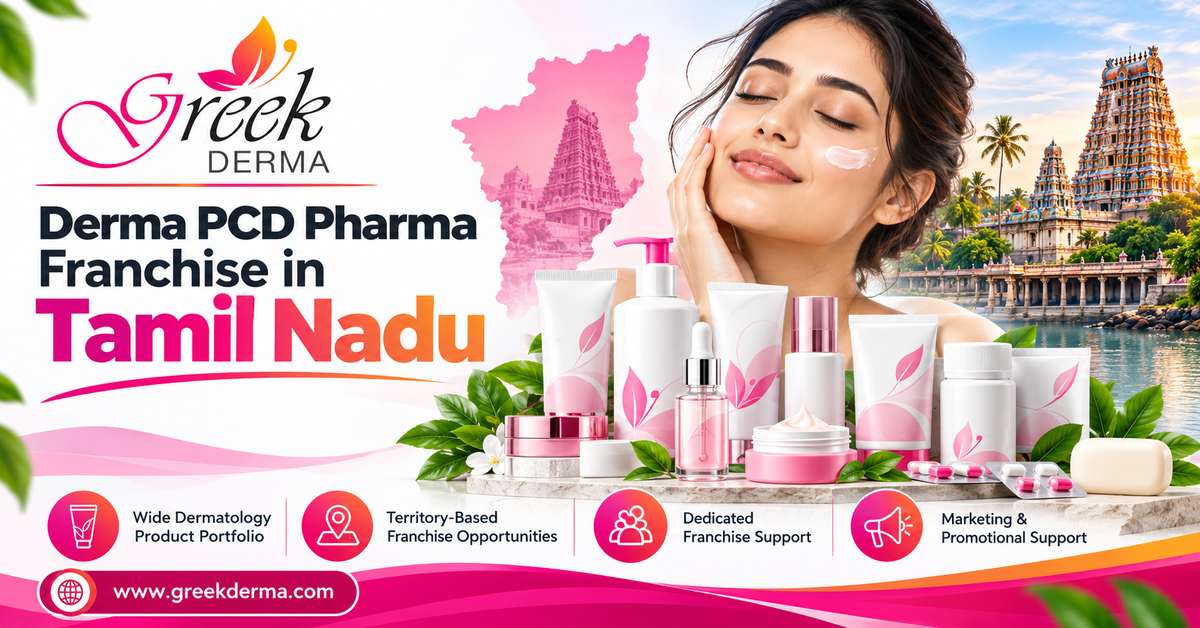
Greek Derma skincare and dermatology products displayed with Tamil Nadu map and regional architecture for a Derma PCD franchise opportunity

Derma PCD Pharma Franchise in Tamil Nadu: Start Your Skin Care Business

Derma PCD Pharma Franchise in Tamil Nadu: Start Your Skin Care Business
If you want to start a derma PCD pharma franchise in Tamil Nadu, Greek Derma offers a dermatology and skin care range with ISO and GMP certified quality standards and the backing of a company that has focused on skin care since 2015. You build relationships with doctors and chemists in your area. We take care of the products.

That’s the short answer. The rest of this guide is for people who want to do it properly. We’ll cover what a derma franchise really involves, why Tamil Nadu suits it so well, which documents you’ll need, and how to judge any company (us included) before you put your money in.

What Is a Derma PCD Pharma Franchise?

A derma pharma franchise is an arrangement in which a pharmaceutical company gives you the right to market and sell its dermatology products in a defined area. PCD stands for Propaganda Cum Distribution. Put simply, you handle the propaganda, which means promoting the range to dermatologists, general physicians and chemists, and you handle the distribution, which means getting stock from the company into the market.

The money side is straightforward. You buy products from the company at the franchise rate, sell them to stockists and chemists at a higher rate, and keep the difference. Manufacturing, quality testing and packaging stay with the company. You don’t need a factory, and you don’t need to build a brand from scratch.

A dermatology PCD pharma franchise works exactly like a general one. Only the bag changes. Instead of antibiotics and painkillers, you carry creams, ointments, lotions, antifungal and anti-acne preparations, hair care, sunscreens and cleansers. Your core audience becomes dermatologists, cosmetologists and skin clinics, along with the GPs who see everyday skin complaints in their OPD.

Why Tamil Nadu Is a Strong Market for a Derma PCD Franchise

Some states are a slow grind for a new derma brand. Tamil Nadu usually isn’t, and the reasons are fairly practical.

A Well-Developed Healthcare and Pharmacy Network

Tamil Nadu has one of the stronger healthcare systems in the country, both public and private. Chennai gets most of the attention, but the real depth sits in the district towns, where private clinics, nursing homes, and chemist shops are packed close together. For a franchise partner, that simply means more doctors to visit and more counters to stock.

Year-Round Demand for Skin Care in a Hot, Humid Climate

This is the big one. Large parts of Tamil Nadu stay hot and humid for most of the year, and that climate is hard on skin. Fungal infections, prickly heat, acne, pigmentation and sun damage are everyday complaints here, not seasonal ones. Antifungal creams, dusting powders, sunscreens, and anti-acne products don’t sit on the shelf waiting for the weather to change. They move every month, which gives a derma partner far steadier sales than many other therapy areas.

Growing Awareness of Dermatology and Cosmetic Care

Not long ago, plenty of people treated a rash or a breakout with whatever the chemist handed over. That habit is fading. More patients now go straight to a dermatologist, and younger customers are visiting skin clinics for acne scars, pigmentation and hair fall. That shift favours doctor-prescribed derma brands over generic counter products, and it’s exactly the space a skin care PCD franchise in Tamil Nadu is built for.

Room for New Derma Brands in Tier 2 and Tier 3 Towns

The big national derma brands concentrate their field force in the metros. In smaller towns their coverage gets thin, and doctors there are often happy to try a new brand if the quality holds up and the representative keeps turning up. That gap is the real derma PCD franchise opportunity in Tamil Nadu. A partner who already knows the local doctors can build a solid territory anywhere in TN much faster than in a crowded city market.

About Greek Derma: A Trusted Derma PCD Pharma Company

Our Journey Since 2015

Greek Derma started in 2015 with one clear focus: dermatology. We’re based in Panchkula, one of the main centres of India’s PCD pharma industry, and we’ve spent the years since building a derma and cosmetic range that doctors can prescribe with confidence.

If you’re searching for a derma PCD pharma company in Tamil Nadu, it’s worth knowing that the company doesn’t have to be headquartered in the state. What matters is the quality of the range, how consistently stock reaches you, and how well the company backs you once you’ve signed up. That’s the standard we hold ourselves to.

Quality Standards and Certifications

Greek Derma is ISO and GMP certified and holds the licences required to manufacture and sell its products. GMP, or Good Manufacturing Practice, sets the rules for how medicines are made, tested, and stored so that every batch matches the last one. For a derma partner, this matters more than it might seem. A cream that changes texture or smell from one batch to the next loses a dermatologist’s trust very quickly.

Any serious partner should ask for copies of a company’s certificates before signing. Ask us, and we’ll share ours.

Our Derma and Skin Care Range

As a derma cosmetics franchise company in Tamil Nadu, our range covers what a dermatologist actually writes in a typical week:

  • Creams, ointments, gels, and lotions for topical treatment
  • Dusting powders and medicated soaps
  • Sunscreens and facial cleansers
  • Hair care products
  • Tablets and capsules
  • Syrups and other oral liquids
  • Injectables

Having all of this under one company is what makes a derma product PCD franchise in Tamil Nadu workable. You can walk into a skin clinic with a full bag instead of three or four scattered products.

Benefits of Choosing Greek Derma for Derma PCD Franchise in Tamil Nadu

Every company claims to be the best derma PCD pharma franchise in Tamil Nadu. Here’s what you actually get with us and what you should expect from any company you consider.

ISO and GMP Certified Products

Quality is the one thing you can’t fix in the field. If a product lets a patient down, no amount of follow-up visits will win that doctor back. Our certified manufacturing standards give you products you can stand behind when a dermatologist asks hard questions.

Wide Derma and Cosmetic Portfolio

A narrow range forces you to work with two or three companies at once, with separate orders, separate payments, and separate dispatch problems. Our portfolio covers treatment and cosmetic care together, so one partnership can serve most of what a skin clinic needs.

Promotional and Marketing Support

A new brand needs something to show the doctor. Most PCD companies support their partners with promotional material such as visual aids, product literature, and samples, though what’s included varies a lot from one company to another. Before you sign with anyone, ask for the exact list in writing. When you speak to us, we’ll walk you through precisely what comes with a derma PCD franchise with promotional support in Tamil Nadu, so there are no surprises later.

Low Investment to Get Started

A low investment derma PCD franchise in Tamil Nadu is entirely possible because you don’t have to stock the full range on day one. Your starting cost depends mainly on three things: how many products you pick, the quantity of your first order, and what you spend on licences and storage space. Our advice is to start with a focused basket of fast-moving products that suit your doctors, then widen the range as prescriptions come in.

Reliable Dispatch and Supply

Tamil Nadu is a long way from Panchkula, so supply planning matters. A partner who runs out of a fast-moving cream for two weeks can lose that prescription to a competitor. We’ll share dispatch timelines and transport options with you before your first order, so you can plan your reorders around them instead of guessing.

Transparent Pricing and Billing

You’ll get a clear product price list before you commit, and every order is billed with a proper GST invoice. Simple, but you’d be surprised how many partners have been caught out by unclear rates elsewhere.

Monopoly Derma PCD Franchise in Tamil Nadu

A monopoly derma PCD franchise in Tamil Nadu gives you exclusive rights to sell a company’s range in a defined territory, usually a district or a group of towns. No other partner from the same company can sell those products there. A monopoly based derma franchise in Tamil Nadu usually comes with a minimum order commitment, because the company is handing that territory to you alone.

Is it worth it? Honestly, it depends on you. A derma PCD franchise with monopoly rights in Tamil Nadu pays off well if you have the field strength to cover every doctor in the area. If you’re starting alone, it can make more sense to begin without a monopoly, prove the range works with your doctors, and then move to an exclusive derma franchise in Tamil Nadu once you know your numbers.

If you’re interested, ask our team whether monopoly rights are open for your district and what commitment comes with them.

Who Can Start a Derma PCD Franchise in Tamil Nadu?

You don’t need a pharma degree to run a derma franchise in Tamil Nadu, though you do need someone qualified on the licence (more on that below). The people who tend to do well are:

  • Medical representatives who already have a working relationship with dermatologists and GPs and want to run their own business. A derma PCD franchise for medical representatives in Tamil Nadu is one of the most natural next steps in an MR’s career.
  • Pharma distributors and stockists who want to add a derma range to their existing network.
  • Pharmacists and chemists who see daily demand for skin products and want a margin on the brand, not just the sale.
  • New entrepreneurs who are willing to learn the field and put in regular doctor visits.

How to Start a Derma PCD Pharma Franchise in Tamil Nadu

Here’s the sequence most successful partners follow when they work out how to start a derma PCD pharma franchise in Tamil Nadu:

  1. Shortlist two or three companies: Compare their ranges, certifications, and the support they offer, not just their prices.
  2. Verify their credentials: Ask for their manufacturing certificates and licence copies. A genuine company won’t hesitate.
  3. Arrange your documents: Apply for your drug licence and GST registration early, because the licence can take time.
  4. Finalise your territory: Agree the area you’ll cover, and settle whether you’re taking it on a monopoly or non-monopoly basis.
  5. Place your first order: Keep it focused on the products your local doctors are most likely to prescribe.
  6. Launch with your promotional material: Start visiting doctors, place stock with nearby chemists, and follow up consistently. The first three months decide most territories.

Documents Required for a Derma PCD Franchise in Tamil Nadu

These are the documents required for a derma PCD franchise in Tamil Nadu in most cases:

  • Wholesale drug licence (Forms 20B and 21B), issued by the Tamil Nadu Drugs Control Department
  • GST registration
  • PAN card of the business or proprietor
  • Aadhaar card of the proprietor or partners
  • Current bank account in the firm’s name
  • Proof of premises, such as a rent agreement or ownership papers
  • Details of a qualified competent person, such as a registered pharmacist, as the drug licence rules require

Requirements can change, so check the current list with the state drug control office before you apply.

How to Choose the Best Derma PCD Company in Tamil Nadu

Ask ten people which is the best derma PCD company in Tamil Nadu and you’ll get ten names. A better question is which company is best for your territory. Use this checklist on any company you’re considering, including us:

  • Certifications you can see: If a company is vague about its ISO or GMP status, walk away.
  • A range that matches your doctors: A long product list means nothing if your dermatologists don’t prescribe half of it.
  • Clear territory terms: Monopoly or not, get your area in writing.
  • Real promotional support: Ask exactly what you’ll receive, and when.
  • A dispatch record: Talk to an existing partner if you can. Ask how quickly orders actually arrive.
  • Straight answers: If you can’t get a clear reply on pricing before you sign, don’t expect better afterwards.

Our honest view: the top derma PCD company in Tamil Nadu for you is rarely the cheapest one. Low rates mean little if stock arrives late or batches vary. Consistency is what keeps doctors prescribing.

Frequently Asked Questions

Q1. How do I start a derma PCD pharma franchise in Tamil Nadu?

Ans: Shortlist a few certified derma companies, compare their ranges and support, and arrange your wholesale drug licence and GST registration. Then finalise your territory, place a focused first order and start visiting doctors and chemists with the company’s promotional material.

Q2. Which is the best derma PCD company in Tamil Nadu?

Ans: The best company is the one whose range suits your doctors and whose quality and supply stay consistent. Check certifications, territory terms, promotional support and dispatch record before deciding. Greek Derma is an ISO and GMP certified derma company working in dermatology since 2015.

Q3. What is the investment required for a derma PCD franchise in Tamil Nadu?

Ans: The investment depends on how many products you choose, the size of your first order and your licence and storage costs. You don’t need to stock the full range at the start. Most partners begin with a small set of fast-moving products and expand as prescriptions grow.

Q4. Is a derma PCD franchise profitable in Tamil Nadu?

Ans: It can be, because Tamil Nadu’s hot and humid climate keeps demand for antifungal, anti-acne and sun care products steady all year. Your profit comes from the gap between the franchise rate and your selling rate, so it grows with the number of doctors prescribing your range.

Q5. What documents are required for a derma PCD franchise in Tamil Nadu?

Ans: You’ll usually need a wholesale drug licence (Forms 20B and 21B), GST registration, PAN and Aadhaar cards, a current bank account and proof of premises. The drug licence also requires a qualified competent person, such as a registered pharmacist.

Q6. Does Greek Derma offer monopoly rights in Tamil Nadu?

Ans: Monopoly availability depends on the district and on whether another partner already covers it. Speak to our team to check whether your area is open and what order commitment comes with exclusive rights.

Q7. Can a medical representative start a derma PCD franchise?

Yes, and medical representatives are often the best placed to succeed. They already know the doctors and how the field works. They’ll still need a valid drug licence, which requires a qualified competent person on record.

Q8. Does Greek Derma provide promotional support to its partners?

Ans: Yes. Promotional support helps partners introduce the range to doctors. Our team will explain exactly what is included with your franchise before you place your first order.

Partner with Greek Derma for Derma PCD Franchise in Tamil Nadu

Tamil Nadu rewards derma partners who show up consistently. The demand is already there, driven by the climate, by growing skin awareness and by doctors in smaller towns who are open to a dependable new brand. What you need is a range you can trust and a company that answers the phone after the first order.

If you’re ready to start a derma PCD pharma franchise in Tamil Nadu, or you simply want our price list and range to compare, get in touch with Greek Derma today. Tell us your district and the doctors you work with, and we’ll help you plan a starting basket that fits your part of Tamil Nadu.

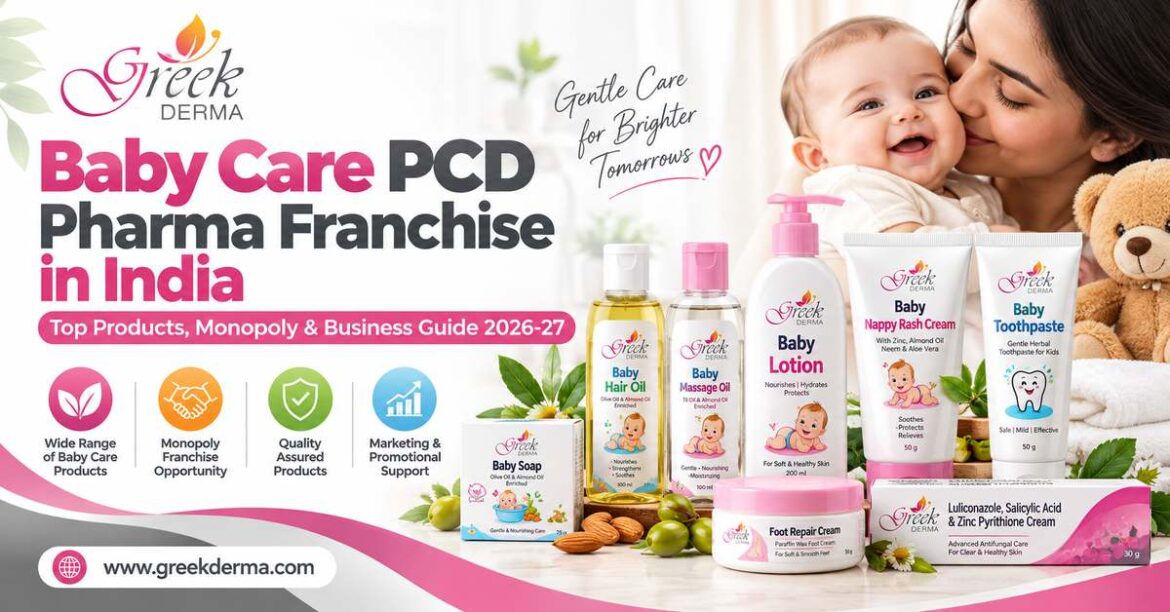
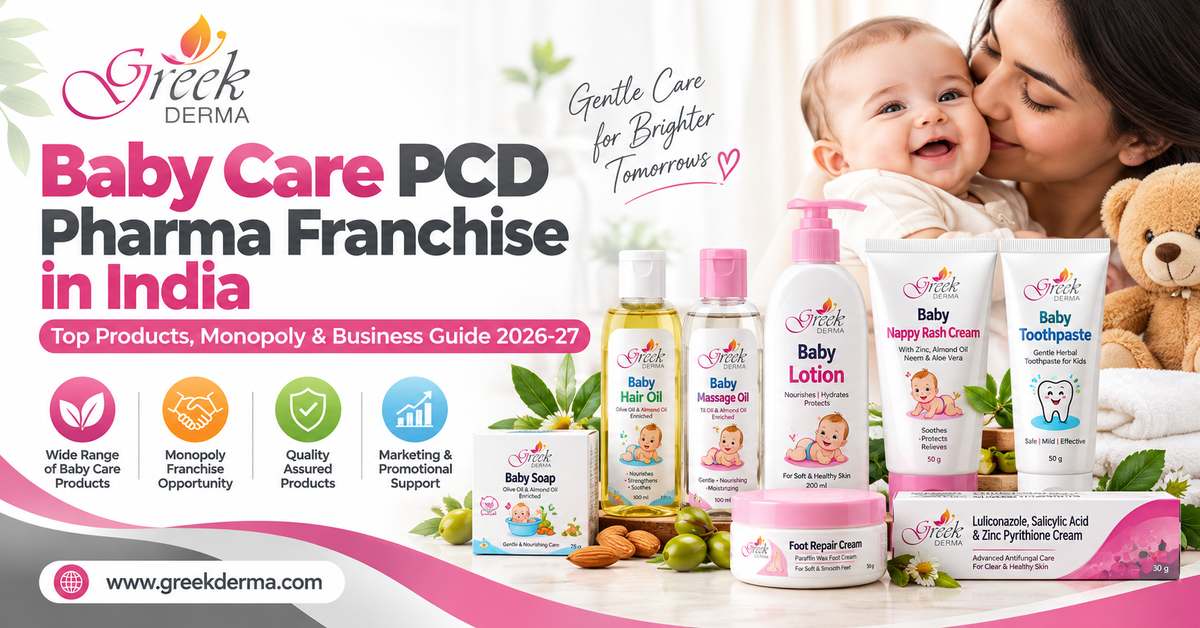
Baby Care PCD Pharma Franchise in India-Greek Derma

Baby Care PCD Pharma Franchise in India – Top Products, Monopoly & Business Guide 2026-27

Baby Care PCD Pharma Franchise in India-Greek Derma

The baby care segment has developed into a specialised part of the skincare and personal-care market. Parents increasingly look closely at product formulation, ingredients, packaging, usage information and overall product quality when selecting products for their children. For pharma distributors and entrepreneurs, this creates a specialised business category that requires careful product selection rather than simply maintaining a large catalogue.

A Baby Care PCD Pharma Franchise in India allows eligible entrepreneurs and pharma professionals to develop a focused portfolio of baby-care and related products without establishing their own manufacturing facility. Depending on the franchise company, the business model may also include territory-based monopoly rights, promotional assistance and product supply support.

Greek Derma operates primarily in dermatology and skincare and officially includes Baby Care among its product categories. The company also markets monopoly-based PCD franchise opportunities, subject to territory availability and applicable terms.

This guide explains baby-care product selection, franchise planning, monopoly rights, investment, inventory management and the factors entrepreneurs should evaluate before starting a Baby Care Products PCD Franchise in India.

What is a baby care PCD Pharma franchise?

A baby care PCD pharma franchise is a business arrangement where a company works with an independent franchise associate for the marketing and distribution of selected baby-care products within an agreed market or territory.

Depending on the available portfolio, products may include baby massage oils, baby hair oils, lotions, soaps, nappy-care products, children’s oral-care products and other skincare or personal-care formulations.

The company generally handles product development or sourcing, branding, packaging and supply, while the franchise partner concentrates on developing the local market.

The exact arrangement varies between companies, so product availability, pricing, MOQ, territory rights and commercial terms should always be checked before starting.

Why Consider the Baby Care Segment for PCD Pharma Franchise?

Baby care differs from a general pharma portfolio because the product range is built around a relatively specific consumer segment.

This allows a franchise partner to develop a more focused portfolio across several complementary categories, such as:

  • Baby massage and body care
  • Baby hair and scalp care
  • Baby moisturising products
  • Baby cleansing products
  • Nappy-area skincare
  • Children’s oral care
  • Other related skincare products

For business planning, the advantage is not simply the number of products. What matters is whether individual products have identifiable demand within the selected territory.

Baby Care Product Range by Greek Derma

Greek Derma includes baby care within its broader dermatology and skincare portfolio. Rather than presenting the range as a “Top 10” list when the available catalogue is smaller, it is more useful to evaluate the products individually according to category, formulation and market relevance.

1. Baby Hair Oil – Olive Oil & Almond Oil Enriched:

Baby Hair Oil provides a dedicated hair and scalp-care option within the baby-care portfolio.

An oil-based hair-care product can complement bathing, massage and moisturising products when building a broader daily-care range.

For franchise planning, compare the current ingredients, pack size, pricing, packaging and expected demand before deciding opening quantities.

2. Baby Massage Oil – Til Oil & Almond Oil Enriched:

Baby massage oil represents an important body-care category within a specialised baby portfolio.

Greek Derma’s product range includes a variant based around Til Oil and Almond Oil. When selecting massage oils for a franchise portfolio, compare formulation, product information, packaging and current commercial terms.

3. Baby Lotion:

A baby lotion adds a moisturising category to the range.

Lotions can complement cleansing and massage products, allowing a franchise associate to build a portfolio around multiple parts of the daily baby-care routine rather than relying on one product category.

The current product label and formulation should always be checked before making ingredient or performance claims.

4. Baby Nappy Rash Cream with Zinc, Almond Oil, Neem & Aloe Vera:

Nappy-area care represents a more specialised part of a baby skincare portfolio.

Greek Derma lists a Baby Nappy Rash Cream positioned around ingredients including Zinc, Almond Oil, Neem and Aloe Vera.

For products intended for delicate skin, franchise partners should rely on the latest approved product information and avoid unsupported safety or treatment claims.

5. Baby Soap – Olive Oil & Almond Oil Enriched:

Baby Soap adds a cleansing product to the portfolio.

A dedicated cleansing category can work alongside lotions, massage oils and hair-care products to create a more rounded baby-care range.

Product formulation, packaging, usage instructions and current pack presentation should be verified before marketing.

6. Baby Toothpaste – Gentle Herbal Toothpaste for Kids:

The range also extends beyond skin and hair care through a gentle herbal toothpaste for kids.

This gives a franchise portfolio an oral-care category alongside conventional baby skincare products.

As with any children’s product, current labelling, intended age/use information and directions should be followed rather than making assumptions based only on the product name.

7. Vitamin A, D & Olive Oil Baby Massage Oil:

Greek Derma also lists another baby massage-oil formulation positioned around Vitamin A, Vitamin D and olive oil.

Having more than one massage-oil option can provide portfolio variety, but a franchise partner should compare both formulations before stocking them heavily.

The goal should be to understand which variant has stronger demand within the target market.

Related Dermatology Products Listed Alongside the Range

Two additional product pages supplied for this range are Foot Repair Cream with Paraffin Wax and a Luliconazole, Salicylic Acid & Zinc Pyrithione formulation.

These should not automatically be marketed as baby-care products merely because they appear alongside the supplied product set. They are better treated as part of the wider dermatology portfolio unless their current approved product information specifically supports baby-care positioning.

This distinction is particularly important in a Baby Care PCD Pharma Franchise because product categorisation and intended-use information should remain accurate.

How to Select Baby Care Products for a PCD Franchise

A new franchise partner does not necessarily need to purchase the same quantity of every product.

A better process is:

Market Research → Category Selection → Product Comparison → Opening Stock → Sales Tracking → Reordering

First identify the baby-care categories for which demand exists within the target territory.

Then compare individual products based on formulation, pricing, pack presentation, competition and supply.

After launching, use actual sales and repeat-order data to determine which products deserve higher inventory.

Building a Balanced Baby Care Portfolio

A focused portfolio can be divided according to product purpose.

Product Category Portfolio Role
Baby Hair Oil Hair & scalp care
Baby Massage Oil Massage & body care
Baby Lotion Moisturising
Baby Nappy Rash Cream Nappy-area skincare
Baby Soap Daily cleansing
Baby Toothpaste Kids’ oral care
Vitamin A, D & Olive Oil Baby Massage Oil Massage & body care

This approach makes it easier to identify gaps and prevents unnecessary duplication.

What is a Baby Care Monopoly PCD Pharma Franchise?

A baby care monopoly PCD Pharma franchise generally means that a franchise partner receives agreed marketing or distribution rights for specified products within a defined geographical territory.

The important words are agreed upon and defined.

A monopoly arrangement should not be interpreted as permanent exclusivity across an entire city, district or state unless the written agreement specifically provides those rights.

Greek Derma states that it offers monopoly-based PCD franchise opportunities in selected locations. Exact availability and terms therefore need to be confirmed for the intended territory.

How Do Monopoly Rights Work?

Monopoly arrangements can differ significantly between companies.

A franchise agreement should clearly explain:

Territory: The exact geographical area allocated to the franchise partner.

Products: Whether rights cover the complete range or only selected products.

Duration: How long the arrangement remains valid.

Purchase Conditions: Whether minimum purchases or sales targets apply.

Renewal: Requirements for continuing the territory.

Direct Supply Policy: How enquiries from other distributors in the same territory are handled.

Termination Conditions: Circumstances under which monopoly rights can be withdrawn.

Getting these conditions in writing helps reduce future misunderstandings.

City-Based vs District-Based Monopoly

Entrepreneurs should also understand the difference between different territory structures.

A city-based monopoly may provide rights only within specified city limits.

A district-based monopoly can cover a larger geographical market if the company’s policy and current availability allow it.

A state-level territory can be significantly larger and may require more working capital, inventory and distribution capacity.

Bigger territory does not automatically mean a better business opportunity. Select an area that can realistically be developed.

Benefits of Focused Baby Care Monopoly Franchise

Where the territory and conditions are clearly defined, a focused monopoly arrangement can help with:

  • Territory-specific business planning
  • Local distribution development
  • Product-focused promotion
  • Inventory planning
  • Building retailer and professional networks
  • Reducing internal channel conflict
  • Developing consistent brand presence

However, monopoly rights themselves do not guarantee sales or profitability.

Actual business performance still depends on demand, product selection, pricing, competition, supply and execution.

What to Check Before Selecting Baby Care Products

Baby-care products require careful evaluation.

Before ordering, check the current:

Product Name – Confirm the correct brand and variant.

Ingredients/Formulation – Use current product information.

Pack Size – Verify the latest presentation.

Batch Details – Check the supplied batch information.

Shelf Life – Evaluate remaining shelf life before accepting significant inventory.

Storage Instructions – Follow the label requirements.

Usage Information – Marketing communication should remain consistent with approved information.

Packaging – Check container quality, sealing and label clarity.

Avoid claims such as “100% safe”, “no side effects” or guaranteed results unless they are appropriately substantiated.

Importance of Packaging in Baby Care Products

Packaging has particular importance in the baby-care segment.

It should provide clear information while remaining convenient for the intended product type.

Important points include:

  • Clear ingredient/formulation information
  • Readable directions
  • Batch and expiry details
  • Proper sealing
  • Storage information
  • Professional presentation
  • Consistent branding

Visual appeal can improve shelf presentation, but accurate information should remain the priority.

Investment for Baby Care PCD Pharma Franchise in India

There is no fixed investment applicable to every Baby Care PCD Pharma Franchise in India.

Initial working capital can depend on:

  • Number of products selected
  • Quantity per SKU
  • Product pricing
  • MOQ
  • Freight
  • Promotional expenditure
  • Territory size
  • Business documentation
  • Distribution expenses
  • Credit offered in the market
  • Reorder cycle

Instead of starting with the maximum possible range, calculate the investment product by product.

Opening Stock Planning:

Suppose seven clearly baby/kids-oriented products are selected initially.

There is no requirement to purchase identical quantities of all seven.

The opening portfolio can be divided into:

Core Products: Products for which stronger demand has already been identified.

Supporting Products: Complementary products maintained at moderate quantities.

Test Products: Products initially stocked in smaller quantities while market response is evaluated.

After a few sales cycles, actual movement can guide future purchases.

MOQ & Working Capital

Minimum Order Quantity can significantly influence the amount of capital required.

Before starting, ask whether MOQ applies:

  • Per product
  • Per box
  • Per case
  • Per invoice
  • Per total order value

Also ask whether the opening-order MOQ differs from repeat orders.

Lower purchase prices are not always beneficial if the required quantity causes excessive stock holding.

Stock & Expiry Management

Inventory management becomes important even with a relatively compact baby-care portfolio.

Maintain records such as:

Brand → Batch → Purchase Date → Quantity → Sales → Closing Stock → Expiry → Reorder Level

Where applicable, FEFO (First Expiry, First Out) can help prioritise valid stock with earlier expiry dates.

Regularly identify fast-moving, moderate-moving and slow-moving products.

How to Market a Baby Care PCD Franchise

Marketing should focus on accurate product information rather than exaggerated claims.

Depending on the nature and regulatory classification of individual products, relevant channels may include suitable retail, distribution, professional and digital networks.

Digital visibility can also be developed through:

  • Product category pages
  • Informative blogs
  • Local SEO
  • Product-focused content
  • Educational social media content
  • Business profile optimisation

The messaging should clearly distinguish routine baby-care products from dermatological or medicated formulations.

Promotional Support for Franchise Partners

Promotional support can help franchise partners introduce a new portfolio within their territory.

Greek Derma states that its franchise support can include product brochures, visual aids, MR bags, sample kits and branding materials. The exact package available to a Baby Care franchise partner should be confirmed at the time of enquiry.

How to Start a Baby Care PCD Pharma Franchise in India

Step 1 – Select Your Territory

Choose a city, district or other manageable geographical market.

Step 2 – Research Product Demand

Study existing baby-care products, competition, pricing and distribution channels.

Step 3 – Evaluate the Product Portfolio

Compare formulations, packaging, pricing and product positioning.

Step 4 – Verify Company Information

Review applicable manufacturing and quality documentation instead of relying only on promotional claims.

Step 5 – Check Monopoly Availability

Confirm whether the desired territory is currently available.

Step 6 – Understand Commercial Terms

Discuss price lists, MOQ, freight, payment terms, supply and promotional support.

Step 7 – Review the Agreement

Read territory, product coverage, sales conditions, renewal and termination clauses carefully.

Step 8 – Place a Controlled Opening Order

Select quantities according to realistic demand.

Step 9 – Develop Your Market

Build the relevant local distribution and professional network.

Step 10 – Track Performance

Use sales and inventory records to improve future purchasing decisions.

Common Mistakes to Avoid

One of the biggest mistakes is assuming that every product listed near a Baby Care category is automatically suitable for babies.

Also avoid:

  • Ordering excessive opening inventory
  • Choosing products only because they are inexpensive
  • Ignoring shelf life
  • Assuming verbal monopoly rights are sufficient
  • Ignoring territory boundaries
  • Stocking multiple similar products without demand
  • Making unsupported safety claims
  • Not tracking slow-moving stock
  • Offering excessive market credit
  • Ignoring repeat-order patterns

A smaller, carefully selected portfolio can be commercially more manageable than an unnecessarily large range.

About Greek Derma:

Greek Derma is a dermatology-focused company offering skincare, hair-care, baby-care and related derma products. Its official website currently lists categories including sunscreen, soap, shampoo, ointment, lotion, hair care, face wash and Baby Care.

The company also promotes monopoly-based PCD franchise opportunities and states that franchise partners can receive marketing and promotional support. Its broader franchise content advises evaluating product range, territory, documentation, pricing, stock availability and supply conditions when considering a derma franchise arrangement.

For someone specifically exploring a Baby Care PCD Franchise Company in India, Greek Derma can therefore be evaluated on the strength of its current baby-care range as well as its wider dermatology portfolio.

Why Evaluate Greek Derma for Baby Care PCD Franchise?

Specialised Dermatology Portfolio:

Baby Care sits alongside Greek Derma’s wider skin and hair-care categories rather than being isolated from the company’s core dermatology focus.

Multiple Baby Care Categories:

The supplied product range covers massage, hair care, moisturising, cleansing, nappy-area care and children’s oral care.

Monopoly Franchise Opportunities:

Greek Derma publicly states that monopoly-based opportunities are available in selected locations, subject to current territory availability.

Wider Product Expansion Possibility:

A franchise partner beginning with baby-care products can separately evaluate complementary dermatology categories if relevant to the territory.

Promotional Support:

Greek Derma states that it provides franchise partners with promotional and marketing support.

Future Scope of Baby Care PCD Pharma Franchise in India

A specialised Baby Care PCD business gives entrepreneurs the ability to build around complementary daily-care categories rather than depending on a single product.

The portfolio can also be expanded gradually.

Instead of purchasing a large number of products at the beginning, franchise partners can first establish demand for massage oils, lotion, cleansing, nappy care and other core categories.

New products can then be introduced according to actual territory requirements.

This demand-led approach can help control inventory and working capital while creating a more structured franchise business.

Conclusion:

A Baby Care PCD Pharma Franchise in India can be developed as a focused business around baby skincare, massage, cleansing, hair care, nappy care and related categories.

However, successful portfolio planning requires more than simply collecting products under a Baby Care label.

Entrepreneurs should evaluate individual products, ingredients or compositions, packaging, pricing, MOQ, shelf life, supply consistency and local demand. For a Baby Care Monopoly PCD Pharma Franchise, territory boundaries and commercial conditions should also be documented clearly.

Greek Derma currently includes Baby Care within its wider dermatology portfolio and promotes monopoly-based franchise opportunities subject to territory availability.

Its baby-oriented range provides several complementary categories that prospective franchise partners can evaluate when planning a specialised portfolio for 2026-27.

Frequently Asked Questions:

Q.1 What is a Baby Care PCD Pharma Franchise?

Ans. It is a franchise business model focused on the marketing and distribution of baby-care products within an agreed territory and under defined commercial terms.

Q.2 Which Baby Care products does Greek Derma offer?

Ans. The supplied range includes Baby Hair Oil, Baby Massage Oil, Baby Lotion, Baby Nappy Rash Cream, Baby Soap, Baby Toothpaste and Vitamin A, D & Olive Oil Baby Massage Oil.

Q.3 Does Greek Derma offer Baby Care PCD Pharma Franchise opportunities?

Ans. Greek Derma operates a dermatology-focused PCD franchise model and includes Baby Care among its product categories. Its website states that monopoly-based franchise opportunities are available in selected locations. Exact product and territory availability should be confirmed before proceeding.

Q.4 What is a Baby Care Monopoly PCD Pharma Franchise?

Ans. It generally refers to agreed marketing or distribution rights for specified baby-care products within a defined geographical territory, subject to the company’s written terms.

Q.5 How much investment is required for a Baby Care PCD Franchise?

Ans. There is no single fixed amount. Investment depends on the number of products, opening quantities, pricing, MOQ, territory size, freight, marketing costs and working-capital requirements.

Q.6 Which products should I select first?

Ans. Start with products that have identifiable demand within your territory. Compare massage, cleansing, moisturising, hair care, nappy care and other categories before deciding opening quantities.

Q.7 Should all nine supplied Greek Derma products be promoted as Baby Care?

Ans. Not automatically. The Foot Repair Cream and Luliconazole/Salicylic Acid/Zinc Pyrithione product should remain under their appropriate dermatology positioning unless current approved product information specifically supports baby-care use.

Q.8 Does a monopoly franchise guarantee business success?

Ans. No. Monopoly rights define agreed territory conditions but do not guarantee sales or profit. Results depend on product demand, pricing, competition, supply, inventory management and business execution.

Q.9 What should I verify before taking the franchise?

Ans. Verify the latest product list, pricing, pack sizes, MOQ, applicable quality documentation, shelf life, supply terms, promotional support and written monopoly conditions.

Q.10 Can the portfolio later be expanded into other derma categories?

Ans. Yes, where commercially relevant and available. Greek Derma’s broader portfolio includes several skincare, hair-care and dermatology categories that can be evaluated separately.


Derma PCD Pharma Franchise in Himachal Pradesh–Greekderma

Derma PCD Pharma Franchise in Himachal Pradesh – Products, Monopoly & Business Guide 2026-27

Derma PCD Pharma Franchise in Himachal Pradesh–Greekderma

Dermatology and skincare have become a genuinely important specialised area within pharma. People care more about skin care, hair care, sun protection, scalp care, and personal hygiene than they used to, and that shift has opened up real opportunity for professionals wanting to build a focused dermatology portfolio. For entrepreneurs exploring a Derma PCD Pharma Franchise in Himachal Pradesh, this model gives you a way to work with specialised derma formulations while developing your own assigned market.

Within Himachal Pradesh, Baddi deserves particular attention — it’s one of India’s established pharmaceutical manufacturing clusters. That makes Derma PCD Pharma Franchise in Baddi an important search for distributors and franchise professionals looking at opportunities across the state.

Greek Derma operates in the dermatology-focused segment, with a portfolio covering skincare, hair care, sunscreens, soaps, shampoos, face washes, creams, ointments, lotions, and related categories.

This guide walks through the derma franchise business model, product selection, monopoly rights, investment, quality verification, stock planning, and the opportunities available across Baddi and other parts of Himachal Pradesh.

What Is a Derma PCD Pharma Franchise?

A Derma PCD Pharma Franchise is a business arrangement built specifically around dermatology, skincare, hair-care, and related product categories.

Under a typical PCD model, the company handles branding, product sourcing or manufacturing arrangements, packaging, and supply. The franchise associate develops the agreed market according to whatever commercial terms both parties settle on.

Compared to a broad general pharmaceutical franchise, a derma-focused franchise lets an entrepreneur build something more specialised — depth instead of breadth.

The exact responsibilities, territory rights, and commercial conditions vary from company to company, so confirm these directly before you invest anything.

Why Consider a Derma PCD Pharma Franchise in Himachal Pradesh?

Himachal Pradesh has an established pharmaceutical manufacturing ecosystem, particularly around industrial areas like Baddi-Barotiwala-Nalagarh.

That said, the presence of manufacturing facilities alone shouldn’t be what drives your business decision.

The real potential of a Derma PCD Pharma Franchise in Himachal Pradesh comes down to local dermatology demand, professional networks, competition, product availability, pricing, and how much territory you can realistically cover.

Different districts and cities can look quite different from each other in terms of market character.

So treat state-level opportunity as a starting point, not the whole picture — local territory research still needs to follow.

Derma PCD Pharma Franchise in Baddi

Baddi is one of the most recognised pharmaceutical manufacturing locations in Himachal Pradesh.

Its established pharma ecosystem makes it particularly relevant for anyone researching a Derma PCD Pharma Franchise in Baddi specifically.

But a franchise business and a manufacturing business are genuinely different models.

A franchise partner focuses on developing the market for an existing company’s brands, while a manufacturer focuses on production. Those are two different jobs.

So simply sitting near pharmaceutical manufacturing units doesn’t automatically make a franchise successful — proximity isn’t the same as demand.

For anyone planning a franchise in Baddi, the important considerations stay the same: product demand, competition, territory availability, product portfolio, commercial terms, and supply reliability.

Why Baddi Is Important to the Pharmaceutical Sector

Baddi and the surrounding industrial belt have grown into a major pharmaceutical manufacturing cluster over the years.

That ecosystem has built up supporting infrastructure around production, packaging, logistics, and related industries.

For a PCD franchise professional, being close to a pharma cluster does offer useful industry exposure.

At the same time, Baddi can also be genuinely competitive.

So evaluate the local market independently, rather than assuming a strong manufacturing base automatically means high demand for every dermatology product — the two don’t necessarily track together.

Derma Franchise vs General PCD Pharma Franchise

A general PCD portfolio can span several therapeutic categories at once.

A derma franchise, by contrast, stays more specialised.

The portfolio can include:

Creams → Gels → Ointments → Lotions → Face Washes → Sunscreens → Soaps → Shampoos → Hair-Care Products → Baby-Care Products

That specialisation lets franchise partners focus their market development squarely on dermatology and related healthcare categories, rather than juggling unrelated segments.

Major Dermatology Product Categories

A strong Derma PCD Pharma Franchise in Himachal Pradesh should be judged on how relevant its product portfolio actually is — not the total product count.

Here are the categories worth paying attention to.

Dermatology Creams:

Creams form an important part of many derma portfolios.

Different formulations can carry completely different compositions and intended uses, so evaluate each product individually rather than treating them as interchangeable.

Check composition, manufacturer details, pack presentation, pricing, and local competition before selecting any of them.

Derma Gels:

Gel formulations offer another important topical category.

When selecting gels, compare the formulation against actual market requirement — don’t just pick several similar products to pad out the catalogue.

Ointments:

Ointments broaden the topical dermatology portfolio further.

Figure out which compositions have genuine relevance within your target Himachal Pradesh territory before stocking them.

Face Wash Range:

Face washes complement a dermatology and skincare portfolio nicely.

Different formulations target different skincare needs, so build the range around actual market demand rather than variety for its own sake.

Sunscreen Range:

Sun-care products add another useful skincare category.

When comparing sunscreens, weigh SPF positioning, formulation, packaging, and supporting product information together.

Derma Soaps:

Dermatology-focused soaps complement other topical products well.

Avoid stocking several near-identical soaps unless local demand genuinely justifies the extra inventory.

Shampoo & Scalp-Care Range:

Shampoos matter for scalp and hair-related portfolios specifically.

Weigh composition and intended positioning carefully before settling on individual products.

Hair-Care Products:

Hair serums, topical solutions, and related products extend the franchise portfolio beyond conventional skin care.

It’s worth treating hair care as its own dedicated segment during market research, rather than an afterthought.

Lotions & Moisturisers:

Lotions and moisturising formulations round out a more complete dermatology portfolio.

Product selection here should factor in composition, market positioning, packaging, and local demand.

Baby-Care Range:

Baby-care formulations add further diversification where they genuinely fit your business network.

Because this is a sensitive category, review product information and applicable quality documentation with extra care.

Major Greek Derma Products to Evaluate

Greek Derma offers multiple dermatology and skincare formulations. Some examples worth evaluating:

BRAND NAME COMPOSITION / PRODUCT TYPE
ACIGLOW-A Gel Clindamycin Phosphate + Adapalene Gel
KERAPIL Solution Procapil + Burgeon + Burgeon Up + Anagain + Baicapil Solution
NOVAXDIL-F Solution Minoxidil 5% w/v + Finasteride 0.1% w/v Topical Solution
ACIGLOW-B Cream Betamethasone 0.10% w/w + Clindamycin 1.0% w/w + Nicotinamide IP
DAZKET Soap Ketoconazole 2% Soap
DAZEBER Cream Eberconazole 1% w/w Cream
GREEK DAZ N CARE SPF 50 Broad Spectrum Sunscreen SPF 50
CIPTOSS-XL Cream Ciprofloxacin Hydrochloride + Metronidazole Benzoate + Terbinafine Hydrochloride + Clobetasol Propionate

Current product availability, pack sizes, compositions, and commercial conditions should be checked against the latest company catalogue before placing an order.

How to Select Derma Pharma Products for Himachal Pradesh

Don’t start by grabbing the maximum possible number of products.

Start with market research instead.

A useful selection process looks like this:

Local Demand → Product Category → Composition → Competition → Pricing → MOQ → Shelf Life → Availability

Following this order helps keep working capital from getting stuck in products that just don’t move.

Build a Focused Opening Portfolio:

A new franchise can split its products into three groups.

Priority Products:

These are formulations backed by stronger evidence of local demand.

They deserve more attention during the initial business stage.

Development Products:

These look relevant but need more market development before they prove themselves.

Keep opening quantities controlled here.

Specialised Products:

These address narrower requirements.

Stock them according to identified demand — not in bulk, hoping demand shows up later.

This approach makes inventory noticeably easier to manage overall.

Monopoly Derma PCD Pharma Franchise in Himachal Pradesh

Monopoly rights come up constantly in the PCD franchise world.

Under a monopoly arrangement, the company may offer defined marketing or distribution rights for selected products within an agreed geographical area, subject to its commercial agreement.

But monopoly doesn’t mean no competing dermatology company can operate in that territory.

It generally describes the relationship between the franchise partner and the company granting the rights — nothing broader than that.

Territory Rights in Baddi:

Anyone considering a Monopoly Derma PCD Pharma Franchise in Baddi should get the exact territory clarified before making a significant investment.

Does the agreement cover only Baddi? Does it stretch into nearby industrial areas? Does it extend into Nalagarh? Which products fall under it? Is the territory open for the complete portfolio or just selected brands?

Get all of this documented clearly — none of it should stay a verbal understanding.

Other Potential Markets in Himachal Pradesh:

A company offering franchise opportunities across Himachal Pradesh may work with partners in different cities and districts, subject to what’s actually available at the time.

Markets worth researching include Baddi, Solan, Nalagarh, Shimla, Una, Mandi, Kangra, Dharamshala, Hamirpur, and Bilaspur.

That doesn’t mean every territory is available from a particular company, though. Confirm availability individually rather than assuming.

Why Territory Selection Matters:

A larger territory isn’t automatically more valuable — bigger doesn’t mean better here.

Think about your actual ability to cover the market consistently.

A useful way to weigh it:

Healthcare Network + Existing Relationships + Competition + Travel Requirements + Distribution Capability

A smaller, manageable territory is often more practical than a sprawling one you can’t service properly.

Quality Standards to Check:

Product quality and manufacturing information deserve real weight in evaluating a franchise company.

If a company references WHO-GMP, GMP, ISO, or other quality credentials, request current applicable documentation directly.

Also check the manufacturer information shown on current product packaging, not just what’s printed in marketing material.

A marketing company’s products can come from different facilities, so evaluate documentation product by product rather than assuming one certificate covers everything.

Product Packaging Matters:

Before settling on a product range, review the current packaging closely.

Check: Brand Name → Composition → Strength → Manufacturer → Batch Information → Manufacturing Date → Expiry Date → Storage Information

Professional, clearly labelled packaging also supports more consistent brand presentation across your territory.

Derma PCD Franchise Investment in Himachal Pradesh

There’s no universal investment figure for starting a Derma PCD Pharma Franchise in Himachal Pradesh.

Investment depends on:

Number of Products + Product Rates + Opening Quantities + MOQ + Freight + Business Expenses + Working Capital

Someone starting with a focused portfolio will need different capital than someone taking on a broad dermatology range — the two aren’t really comparable.

Request current product-wise rates before finalising your budget.

Keep Working Capital Separate:

Opening inventory and working capital shouldn’t get treated as the same pool of money.

If the entire available budget goes into the first product order, the franchise can run into trouble when fast-moving products need replenishing.

Funds also get needed for transportation, operating expenses, and payment cycles along the way.

Keeping enough liquidity in reserve makes the whole business easier to manage.

Understand MOQ Before Ordering:

Minimum order quantity can genuinely affect your initial investment.

Ask whether MOQ applies per product, per box, per invoice, or by some other company policy.

Avoid taking unnecessarily large quantities of uncertain-demand products just to complete an order threshold.

Check Shelf Life:

Shelf life matters a lot when you’re building a new market from scratch.

Review current batch information before purchasing significant quantities.

Products expected to move slower need enough remaining shelf life to allow for realistic market development — not just enough to clear the invoice.

Use FEFO for Stock Management:

A genuinely useful inventory principle here is First Expiry, First Out (FEFO).

Products with an earlier valid expiry date go out before products with a later one, subject to applicable requirements.

Keep batch-wise stock records so expiry can actually be tracked, not just estimated.

Check Expiry & Replacement Terms:

Before placing a major order, understand the company’s current policy on near-expiry, expired, and damaged stock.

Check notification requirements and applicable replacement conditions directly.

Never assume all unsold inventory automatically qualifies for replacement — that assumption causes real problems later.

Supply & Dispatch Planning:

Reliable product availability keeps market continuity intact.

Ask about typical order processing and dispatch timelines up front.

The full supply process runs: Order → Confirmation → Processing → Dispatch → Transit → Delivery

Once you actually know the real lead time, you can set reorder levels that make sense.

Avoid Preventable Stock-Outs:

When a product starts generating repeat demand, keep a close eye on its stock.

A simple reorder concept: Expected Demand During Lead Time + Safety Stock = Reorder Point

The right safety stock depends on product movement and how reliable supply actually is — not a fixed number that works for every product.

Marketing Support for Franchise Partners:

Marketing support helps franchise associates communicate the product portfolio more effectively.

Depending on the company’s current policy, that support can include visual aids, brochures, product cards, sample-related materials, MR bags, or other branding inputs.

Confirm exactly what promotional material comes with your franchise arrangement before finalising anything.

Any pharmaceutical promotional activity should follow applicable requirements, naturally.

Documents Required for a Derma PCD Franchise

Documentation requirements depend on the business activity and regulatory framework involved.

Depending on the model, relevant requirements can include appropriate pharmaceutical licences, GST registration where applicable, PAN, and standard business documentation.

Since regulatory requirements shift and vary by activity, verify current requirements with the appropriate authority or a qualified professional.

How to Start a Derma PCD Pharma Franchise in Baddi

Start with Baddi market research, not product purchasing.

Identify the market area you can realistically cover.

Shortlist a specialised dermatology company and request its latest catalogue.

Select relevant products based on market demand.

Verify product and manufacturing information.

Check Baddi territory availability and understand the monopoly conditions attached.

Review current pricing, MOQ, and payment terms.

Prepare opening-stock and working-capital budgets separately, not as one lump sum.

Complete the applicable documentation.

Once commercial terms are finalised, start with controlled inventory and grow stock according to actual product movement.

Derma PCD Franchise in Baddi vs Other Himachal Markets

Baddi carries a strong pharmaceutical identity thanks to its manufacturing ecosystem.

Other Himachal markets look quite different.

The competitive environment, healthcare network, travel requirements, and distribution infrastructure can vary significantly between Baddi, Shimla, Mandi, Una, and Kangra.

So the same product and marketing strategy shouldn’t get applied identically across every territory — local research still matters, wherever you’re looking.

Marketing Strategy for Himachal Pradesh:

Avoid trying to develop the entire state at once unless your business already has the network and infrastructure to support that.

Start with a manageable territory instead.

Identify priority products and relevant accounts.

Track enquiries, initial orders, and repeat orders closely.

Once a market stabilises, consider expanding into another available territory — not before.

This keeps the growth process controlled rather than scattered.

Monitor Product Performance:

After launch, classify products by actual movement: Fast-Moving → Regular-Moving → Slow-Moving → Non-Moving

Repeat purchasing should increasingly follow real sales data, not initial assumptions.

Products showing consistent demand earn higher inventory priority. Slow-moving products deserve a second look before you order more.

Common Mistakes to Avoid

Taking on an excessively large opening product range is a common one.

So is assuming Baddi’s manufacturing presence automatically guarantees franchise demand — it doesn’t.

Franchise partners should also avoid leaning on verbal monopoly promises, ignoring MOQ, overlooking shelf life, or dumping the entire budget into inventory.

Other mistakes worth avoiding: poor credit management, weak stock monitoring, and expanding into multiple territories before the first market’s even established.

About Greek Derma:

Greek Derma is a dermatology-focused company with a portfolio spanning skincare, hair care, baby care, and related derma categories.

The range includes creams, gels, ointments, face washes, sunscreens, soaps, shampoos, lotions, and hair-care formulations.

The company also offers PCD franchise opportunities and business support for professionals building specialised dermatology markets.

For entrepreneurs evaluating a Derma PCD Pharma Franchise in Himachal Pradesh or Derma PCD Pharma Franchise in Baddi, Greek Derma is worth including while comparing specialised dermatology franchise options.

Before finalising anything, verify current territory availability, the latest product catalogue, pricing, manufacturing documentation, MOQ, supply terms, and written monopoly conditions directly.

Why Consider Greek Derma for a Derma PCD Franchise?

A specialised company suits franchise partners who want to concentrate mainly on dermatology instead of managing a very broad multi-therapy portfolio.

Greek Derma offers multiple categories under one derma-focused portfolio, letting prospective partners evaluate skincare, hair care, and related formulations against their own target market.

The final decision should still rest on current products, quality documentation, commercial conditions, and territory suitability — not brand recognition alone.

Final Checklist Before Starting

Before starting a Derma PCD Pharma Franchise in Himachal Pradesh, research the specific city or district rather than treating the entire state as one market.

For Baddi, analyse local demand and competition separately from the rest of the state.

Select a focused derma portfolio.

Verify current product compositions, manufacturers, and applicable quality documents.

Understand pricing, MOQ, freight, shelf life, and expiry terms.

Confirm territory rights and monopoly conditions in writing.

Keep sufficient working capital outside your opening-stock budget.

Track inventory and payments closely after launch.

Expand into additional Himachal territories only once your existing business and distribution capability can actually support it.

Conclusion:

A Derma PCD Pharma Franchise in Himachal Pradesh can genuinely open the door to a specialised business built around dermatology, skincare, and hair-care categories. But successful market development takes more than just landing a large product catalogue.

Baddi stands out because of its established pharmaceutical ecosystem, making the Derma PCD Pharma Franchise in Baddi an important option for anyone researching the Himachal market.

The practical approach: research the territory, select relevant products, verify quality and manufacturing information, understand monopoly conditions, keep inventory controlled, and expand only as the market actually responds.

Greek Derma offers a specialised derma portfolio worth evaluating for professionals seeking franchise opportunities in Baddi and other parts of Himachal Pradesh.

The real key is building the business around relevant products, a manageable territory, reliable supply, and disciplined stock planning — not chasing the biggest possible catalogue or the widest geographical spread.

FAQs:

Q.1 What is a Derma PCD Pharma Franchise in Himachal Pradesh?

Ans. Basically, it’s a franchise built around marketing and distributing dermatology, skincare, and hair-care products — you get an agreed territory somewhere in Himachal Pradesh, and the products come from a company you’ve partnered with rather than something you manufacture yourself.

Q.2 Can I start a Derma PCD Pharma Franchise in Baddi?

Ans. You can, but “can I” isn’t really the interesting question — it’s more about whether it makes sense for you. That depends on local demand, which company you go with, the usual business requirements, and whether the territory you actually want is free right now.

Q.3 Why is Baddi important for the pharma sector?

Ans. Mostly because of what surrounds it. The whole industrial belt around Baddi has grown into a genuine pharmaceutical manufacturing hub, and that’s pulled in a lot of related activity — which is exactly why it keeps coming up in these conversations.

Q.4 What products can be included in a Derma PCD Franchise?

Ans. Think creams, gels, ointments, face washes, sunscreens, soaps, shampoos, lotions, hair-care items — pretty much anything that falls under dermatology, depending on what the specific company actually carries.

Q.5 What are monopoly rights in a Derma PCD Franchise?

Ans. It just means the company won’t hand your specific products to another partner in your territory — that’s the deal, spelled out in writing. It has nothing to do with blocking other pharma companies from selling their own dermatology brands nearby; that competition stays exactly where it was.

Q.6 How much investment is required for a Derma PCD Pharma Franchise in Baddi?

Ans. Honestly, there’s no single number anyone can give you upfront. It moves with how many products you pick, your opening quantities, current pricing, MOQ, freight, day-to-day expenses, and how much working capital you’re keeping in reserve.

Q.7 How should I select a Derma PCD Pharma Franchise Company?

Ans. Look past the pitch. Compare the actual product range, manufacturing info, quality paperwork, pricing, MOQ, how reliably they keep stock available, the territory terms, and what support you’re really getting — not what the brochure promises.

Q.8 Does Greek Derma offer a specialised derma range?

Ans. It does — the whole focus sits on dermatology and related categories. Skincare, hair care, creams, gels, face washes, sunscreens, soaps, shampoos, lotions — that’s the range they work with.

Derma PCD Pharma Franchise Company in Gujarat–greekderma

Derma PCD Pharma Franchise Company in Gujarat – Products, Monopoly & Business Guide 2026-27

Derma PCD Pharma Franchise Company in Gujarat–greekderma

Gujarat’s pharma and healthcare ecosystem is well established at this point — that’s not really up for debate. For anyone exploring specialised distribution or franchise opportunities, it’s a market worth taking seriously. Dermatology specifically has carved out its own lane within that — skincare, hair care, scalp care, sun protection, personal care, and a handful of more specialised dermatological formulations all sitting under one segment.

If you’re an entrepreneur, distributor, or eligible professional looking to get into this space, working with a Derma PCD Pharma Franchise Company in Gujarat gives you a way to build a dermatology-focused portfolio without ever setting up your own manufacturing line.

But don’t pick a company just because the catalogue looks big or the margins sound good on paper — that’s how a lot of people end up regretting the decision six months in. Product relevance, manufacturing information, quality documentation, monopoly terms, stock availability, pricing, territory rights, and franchise support all deserve a proper look first.

This guide walks through the Derma PCD Pharma Franchise in Gujarat — what products are worth considering, how monopoly opportunities actually work, what to think about on investment, and the things worth checking before you settle on a dermatology franchise company.

Understanding the Derma PCD Pharma Franchise Business Model

PCD stands for Propaganda Cum Distribution, in case that wasn’t already familiar.

Under this model, a pharmaceutical company partners with independent franchise associates to market and distribute its branded products within an agreed territory. Nothing unusual there — it’s the standard PCD structure.

A Dermatology PCD Pharma Franchise in Gujarat runs on that same basic model, just narrowed down to dermatology, skincare, hair-care, and related categories instead of a general product mix.

The company generally handles manufacturing or sourcing, branding, packaging, and supply. The franchise partner’s job is developing the assigned market — that division of labour doesn’t really change from one PCD segment to another.

Why Consider a Derma PCD Pharma Franchise in Gujarat?

Gujarat gives you access to several major urban centres plus a fair number of semi-urban and developing healthcare markets.

Ahmedabad, Surat, Vadodara, Rajkot, Gandhinagar — each of these cities offers something a little different when it comes to pharmaceutical distribution and market development. They don’t all behave the same way.

Still, judge each territory on its own. Population size alone tells you very little. Competition, your existing professional network, actual product demand, distribution infrastructure, established brands already in the area, and your own operating costs all matter more than a city’s population figure.

Growing Scope of Dermatology and Skincare Products

A derma portfolio isn’t locked into one type of formulation — far from it.

Depending on which company you work with, franchise partners can end up covering several categories that address different dermatology and skincare needs at once.

That kind of diversification lets a business build a broader specialised portfolio while still staying firmly within the dermatology segment — not stretching into unrelated therapeutic areas just to pad the catalogue.

Even so, product selection should come from actual local demand, not from what looks impressive on a company’s website.

Derma Product Categories for PCD Franchise in Gujarat

A Derma Products PCD Franchise in Gujarat can span several product categories, depending on what the selected company currently offers.

Common categories include creams, gels, ointments, lotions, face washes, sunscreens, soaps, shampoos, moisturisers, hair serums, scalp-care products, baby-care products, and select oral formulations.

Derma Creams and Ointments:

Creams and ointments represent an important category within many dermatology portfolios.

Different formulations can contain completely different ingredients and have different intended uses.

Before selecting these products, verify the composition, strength, pack size, manufacturer information, pricing and approved product information.

Products containing prescription ingredients should be marketed and supplied according to applicable requirements.

Dermatology `Gels:

Gels can provide another useful product format within a specialised derma range.

Franchise partners should compare products according to their formulation rather than treating every dermatology gel as commercially identical.

Composition, product positioning, pricing, packaging, competition and local requirements should guide selection.

Sunscreen Range:

Sun-protection products can complement a dermatology and skincare portfolio.

When evaluating sunscreens, compare factors such as SPF, formulation, texture, pack size, ingredients, positioning and price.

If several variants are available, start with products that have clearer relevance within the target territory instead of stocking every available option.

Face Wash and Cleansing Range:

Face washes and cleansers can serve different skincare requirements according to their formulations.

When developing this category, evaluate ingredients, target positioning, packaging, price and competition.

A balanced portfolio may contain selected cleansers addressing different market requirements without unnecessary duplication.

Shampoo and Scalp-Care Range:

A specialised Derma PCD Franchise Company in Gujarat may also provide shampoos and other scalp-care products.

Check the formulation, intended positioning, manufacturer information and market demand before selecting products.

Products should be chosen according to actual requirements rather than simply because they are available in the catalogue.

Hair-Care and Hair Serum Range:

Hair care can complement the skincare side of a derma franchise.

Depending on the company’s portfolio, products may include hair serums, solutions, oils, shampoos or other formulations.

Evaluate the product information carefully and avoid relying on exaggerated claims.

Market communication should remain consistent with approved product information.

Moisturisers and Lotions:

Moisturisers and lotions can add diversity to a dermatology portfolio.

Compare ingredients, formulation, packaging, pack size and pricing.

The opening portfolio does not necessarily need several similar moisturisers.

Additional variants can be introduced as market information develops.

Derma Soap Range:

Soaps can also form part of a dermatology and personal-care portfolio.

Different formulations may have different positioning and ingredients.

Review composition, product information, pricing and competition before determining how much inventory to maintain.

How to Choose a Derma PCD Pharma Franchise Company in Gujarat

Choosing the right company requires more than finding a supplier.

A prospective franchise partner should compare:

  • Dermatology product portfolio
  • Manufacturing information
  • Quality documentation
  • Product availability
  • Pricing and commercial terms
  • Minimum order requirements
  • Monopoly conditions
  • Territory availability
  • Dispatch timelines
  • Promotional support
  • Expiry policies
  • Communication and business support

The importance of each factor can vary according to your business model.

Specialised Derma Portfolio vs General Pharma Portfolio

A specialised Dermatology Franchise Company in Gujarat concentrates primarily on dermatology and related categories.

A general PCD company may provide products across numerous therapeutic segments.

Neither model is automatically better for every entrepreneur.

A specialised derma portfolio can be particularly relevant for professionals who already have market knowledge or a network within dermatology and skincare.

Why Product Range Matters:

A broad product portfolio can provide flexibility, but catalogue size should not become the primary selection criterion.

A company offering 500 products is not necessarily more suitable than one offering a smaller, carefully focused derma portfolio.

The more important question is whether the available products match the requirements of your Gujarat territory.

Manufacturing & Quality Standards:

Manufacturing information should receive careful attention when comparing a Derma Pharma franchise company in Gujarat.

Review manufacturer details appearing on product labels and request relevant documentation where required.

If WHO-GMP, GMP, ISO or other quality standards are referenced, verify the latest applicable supporting documents rather than relying entirely on marketing statements.

Why Manufacturing Verification Is Important:

The franchise brand and actual product manufacturer may not always be the same organisation.

Products within a broad catalogue can also be produced at different facilities.

Check the manufacturer information for the specific products you intend to market.

This provides a more accurate basis for quality and documentation verification.

Monopoly Derma PCD Pharma Franchise in Gujarat

A Monopoly Derma PCD Pharma Franchise in Gujarat generally refers to a territory-based arrangement where a company provides agreed marketing or distribution rights to a franchise partner for a defined geographical area.

The exact meaning of ‘monopoly’ varies according to company policy and the franchise agreement.

Therefore, franchise partners should never rely only on the word “monopoly”.

The exact territory and conditions should be understood before investing.

How Do Monopoly Rights Work?

Suppose a company provides a franchise partner with defined rights for a particular city or district.

Subject to the agreement, the company may restrict the appointment of another equivalent franchise associate for the covered products within that territory.

This does not prevent other dermatology companies and competing brands from operating there.

Monopoly rights relate to the relationship between the selected company and its franchise partner.

What Should You Check in Monopoly Terms?

Before accepting a Derma Monopoly PCD Franchise in Gujarat, clarify the geographical boundaries of the territory.

Also check product coverage, agreement duration, renewal terms, minimum purchase requirements, performance conditions and termination clauses.

Important commitments should preferably be documented instead of depending entirely on verbal discussions.

City-Wise Derma PCD Franchise Opportunities in Gujarat

Different cities in Gujarat have different market characteristics.

Franchise applicants can evaluate territories according to their existing network and distribution capabilities.

Importantly, evaluating a city does not mean monopoly rights are automatically available there. Territory availability should always be confirmed with the franchise company.

Derma PCD Pharma Franchise in Ahmedabad:

Ahmedabad can be evaluated by entrepreneurs seeking a Derma PCD Pharma Franchise in Ahmedabad.

Before selecting the city or a particular part of it, study local competition, existing dermatology brands, distribution channels and your professional network.

If monopoly rights are required, confirm the exact geographical boundaries.

Derma PCD Pharma Franchise in Surat:

A Derma PCD Pharma franchise in Surat can be explored by professionals with suitable distribution capabilities and knowledge of the local market.

Product selection should be based on actual demand rather than assuming that every skincare or dermatology category will perform equally.

Derma PCD Pharma Franchise in Vadodara:

Entrepreneurs considering a Derma PCD Pharma Franchise in Vadodara should evaluate their market reach, product requirements, existing competition and available investment.

A focused opening portfolio may be more manageable than immediately purchasing a very broad product range.

Derma PCD Pharma Franchise in Rajkot:

Rajkot can also be evaluated for a specialised dermatology franchise.

Before finalising a Derma PCD Pharma Franchise in Rajkot, compare companies according to products, manufacturing information, commercial conditions, supply consistency and territory availability.

Derma PCD Pharma Franchise in Gandhinagar:

Professionals interested in a Derma PCD Pharma Franchise in Gandhinagar should first determine whether the area fits their existing network.

Territory selection should be based on practical market coverage rather than simply choosing the largest available geographical area.

Other Gujarat Markets to Evaluate:

Depending on business capacity and territory availability, franchise professionals may also research markets such as Anand, Bharuch, Mehsana, Bhavnagar, Jamnagar, Junagadh, Vapi, Navsari and other locations.

Every territory should be researched independently before investment.

Greek Derma – Derma PCD Pharma Franchise Company for Gujarat

Greek Derma operates as a specialised dermatology-focused PCD franchise company with a portfolio covering multiple skincare, hair-care and related derma categories. Its current website lists categories including sunscreens, soaps, shampoos, ointments, lotions, hair care, face washes and baby care. The company also states that it provides monopoly-based franchise opportunities and promotional support, subject to current terms and territory availability.

Professionals considering Greek Derma for a Derma PCD Pharma Franchise in Gujarat should confirm the latest product catalogue, territory availability, relevant manufacturing and quality documentation, pricing, MOQ, stock availability and commercial conditions before finalising the franchise.

Product Range Offered by Greek Derma

Greek Derma’s current portfolio is focused on dermatology, skincare and hair-care categories rather than an unrelated general pharmaceutical range. Its website currently features products and categories across creams, ointments, solutions, sunscreens, soaps, shampoos, face washes, hair care and baby care.

This specialised positioning can be relevant for franchise partners who want to concentrate their business primarily within the dermatology segment.

Monopoly Franchise Opportunities With Greek Derma in Gujarat

Greek Derma states that it provides monopoly-based franchise opportunities in selected locations. Its website also mentions promotional support such as visual aids, product brochures, MR bags, sample kits and branding materials. Exact availability and support should be confirmed according to the proposed territory and current commercial arrangement.

For Gujarat applicants, the important step is confirming whether the desired city or district is currently available.

How to Select Products for a Derma Franchise in Gujarat

Begin with market research.

Identify product categories already generating relevant demand within your network.

Then compare the available company portfolio and create a focused opening range.

Instead of purchasing every available SKU, classify products into core products and trial products.

Core products can receive greater inventory attention, while uncertain products can initially be evaluated more conservatively.

Don’t Choose Products Only by Margin:

A high apparent margin does not guarantee strong commercial performance.

A product must actually move through the market.

Evaluate purchase price together with demand, competition, pack size, operating expenses, customer credit and inventory turnover.

A product generating consistent repeat orders can have different commercial characteristics from a higher-margin product that remains in inventory.

Investment Required for Derma PCD Pharma Franchise in Gujarat

There is no universal investment figure applicable to every Derma PCD Pharma Franchise in Gujarat.

  • Investment depends on product selection, opening quantities, pricing, MOQ, territory size, freight, marketing expenditure and working-capital requirements.
  • Request the latest product quotation before preparing a budget.
  • Avoid relying on generic online investment figures.

Opening Stock vs Working Capital

Do not invest the complete available budget in the first product order.

Opening stock establishes the initial portfolio.

Working capital supports repeat orders, transportation, market development and routine operating expenses.

If customers purchase on credit, additional capital may also remain blocked until payments are collected.

Documents Required for Derma PCD Pharma Franchise in Gujarat

Documentation depends on the exact nature of the business and applicable regulations.

Relevant requirements may include PAN, identity and address documents, banking details, GST registration where applicable, business documents and relevant pharmaceutical licences where required.

Current legal and licensing requirements should be confirmed with the appropriate authority or qualified professional before operations begin.

Marketing Support for Derma Franchise Partners:

Marketing and promotional support varies between companies.

Depending on the arrangement, support can include visual aids, brochures, product cards, samples where applicable, MR bags and branding materials.

Before choosing a company, ask exactly which materials are provided and whether they depend on minimum purchases or other conditions.

Stock Availability and Supply Management:

Product availability can strongly influence franchise development.

Once repeat demand begins, frequent stock-outs can disrupt business.

Ask about normal dispatch timelines and product availability before selecting your core range.

Maintain reasonable inventory for products with consistent movement while controlling slow-moving stock.

Expiry Management:

Record batch and expiry information where relevant when inventory is received.

Regularly review slow-moving products.

Also understand the company’s current expiry and replacement terms.

Good purchasing discipline remains important even when some form of replacement policy exists.

How to Start a Derma PCD Pharma Franchise in Gujarat

Start by selecting the city or territory you can realistically cover.

Research local demand and competition.

Shortlist dermatology-focused franchise companies and compare their products, manufacturing information, documentation, pricing and supply systems.

Check monopoly availability and review written commercial terms.

Complete applicable business requirements, select an opening portfolio and begin territory development systematically.

Who Can Consider a Derma PCD Franchise in Gujarat?

The model may be explored by pharmaceutical distributors, wholesalers, medical representatives, existing franchise professionals and eligible entrepreneurs interested in dermatology.

Previous pharmaceutical experience can be useful, but business suitability also depends on market knowledge, professional network, investment capacity and ability to manage inventory and distribution.

Is a Derma PCD Pharma Franchise Profitable in Gujarat?

A Derma PCD Pharma franchise in Gujarat can offer commercial potential, but profitability cannot be guaranteed.

Actual performance depends on product demand, pricing, competition, inventory turnover, operating costs, credit management, supply consistency and territory development.

Prospective franchise partners should prepare projections using their own market conditions rather than relying on generic profit claims.

Future Scope of the Derma PCD Pharma Franchise in Gujarat

The dermatology franchise segment covers multiple categories ranging from specialised topical formulations to skincare, sun protection and hair care.

For franchise entrepreneurs, this creates opportunities to develop a focused portfolio rather than depending on a single product category.

Future business development will still depend on product relevance, quality, competition, supply reliability and the ability to understand changing local demand.

Why Consider Greek Derma for the Derma PCD Franchise in Gujarat?

Greek Derma can be evaluated by professionals looking for a specialised dermatology portfolio rather than a broad general-pharma range. The company currently presents itself as a derma PCD franchise provider with monopoly-based opportunities, a multi-category dermatology portfolio and franchise support.

Before proceeding, Gujarat-based applicants should verify the current availability of their preferred territory along with product pricing, MOQ, applicable documentation and commercial terms.

Final Checklist Before Choosing a Derma PCD Company in Gujarat

Before finalising a company, check its latest dermatology portfolio, compositions, pack sizes, manufacturer information, applicable quality documents, product availability, pricing and MOQ.

Also confirm monopoly territory, agreement conditions, dispatch timelines, promotional support, expiry terms and payment conditions.

Finally, compare these factors against your own Gujarat territory, professional network, working capital and local product demand.

Conclusion:

Choosing a derma PCD pharma franchise company in Gujarat requires careful evaluation of the company as well as the local market.

A specialised dermatology portfolio can provide opportunities across creams, ointments, gels, sunscreens, face washes, soaps, shampoos, lotions, hair care and other related categories. However, catalogue size alone should never determine the decision.

Entrepreneurs should compare product relevance, manufacturing information, quality documentation, monopoly rights, pricing, supply consistency, working-capital requirements and franchise support.

Greek Derma can be considered by professionals exploring a specialised Derma PCD Pharma Franchise in Gujarat. Before starting, verify the latest product portfolio, exact territory availability and applicable commercial terms so the franchise can be planned around genuine market requirements.

Frequently Asked Questions:

Q1. What is a Derma PCD Pharma Franchise Company in Gujarat?

Ans. A Derma PCD Pharma Franchise Company provides dermatology, skincare, hair-care and related products to eligible franchise partners for marketing and distribution within agreed territories, subject to the company’s commercial terms.

Q2. How can I start a Derma PCD Pharma Franchise in Gujarat?

Ans. Choose your target territory, research the local derma market, compare franchise companies, select appropriate products, verify manufacturing and quality information, check monopoly availability and complete applicable documentation before starting.

Q3. Which products are available in a Derma PCD Franchise?

Ans. Depending on the company, products may include creams, ointments, gels, face washes, sunscreens, soaps, shampoos, lotions, moisturisers, hair-care products and other dermatology formulations.

Q4. Is monopoly Derma PCD Pharma Franchise available in Gujarat?

Ans. Some companies provide monopoly-based opportunities subject to territory availability and their current policies. The exact city or district and applicable terms should be confirmed before investment.

Q5. How much investment is required for a Derma PCD Franchise in Gujarat?

Ans. There is no fixed amount. Investment depends on the selected products, opening stock, MOQ, company pricing, territory, freight, marketing and working-capital requirements.

Q6. Which cities can be considered for a Derma PCD Franchise in Gujarat?

Ans. Markets such as Ahmedabad, Surat, Vadodara, Rajkot, Gandhinagar, Anand, Bharuch, Mehsana, Bhavnagar, Jamnagar, Vapi and other Gujarat locations can be researched. Territory availability depends on the selected company.

Q7. What should I check before choosing a Derma PCD Pharma Company?

Ans. Evaluate the company’s product portfolio, manufacturer information, relevant quality documents, pricing, MOQ, stock availability, supply consistency, monopoly policy, expiry terms and promotional support.

Q8. Does Greek Derma offer a Derma PCD Pharma Franchise?

Ans. Greek Derma states that it offers dermatology-focused PCD franchise opportunities with monopoly-based arrangements in selected locations, subject to current territory availability and applicable terms.

Q9. Does Greek Derma provide marketing support?

Ans. Greek Derma’s current website states that franchise support can include promotional materials such as visual aids, brochures, MR bags, sample kits and branding materials. Applicants should confirm what is included in their specific arrangement.

Q10. Is a Derma PCD Pharma Franchise in Gujarat profitable?

Ans. It can have commercial potential, but profitability is not guaranteed. Results depend on demand, competition, pricing, inventory movement, operating expenses, collections, supply reliability and territory development.


Derma PCD Pharma Franchise in Ambala – Greek Derma

Derma PCD Pharma Franchise in Ambala – Products, Monopoly & Business Guide 2026-27

Derma PCD Pharma Franchise in Ambala – Greek Derma
 

Skin and hair have quietly become a big deal in Indian pharma. Not overnight — but the shift’s been steady, and it shows in how many people now ask specifically for dermatology-focused treatment instead of a general cream off the shelf. Sun protection, hygiene, dermatological conditions, and hair care — all of it feeds into the same growing appetite. And for pharma professionals watching that shift, it’s opened a door.

If you’re an entrepreneur, distributor, or medical rep thinking about this segment, a Derma PCD Pharma Franchise in Ambala deserves a proper look. Here’s the appeal in plain terms: the PCD model lets you market and distribute someone else’s dermatology products within your own agreed territory, and you never have to build a manufacturing line to do it.

Greek Derma is one name that sits specifically in this space — dermatology, skincare, hair care, and the franchise opportunities that come with that portfolio. Greek Derma

This guide covers how the derma franchise model actually works, which products make sense to stock, how monopoly rights tend to play out in practice, and what’s worth checking before you settle on a Derma PCD Pharma Franchise Company in Ambala.

Understanding the Derma PCD Pharma Franchise Business Model

Strip it down and a Derma PCD Pharma Franchise is just a pharmaceutical business model built around one thing: dermatology, skincare, hair care, and whatever sits closely related to those.

A pharmaceutical company hands its branded products to an independent franchise partner, who then markets and distributes them within an agreed territory. That’s the arrangement in a sentence.

The company side of things usually covers manufacturing or sourcing, branding, packaging, and supply. Your side, as the partner, is building out the local market — that’s really where the actual work happens.

Compare that to a general pharma franchise juggling several therapeutic segments at once, and a Dermatology PCD Franchise in Ambala starts to look like the simpler bet — one specialised portfolio, not five unrelated ones pulling attention in different directions.

Why Consider Ambala for a Derma PCD Pharma Franchise?

Ambala’s already an established commercial and healthcare market in Haryana — that part isn’t new. What makes it more interesting is the connectivity: Chandigarh, Panchkula, and other nearby markets sit close enough that pharmaceutical distribution genuinely benefits from the geography.

For a derma franchise entrepreneur specifically, the local market stretches across dermatologists, healthcare professionals, pharmacies, distributors, and other healthcare channels worth tapping into.

None of that guarantees sales, though — worth saying plainly. Before starting a Derma PCD Pharma Franchise in Ambala, actually study the local competition, product demand, existing professional networks, and territory availability. A city’s reputation tells you very little about your specific corner of it.

Greek Derma – Derma PCD Pharma Franchise in Ambala

Greek Derma runs as a dermatology-focused pharma company, with products spread across skincare, hair-care, and dermatology categories. The official portfolio covers sunscreens, soaps, shampoos, ointments, lotions, hair-care products, face washes, and baby-care products. Greek Derma

For anyone comparing options for a Derma PCD Franchise in Ambala, Greek Derma is a name worth putting on the list — especially relevant if a Derma Pharma Franchise in Ambala is specifically the kind of business you’re building, not just pharma in general.

The company also promotes monopoly-based PCD franchise opportunities for selected locations. Confirm the exact Ambala territory availability and the current commercial terms directly before entering into any agreement — don’t work off assumptions. Greek Derma

How Do Monopoly Rights Work in Derma PCD Franchise?

Monopoly rights, in plain terms, give a franchise partner agreed marketing or distribution rights for specified products within a defined territory. Not more than that.

Say a company allocates a particular area of Ambala to one franchise partner — that happens subject to the company’s current franchise policy and commercial conditions, not as some blanket guarantee.

Before you accept a Monopoly Derma PCD Franchise in Ambala, nail down the exact geographical territory, which products it covers, minimum purchase requirements, how long the agreement runs, renewal terms, and whatever else is attached.

Get it documented. A verbal understanding just doesn’t hold the same weight when something goes sideways later.

How to Choose a Derma PCD Pharma Company in Ambala?

Comparing prices is the easy part. It’s also not enough on its own.

Start by checking whether the company’s dermatology portfolio is actually relevant right now — not two years ago. A big catalogue only helps if what’s in it matches your target market; otherwise it’s just noise.

Next, look at the manufacturing side and whatever quality documentation is available. If a company throws around certifications or manufacturing standards, ask for the current paperwork tied specifically to the products you’re planning to market. Don’t accept the claim at face value.

Also go through product pricing, stock availability, monopoly terms, minimum order requirements, payment conditions, and supply arrangements — all of it, not just the parts that sound good in a sales pitch.

And finally, figure out what franchise and promotional support is genuinely included. Advertised support and actual support aren’t always the same thing.

How Much Investment Is Required for a Derma PCD Franchise in Ambala?

There’s no single number that fits every Derma PCD Pharma Franchise in Ambala. Anyone who quotes you one flat figure is oversimplifying.

Total investment shifts with the number of products selected, opening stock, product pricing, minimum order conditions, marketing expenses, transportation, storage, and working capital.

Someone starting with a limited portfolio is looking at a completely different budget than someone launching a broad dermatology range — the two situations barely compare.

So get the latest product quotation and work out your investment from your actual product selection. Skip the generic number floating around online.

How to Start a Derma PCD Pharma Franchise in Ambala?

Honestly, the process can stay fairly simple if you don’t overcomplicate it.

Start by researching the dermatology market in Ambala — which product categories are actually seeing demand.

Then decide on a territory you can realistically cover, and check its availability with the franchise company directly.

Compare derma companies on product portfolio, manufacturing information, quality documentation, pricing, stock availability, monopoly terms, and business support — side by side, not one at a time from memory.

Once you’ve shortlisted someone, pick a focused product range. Go through the commercial terms, finish the documentation, and make sure the territory conditions are spelled out clearly before you sign.

After the agreement and first order are locked in, put your energy into building the professional and distribution network within your territory. That’s where the real business starts.

How to Select the Right Dermabrasive Products for Ambala?

Product selection should follow market demand — not how impressive the catalogue looks.

Study which categories actually have demand in your target area, and get a read on the competition already sitting there.

Starting with a manageable portfolio — a handful of relevant skincare, hair-care, and dermatology categories — tends to work better than trying to cover everything on day one.

Once the business is running, keep an eye on enquiries, product movement, and repeat demand. Keep what’s consistently moving, and bring in new categories gradually as the evidence supports it.

It also just makes inventory and working-capital management a lot less stressful.

Benefits of a Specialised Derma PCD Franchise in Ambala

Going specialised means the entrepreneur gets to focus on one market segment instead of stretching across unrelated categories at once.

That kind of focus tends to make product knowledge, inventory planning, and professional networking genuinely easier to manage.

A derma portfolio still has room to include several complementary categories — skincare, hair care, sun protection, cleansers, lotions, shampoos, and other dermatology products — so “specialised” doesn’t mean narrow.

Actual business performance still comes down to local demand, product selection, pricing, competition, and how well the territory gets developed, though. Specialisation helps, but it isn’t a shortcut around any of that.

Is the Derma PCD Pharma Franchise in Ambala Profitable?

There’s real commercial potential in a derma PCD pharma franchise in Ambala. Guaranteed profit, though — that’s not something anyone can honestly promise.

Actual results hinge on product demand, purchase pricing, sales volume, competition, operating expenses, inventory turnover, credit management, marketing expenses, and territory development.

Franchise partners should also keep product margin and actual net profit separate in their heads — people blur these together more than they should.

Transport, promotional expenses, staff costs, credit cycles, and unsold inventory all quietly eat into what actually ends up as profit.

Who Can Start a Derma PCD Franchise in Ambala?

Pharmaceutical distributors, wholesalers, medical representatives, existing pharma franchise operators, and entrepreneurs with relevant market knowledge — all of them fit here.

Previous pharmaceutical experience genuinely helps, since the business touches product selection, inventory management, market development, and regulatory requirements all at once.

New entrepreneurs can explore the model too — just get a handle on the applicable licences, business structure, and local market before committing real money.

Future Scope of the Derma PCD Pharma Franchise in Ambala

Dermatology covers a lot of ground — skin, hair, scalp, personal care, all of it.

As consumer awareness and professional skincare keep evolving, franchise businesses have genuine room to explore multiple product categories within this one specialised segment.

For entrepreneurs in Ambala, long-term development really comes down to picking relevant products, keeping stock available, building real professional relationships, and managing the territory properly.

Rather than piling on more and more products, franchise partners can grow their portfolio based on actual market response — let the evidence lead, not the ambition.

Monopoly Derma PCD Pharma Franchise in Ambala – How Territory Rights Work

A Monopoly Derma PCD Pharma Franchise in Ambala basically hands a franchise partner a defined territory with less direct competition from the same company’s other partners. But “defined” is doing a lot of work in that sentence — not “unlimited”, not “forever”.

The company draws the boundary — a city, a locality, a specific pocket of Ambala — and that boundary, plus whatever products it covers, needs to sit in writing inside the franchise agreement. A Derma Monopoly PCD Franchise in Ambala doesn’t shut out every other dermatology brand from the area; it just means the company won’t hand the same products to a second partner within that territory.

Before signing, get clarity on whether the monopoly covers your whole product range or just select items, how long it runs, what triggers renewal, and what could change or end the exclusivity down the line. Verbal reassurance about territory protection just doesn’t carry the same weight a written agreement does — and that gap tends to show up at the worst possible time.

WHO-GMP Derma PCD Pharma Company in Ambala – Why Quality Standards Matter

Quality matters more in dermatology than a lot of people give it credit for, given how directly these products go onto skin. That’s exactly why phrases like ‘WHO-GMP Derma PCD Pharma Company’ show up so often in franchise marketing — the term carries weight, even if it’s sometimes used loosely.

WHO-GMP basically refers to manufacturing practices aligned with the World Health Organisation’s Good Manufacturing Practice guidelines—a baseline for consistency, hygiene, and quality control at the manufacturing end. If a company leans on this credential in its marketing, don’t just take the label and move on. Ask for current documentation, and check exactly which manufacturing facility or entity the certification is actually tied to.

This gets even more important when a marketing company works through third-party manufacturing. The certification has to trace back to the facility actually producing the goods, not just the name on the box. A company that’s genuinely quality-focused won’t hesitate to hand over this documentation when asked — hesitation itself tells you something.

Final Checklist Before Choosing a Derma PCD Company in Ambala

Before finalising a franchise company, check its dermatology product portfolio, manufacturing information, applicable quality documents, product pricing, stock availability, minimum order requirements, monopoly conditions, territory availability, payment terms, promotional support, and written franchise agreement.

For Greek Derma specifically, confirm the latest product catalogue and whether your preferred Ambala territory is currently available.

Conclusion:

Starting a Derma PCD Pharma Franchise in Ambala can genuinely open a real path for entrepreneurs wanting to build a specialised pharmaceutical business around dermatology, skincare, and hair-care products.

The part that actually matters is choosing the franchise company and product portfolio carefully. Product relevance, quality documentation, monopoly conditions, pricing, stock availability, and supply support all deserve a proper look before any money changes hands.

Greek Derma is worth considering for entrepreneurs exploring a Derma PCD Franchise in Ambala, given its specialised dermatology portfolio and monopoly-based franchise model — a relevant name whether you’re weighing it as a Derma PCD Pharma Franchise company in Ambala or comparing it against other derma-focused options. Its current website also lists a broad range of derma and skincare categories. Greek Derma

Before starting, confirm the latest product range, Ambala territory availability, and applicable commercial terms. A focused portfolio and an honest read on the local market give the franchise business a far more structured foundation to actually grow from.

Frequently Asked Questions:

Q.1 What is a Derma PCD Pharma Franchise?

Ans. A Derma PCD Pharma Franchise is a pharmaceutical franchise model focused mainly on dermatology, skincare, hair care, and related product categories.

Q.2 How can I start a Derma PCD Pharma Franchise in Ambala?

Ans. Research the Ambala market, select your target territory, compare derma companies, choose suitable products, verify company information, understand monopoly terms, and complete the applicable documentation before starting.

Q.3 Does Greek Derma offer Derma PCD franchise opportunities?

Ans. Yes. Greek Derma markets dermatology-focused PCD franchise opportunities along with monopoly-based arrangements in selected locations. Greek Derma

Q.4 Are monopoly rights available in Ambala?

Ans. Monopoly availability depends on the company’s current territory allocation. The exact Ambala location and conditions should be confirmed before entering into an agreement.

Q.5 Which products can be included in a Derma PCD Franchise?

Ans. Depending on the company portfolio, categories may include creams, ointments, gels, face washes, sunscreens, soaps, shampoos, lotions, hair-care, and other dermatology products.

Q.6 How much investment is required?

Ans. There’s no universal fixed investment. It depends on product selection, initial stock, pricing, minimum order requirements, marketing expenses, and working capital.

Q.7 What should I check before choosing a derma PCD company in Ambala?

Ans. Check the company’s product portfolio, manufacturing information, quality documentation, pricing, monopoly terms, stock availability, minimum orders, supply arrangements, and franchise support.

Q.8 Is a Derma PCD Pharma Franchise profitable?

Ans. It can have commercial potential, but profits aren’t guaranteed. Results depend on demand, product selection, pricing, competition, expenses, stock movement, and overall business execution.


Top 10 Derma PCD Pharma Franchise Companies in Haryana – Greek Derma

Top 10 Derma PCD Pharma Franchise Companies in Haryana – Products, Monopoly & Business Guide 2026-27

Top 10 Derma PCD Pharma Franchise Companies in Haryana – Greek Derma


If you’re weighing a Derma PCD Pharma Franchise in Haryana, the state gives you more to work with than most — Panchkula, Ambala, Gurugram, Faridabad, Karnal, Panipat, Rohtak, Hisar and Sonipat all have functioning healthcare markets, not just one dominant city carrying the whole state.But picking a partner isn’t as simple as comparing rate cards and opening offers. What actually matters is the product specialization, how transparent the company is about manufacturing, whether the quality paperwork holds up, what territory you’re really getting, and whether supply stays consistent once the honeymoon period ends.

This guide walks through the top 10 derma PCD companies active in Haryana, how the franchise model actually works, what monopoly rights really mean in practice, and what to check before you sign anything.

What Is a Derma PCD Pharma Franchise?

It’s a model built around one segment — dermatology, skincare, hair care and related formulations — rather than a general pharma catalogue. A company supplies its branded products; you, as the franchise partner, market and distribute them within a territory both sides agree on. Sometimes that’s a city. Sometimes a whole district, or just a slice of the company’s derma range. It varies by agreement.

How Does the Derma PCD Franchise Model Work?

The company handles the back end — product development, manufacturing tie-ups, packaging, and supply. You handle the ground game: building relationships with dermatologists, skin clinics, pharmacies and distributors in your patch, subject to whatever regulations apply to those products.

What Is the Role of the Pharma Company?

Keeping the portfolio current, arranging production, packaging, processing your orders, and getting stock to you. Some companies throw in promotional material too, though that depends entirely on their current policy — don’t assume it’s standard.

What Is the Role of the Franchise Partner?

You develop the territory. That means stocking sensibly, running local sales, building doctor and pharmacist relationships, and staying on the right side of pharma regulations while you do it.

Why Is Haryana an Important Market for Derma PCD Pharma Franchise Business?

Haryana isn’t a one-city state, and that’s the real advantage — you’re not forced to bet everything on a single metro.

Established Healthcare Markets

Gurugram, Faridabad, Panchkula, Ambala, Karnal, Panipat and Hisar all have healthcare networks with some maturity to them. That said, the numbers on paper mean nothing without checking the local dermatologist density, pharmacy count and who’s already selling there.

Connectivity with Delhi NCR & North India

Being wired into Delhi NCR, Punjab and Chandigarh makes logistics planning genuinely easier — fewer dead zones for stock movement.

Presence of Pharma Businesses in Panchkula and Ambala

Both cities already have a working pharma marketing ecosystem, which is worth factoring in if you’re scouting a derma pharma franchise company in Haryana.

Urban and Developing Healthcare Markets

The biggest city on the map isn’t automatically the best pick. Smaller towns can outperform if the doctor coverage is decent and competition hasn’t crowded in yet.

Distribution & Logistics Advantages

Good transport links matter more than people give them credit for — a territory with great doctor demand and terrible restocking turnaround will still frustrate you.

Why Is Demand for Dermatology & Skincare Products Growing?

Derma isn’t just prescription creams anymore — it’s stretched into skincare, scalp care and daily-use categories, which changes what a strong portfolio looks like.

Greater Awareness About Skin Health:

People are actively seeking help for acne, fungal issues, pigmentation, dryness and scalp problems instead of ignoring them. Prescription products, obviously, still need to be marketed within the rules that govern them.

Growing Professional Skincare Market:

Face washes, moisturisers and sunscreens now sit comfortably alongside clinical dermatology lines in the same portfolio.

Hair & Scalp Care Segment:

Shampoos, scalp treatments and serums have become a real category of their own, not an afterthought.

Sun Protection & Daily Skincare:

Sunscreen has moved from niche to essential — SPF, formulation and positioning all matter for how it sells.

Wider Range of Dermatology Formulations:

Creams, gels, ointments, lotions, soaps, shampoos, face washes, solutions, orals — the toolkit for building a diversified derma line is genuinely broad now.

Top 10 Derma PCD Pharma Franchise Companies in Haryana – Updated List 2026-27

Treat this as a starting point for your own research, not a verdict. Verify current availability, certifications and terms directly with each company before deciding anything.

  1. Greek Derma – Derma PCD Pharma Franchise Company in Haryana

Greek Derma runs a dermatology-focused portfolio spanning creams, gels, ointments, lotions, face washes, sunscreens, soaps, shampoos and hair-care products. It offers monopoly-based franchise opportunities, subject to what’s currently open in your target territory, along with product presentation, supply and promotional support for partners.

If your interest is a focused derma line rather than a sprawling general catalogue, Greek Derma is worth putting on your shortlist for Derma PCD Pharma Franchise Companies in Haryana — but confirm product documentation, manufacturing details, territory rights and commercial terms before you commit.

  1. Dermacia Healthcare

Dermacia runs franchise opportunities across several locations, with a portfolio spread across multiple topical and skincare categories. Check its current Haryana territory status, latest product list, manufacturing paperwork and order conditions before signing anything.

  1. Scot Derma

Another dermatology-focused player worth putting on the comparison list. Weigh its portfolio, pricing, documentation, territory policy and supply reliability against your other options before deciding.

  1. Cutis Biologicals

A specialized derma catalogue that suits distributors who already have dermatologist and clinic relationships in place. Verify the current product list, manufacturing setup, certifications and whatever monopoly territory is actually available in Haryana right now.

  1. Shinto Organics

Operates across pharma, skincare and cosmetic-adjacent categories. Whether it fits depends on which product categories and territory you’re actually after — check manufacturing info, documentation, order quantities and franchise terms first.

  1. Nimvas Dermacare

Worth comparing on whether its portfolio actually lines up with your target doctor and pharmacy network — not just on paper. Confirm territory availability, supply reliability, commercial terms and what promotional support, if any, comes attached.

  1. Green Derma

A dermatology-segment player worth evaluating for a Derma PCD Pharma Franchise in Haryana alongside the rest of this list. Check product availability, documentation, monopoly policy and commercial terms before moving forward.

  1. Derma Essentia

Covers skincare and dermatology with a spread across multiple personal-care needs. Confirm directly whether its business model actually fits your intended territory and network before proceeding.

  1. Dazzle Healthcare

A broader pharma company that happens to include dermatology and skincare products, rather than a derma-only specialist. That breadth can suit partners who want access to multiple therapeutic categories — but if derma is your main focus, compare the depth of its derma range specifically before deciding.

  1. Coniak Lifesciences

Runs a diversified portfolio across multiple dosage forms and therapeutic categories, with some relevant topical products in the mix. Since it isn’t a dermatology-only company, weigh its derma range against the specialists on this list based on what you actually need.

Quick Comparison of Derma PCD Pharma Franchise Companies in Haryana

Company Primary Focus Portfolio Type Franchise/Monopoly
Greek Derma Specialized Dermatology Skin, Hair & Derma Subject to Territory Availability
Dermacia Healthcare Dermatology Derma & Skincare Verify Current Terms
Scot Derma Dermatology Derma Products Verify Current Terms
Cutis Biologicals Dermatology Skin & Related Products Verify Current Terms
Shinto Organics Pharma & Skincare Derma/Cosmetic Range Verify Current Terms
Nimvas Dermacare Dermatology Derma Portfolio Verify Current Terms
Green Derma Dermatology Skin-Care Products Verify Current Terms
Derma Essentia Skincare & Dermatology Skincare/Derma Verify Current Terms
Dazzle Healthcare Multi-Specialty Pharma General + Derma Verify Current Terms
Coniak Lifesciences Multi-Range Pharma Multiple Categories Verify Current Terms

Why Consider Greek Derma for the Derma PCD Pharma Franchise in Haryana?

Specialisation is worth weighing seriously here. Greek Derma treats dermatology as its core business, not a side category tucked into a much bigger general catalogue.

Specialised Focus on Dermatology

That focus tends to work better for partners whose network already leans toward dermatologists, skin clinics, cosmetology centres and pharmacies.

Wide Skin & Hair Care Portfolio

Several complementary categories under one roof, so you’re not stitching together supply from multiple companies to round out your line.

Monopoly-Based Franchise Opportunities

Greek Derma offers Monopoly Derma PCD Franchise in Haryana opportunities, subject to what territory is currently open. Get the exact boundaries, covered products, duration and terms in writing — verbal assurances aren’t worth much later.

Product & Packaging Focus

Packaging does more for brand recall than people expect, but always check the actual labels and documentation before you start marketing anything.

Marketing and Promotional Support

Depending on current policy, this can include literature, visual aids, brochures, MR bags and sample kits — confirm what’s actually included rather than assuming.

Franchise Partner Assistance

Order coordination, stock updates and promotional needs all run through ongoing communication with the company — worth understanding how responsive that channel actually is before you commit.

Product Supply & Business Coordination

Repeat orders are the backbone of this business. Ask directly about replenishment timelines and how shortages get handled when they happen.

Derma Product Categories Offered by Greek Derma

Dermatology Creams

A core dosage form, covering several different segments depending on composition and intended use.

Ointments & Gels

Additional topical formats that round out a diversified derma line.

Face Wash

Fits into acne-care and general cleansing portfolios, depending on formulation.

Sunscreen

SPF, formulation and skin suitability all factor into how a sunscreen line gets positioned.

Lotion

Addresses hydration needs, again depending on the specific formulation.

Soap

A useful complement to a broader topical portfolio.

Shampoo & Scalp Care

Extends the line into hair and scalp management.

Hair Serums & Hair Care

Relevant if your target network includes patients dealing with hair loss or scalp issues.

Baby Care

A specialized add-on category within a broader derma portfolio.

Oral Dermatology Products

Where available, these complement the topical range — always market and supply prescription products according to applicable regulations.

Major Products Offered by Greek Derma

Brand Name Composition
ACIGLOW-A Gel Clindamycin Phosphate + Adapalene Gel
KERAPIL Solution Procapil + Burgeon + Burgeon Up + Anagain + Baicapil Solution
NOVAXDIL-F Solution Minoxidil 5% w/v + Finasteride 0.1% w/v Topical Solution
ACIGLOW-B Cream Betamethasone + Clindamycin + Nicotinamide
DAZKET Soap Ketoconazole 2% Soap
DAZEBER Cream Eberconazole 1% w/w Cream
GREEK DAZ N CARE SPF 50 Broad Spectrum Sunscreen SPF 50
CIPTOSS-XL Cream Ciprofloxacin Hydrochloride + Metronidazole Benzoate + Terbinafine Hydrochloride + Clobetasol Propionate

Compositions and availability change — confirm the latest product information before ordering or marketing anything from this list.

How to Compare Derma PCD Pharma Franchise Companies in Haryana?

There’s no single “best” here — only what’s best suited to your network and goals.

Derma Specialisation

Is dermatology the company’s actual business, or just one line item in a much bigger general catalogue?

Product Portfolio

Relevance beats raw SKU count every time.

Manufacturing & Quality Information

Ask directly where and how the products you plan to sell are actually made.

Product Documentation

Check labels and compositions yourself rather than taking a sales pitch at face value.

WHO-GMP & Quality Certifications – What Should You Verify?

“WHO-GMP certified,” “GMP-certified manufacturing,” “quality-certified” — these phrases get used constantly in franchise marketing, and that’s exactly why they need checking rather than taking on faith.

Ask for the actual certificate. Check the facility name on it, the validity dates, who issued it, and whether it genuinely covers the products you’re discussing. If the marketing company uses third-party manufacturers, don’t confuse certification of the marketing entity with certification of the actual production facility — they’re not the same thing, and conflating them is a common way partners get misled.

Monopoly Territory Availability

Ask plainly whether your desired city or district is open right now, and whether exclusivity covers every product or just a handful of brands.

Pricing & Commercial Terms

Factor in taxes, freight, discounts and payment terms alongside the headline price — the sticker number rarely tells the whole story.

Minimum Order Conditions

Find out if there’s a minimum on the opening order, repeat orders, or both.

Stock Availability

A long catalogue is worthless if the products you actually need keep running out.

Delivery & Logistics

Ask directly about dispatch timelines, delivery windows and who’s paying freight.

Marketing Support

Get specifics on what’s included and whether any conditions are attached.

Franchise Agreement

Anything that matters commercially — especially monopoly rights — needs to be in writing, not implied.

How Do Monopoly Rights Work in a Derma PCD Pharma Franchise?

A Monopoly Derma PCD Franchise in Haryana generally hands you exclusivity for specified products within a defined territory — but “monopoly” doesn’t mean permanent or unconditional.

Territory-Based Monopoly

The agreement defines the geographical boundaries where you’re allowed to operate.

District-Based Monopoly

A full district, where the company’s policy allows it.

City-Based Monopoly

Sometimes it’s a single city rather than a full district — smaller scope, but tighter focus.

Product or Division-Based Exclusivity

Occasionally exclusivity is limited to specific products or a division rather than the whole territory.

Is Monopoly Always Permanent?

No. Purchase targets, performance conditions, renewal clauses and termination triggers can all affect whether it sticks around.

Conditions That Should Be Written in the Agreement

Territory boundaries, covered products, duration, minimum purchase requirements, renewal terms, and exactly what circumstances can change your exclusivity.

Best Locations for Derma PCD Pharma Franchise in Haryana

Panchkula

Strong healthcare network, plus proximity to Chandigarh and Mohali working in its favor.

Ambala

An established commercial and healthcare hub worth evaluating on its own merits.

Gurugram

Big private healthcare ecosystem — but also bigger competition and higher territory-development costs. Factor both in.

Faridabad

Another major NCR market where local dermatologist, clinic and pharmacy relationships need real study before you commit.

Karnal

Solid option for partners targeting North Haryana specifically.

Panipat

Look hard at demand, doctor networks, chemist coverage and existing derma competition before picking this one.

Rohtak

Worth considering based on local network strength and how feasible distribution actually is.

Hisar

The go-to for western Haryana, assuming your existing relationships lean that direction.

Sonipat

Its NCR connectivity makes it worth researching on logistics grounds alone.

Yamunanagar

Depends heavily on local demand and what territory is actually still available.

None of these cities is automatically profitable just because it’s bigger or better connected — the fundamentals still need checking.

How to Evaluate a Haryana Territory Before Taking Monopoly Rights?

Map Dermatologists & Skin Clinics

Know exactly who’s practicing in your proposed territory before you commit to it.

Study Pharmacy & Distributor Network

Understand how products actually move through local pharmacies and wholesalers.

Check Existing Derma Brands

Find out who’s already established and selling there.

Evaluate Product Competition

Compare compositions, pricing and availability against what’s already on shelves.

Estimate Territory Coverage Cost

Travel, field staff and promotional spend add up fast — budget for them honestly.

Understand Logistics & Replenishment

Know how fast repeat orders can actually reach you.

Analyse Repeat Product Demand

Consistent repeat demand beats a big one-time opening order every time.

Check Whether the Territory Is Already Allocated

Get current availability confirmed directly from the company before you build a business plan around it.

How Much Investment Is Required for a Derma PCD Pharma Franchise in Haryana?

There’s no fixed figure — it moves with your product selection, opening order, territory, pricing, promotional spend, logistics and working capital needs.

Initial Product Order

Stock to realistic demand, not to the ceiling of what’s available.

Working Capital

Keep enough in reserve for repeat orders, routine costs and credit cycles.

Marketing Expenses

Literature, local promotion, travel and field activity all draw from this budget.

Logistics

Freight and distribution costs need to be in your plan from day one, not an afterthought.

Staff & Field Expenses

If you’re hiring sales or field staff, budget salaries, travel and related costs properly.

Repeat Stock Requirement

Fast-moving products need reserve capital set aside specifically for timely replenishment.

Documents & Licences Required for Derma PCD Pharma Franchise

Requirements vary with the specifics of your business, but commonly relevant items include a drug sale licence, GST registration where applicable, identity and business-address documents, banking details, and a signed franchise agreement. Confirm current requirements with the appropriate licensing authority or a qualified professional before you start stocking or distributing anything.

How to Select the Right Derma Products for Your Haryana Territory?

Understand Dermatologist & Clinic Network

Pick products that match the professionals and channels you can actually reach.

Identify Relevant Product Categories

Figure out whether your territory calls for stronger acne care, antifungal skincare, hair care or sunscreen representation.

Compare Existing Brands

Know what’s already established before you decide what to compete against.

Start with a Focused Portfolio

A tighter opening line is easier to manage than a sprawling one.

Avoid Over-Stocking

A big opening inventory ties up working capital before you’ve proven demand exists.

Monitor Repeat Orders

Repeat demand tells you which products are actually working — pay attention to it.

Expand Based on Actual Demand

Add to the portfolio as the market response justifies it, not before.

How to Start a Derma PCD Pharma Franchise in Haryana – Step-by-Step

  1. Select your city or district — define the geography you want to develop.
  2. Study the local derma market — dermatologists, clinics, pharmacies, distributors, competing brands.
  3. Shortlist derma-focused companies — compare on product range and business fit.
  4. Compare product portfolios — pick formulations that match your target network.
  5. Check territory availability — confirm your desired location is actually open.
  6. Review product & company documentation — verify manufacturing and quality claims.
  7. Compare commercial terms — pricing, MOQ, payment, freight.
  8. Complete applicable licences — sort registrations relevant to your activities.
  9. Finalize products & initial stock — a focused opening order based on real demand.
  10. Sign the franchise agreement — get commercial and monopoly terms in writing.
  11. Plan local market development — a systematic approach to covering your network.
  12. Monitor stock & repeat demand — let actual sales data guide future decisions.

Derma PCD Franchise vs General PCD Pharma Franchise in Haryana

Factor Derma PCD Franchise General PCD Franchise
Primary Focus Dermatology & Skincare Multiple Therapeutic Segments
Target Network Dermatologists, Skin Clinics & Relevant Pharmacies Multiple Medical Specialties
Product Portfolio Skin, Hair & Related Products Broad Pharmaceutical Range
Market Strategy Specialized Diversified
Suitable For Derma-Focused Professional Network General Pharma Network

Neither model beats the other outright — it comes down to your existing relationships and how you want to run the business.

Questions to Ask Before Selecting a Derma PCD Company

Is your territory currently available? What does the monopoly arrangement actually cover? Which products are actually in stock right now, and what are the minimum order and payment terms?

Also worth asking: what promotional materials are included, what manufacturing documentation can they actually produce, how shortages get handled, what happens to near-expiry stock, and whether territory commitments will be put in writing.

Red Flags to Check Before Taking a Derma PCD Franchise

  • Guaranteed profit or ROI claims — no legitimate business model promises identical returns to every partner.
  • Unclear monopoly boundaries — if the territory can’t be clearly defined, walk away.
  • Verbal-only territory commitments — get it in writing or don’t trust it.
  • Unverifiable WHO-GMP or certification claims — demand the actual paperwork.
  • Unclear manufacturing details — you should know who’s actually making the products.
  • Pressure for excessive opening stock — a red flag dressed up as an “opportunity.”
  • Poor product availability — frequent shortages will stall your territory development.
  • Missing commercial terms — pricing, payment and freight should be spelled out clearly.
  • Unclear replacement or expiry policy — understand this before ordering significant inventory.

Benefits of Starting a Specialised Derma PCD Franchise in Haryana

Concentrating on one therapeutic segment means you’re not spreading resources thin across unrelated categories. You get access to complementary skin, hair and personal-care products, a more focused professional network to work, and the possibility of real territory-based exclusivity — all without the overhead of setting up your own manufacturing. How much of that actually pans out depends on the company, the agreement and how well you execute in the field.

Common Mistakes to Avoid in Derma Franchise Business

Picking a company purely because of a discount is the single most common misstep — product relevance, documentation, stock continuity and commercial terms matter just as much, if not more. Beyond that: ordering too much opening stock, choosing products without checking local demand first, accepting verbal-only monopoly promises, sloppy credit management, ignoring expiry tracking, and assuming every product in the catalogue will sell equally well. A more disciplined approach up front saves a lot of grief later.

Is a Derma PCD Pharma Franchise in Haryana Profitable?

There’s real commercial potential here, but don’t expect a guaranteed ROI — that’s not how this business works. Actual profitability comes down to purchase pricing, selling terms, demand, order volume, competition, doctor and pharmacy coverage, credit cycles, stock movement, expiry management, marketing spend and logistics.

Gross margin isn’t net profit. Travel, salaries, discounts, freight, promotion and slow-moving stock all eat into what you actually keep — a territory-specific financial plan will serve you far better than any generic profit percentage floating around online.

Derma PCD Pharma Franchise vs Third-Party Derma Manufacturing

These two get confused often, but they’re structurally different businesses. In a derma PCD franchise, you’re marketing and distributing products under the company’s existing brand within an agreed territory. In third-party manufacturing, you’re engaging a manufacturer to produce formulations that go out under your own brand, subject to the applicable agreements and regulatory requirements.

The PCD route suits entrepreneurs who want to work with an established portfolio without building one from scratch. Third-party manufacturing suits those who want more control over their own branding. Investment size, inventory responsibility, documentation and market-development effort all differ substantially between the two.

Future Scope of Dermatology Franchise Business in Haryana

Dermatology now spans prescription treatment, skincare, scalp care, hair care and sun protection — which gives franchise businesses real room to build complementary portfolios and grow as demand shifts.

But growth here won’t come from just adding more products to the shelf. Quality documentation, regulatory compliance, consistent stock, active territory management and genuine professional relationships still decide who actually succeeds. Partners who track what’s moving and adjust their portfolio accordingly tend to be the ones still standing in a few years.

Final Checklist Before Choosing a Derma PCD Pharma Franchise Company

Before you decide, verify: derma specialisation, relevant product portfolio, manufacturing information, product documentation, WHO-GMP/GMP or other quality credentials, territory availability, monopoly conditions, pricing, minimum order requirements, payment terms, stock availability, logistics and promotional support.

Also take an honest look at your own dermatologist, clinic, pharmacy and distributor network — and read the full commercial agreement before you sign anything.

Conclusion – How to Choose the Right Derma PCD Company in Haryana

Picking from the top 10 shouldn’t come down to a ranking — it comes down to practical fit. The right company gives you a genuinely relevant dermatology portfolio, transparent commercial terms, reliable supply, clear territory conditions and documentation that actually holds up when you check it.

Greek Derma is worth serious consideration for anyone chasing a specialized dermatology, skincare and hair-care portfolio in Haryana, with monopoly-based opportunities subject to territory availability. Whichever company you land on, compare multiple options, verify the paperwork yourself, understand the agreement fully, and evaluate your chosen territory on its actual merits — not just its reputation.

Frequently Asked Questions

Q.1 What is a Derma PCD Pharma Franchise?

A pharmaceutical franchise model focused on dermatology, skincare, hair-care and related products, where the partner markets and distributes the company’s products within an agreed territory.

Q.2 Which are the Top 10 Derma PCD Pharma Franchise Companies in Haryana?

Greek Derma, Dermacia Healthcare, Scot Derma, Cutis Biologicals, Shinto Organics, Nimvas Dermacare, Green Derma, Derma Essentia, Dazzle Healthcare and Coniak Lifesciences — use this as a starting point for comparison, not an official ranking.

Q.3 How do I choose the best Derma PCD Company in Haryana?

Compare derma specialization, product portfolio, manufacturing information, quality documentation, monopoly terms, pricing, stock availability, delivery and franchise support.

Q.4 How much investment is required for a Derma PCD Franchise?

No fixed number — it depends on product selection, opening order size, territory, marketing spend, logistics and working capital.

Q.5 What are monopoly rights in a Derma PCD Franchise?

Agreed exclusivity for specified products within a defined territory, subject to the franchise agreement’s actual terms.

Q.6 Which products are suitable for a Derma PCD Franchise?

Creams, ointments, gels, lotions, face washes, sunscreens, soaps, shampoos, scalp-care products and hair solutions.

Q.7 Which Haryana cities can be considered for a Derma PCD Franchise?

Panchkula, Ambala, Gurugram, Faridabad, Karnal, Panipat, Rohtak, Hisar, Sonipat and Yamunanagar — actual suitability still depends on local demand and competition.

Q.8 What documents are required to start a Derma PCD Pharma Franchise?

Typically a drug-sale licence, GST registration where applicable, identity and business documents, and a franchise agreement — confirm current requirements with the relevant authority.

Q.9 Can I get district-wise monopoly rights in Haryana?

Possibly, depending on the company’s policy and whether the district you want is currently open.

Q.10 Does Greek Derma offer Derma PCD Franchise opportunities in Haryana?

Yes, on a monopoly basis — confirm specific city or district availability directly before proceeding.

Q.11 What should I verify before signing a franchise agreement?

Territory boundaries, covered products, monopoly conditions, pricing, minimum orders, payment and freight terms, duration, renewal and termination clauses.

Q.12 What does WHO-GMP mean when selecting a Derma PCD company?

Manufacturing aligned with WHO’s Good Manufacturing Practice guidance — but always ask for the current certificate and confirm exactly which facility it covers rather than assuming it applies to every product marketed.

Q.13 Is a Derma PCD Pharma Franchise profitable?

It can be, but it’s not guaranteed — results depend on demand, pricing, sales volume, competition, territory development, credit management and operating costs.

Q.14 What is the difference between Derma PCD Franchise and third-party manufacturing?

A PCD franchise means marketing an existing company’s brand within a territory. Third-party manufacturing means arranging production through a manufacturer, typically for a product line under your own brand.


Derma PCD Pharma Franchise in Punjab –greekderma

Derma PCD Pharma Franchise in Punjab – Products, Monopoly & Business Guide 2026-27

Derma PCD Pharma Franchise in Punjab –greekderma

Dermatology and skincare have quietly become one of the bigger segments in Indian pharma. People care more about skin, hair, hygiene, and dermatological conditions than they used to — and that shift has opened up real space for pharma professionals who want to build something focused around it. For entrepreneurs in Punjab specifically, a Derma PCD Pharma Franchise in Punjab can mean access to a specialised dermatology and skincare portfolio plus a territory to actually work with.

Don’t just pick whoever has the fattest catalogue, though. Product quality, market relevance, territory availability, commercial terms, supply consistency, documentation, and promotional support — all of it carries weight, and skipping any one of them tends to show up later as a problem you didn’t see coming.

This guide walks through how the Derma PCD Pharma Franchise business in Punjab actually works, which products are worth a look, how monopoly rights really operate, what to check before picking a company, and how to develop a territory without just winging it.

Why Is Punjab a Promising Market for Derma PCD Pharma Franchise Business?

Punjab’s got a mix — big cities, growing towns, healthcare markets that are already well established. Ludhiana, Amritsar, Jalandhar, Patiala, Mohali, Bathinda, Hoshiarpur, and the areas around them each throw up different kinds of opportunity for pharmaceutical distribution. No two behave the same.

Dermatology itself is a wide net — acne care, fungal care, sun protection, scalp and hair care, skin hydration, and plenty of other dermatologist-recommended formulations fall under it.

Which means a franchise partner here isn’t stuck with one product category. There’s room to build something broader. Call it a dermatology PCD franchise in Punjab if you want — the label fits either way.

But the actual commercial upside of any territory comes down to local competition, how strong the doctor-chemist network already is, product demand, pricing, how stock moves, and honestly, how good the partner is at developing the market themselves. The company can only do so much.

What Is a Derma PCD Pharma Franchise, and How Does It Work in Punjab?

A Derma PCD Pharma Franchise is basically an arrangement where a pharma company hands its dermatology and skincare products to a franchise partner, who then markets and distributes them within an agreed territory.

Depending on how the deal’s structured, the partner might get rights to a city, a district, a specific product range, or a division.

The franchise partner buys products from the company and builds the local market — usually through healthcare professionals, distributors, wholesalers, retailers, whoever fits.

No manufacturing facility to set up here. That’s the appeal. An entrepreneur can put their energy into product selection, sales, distribution, and territory growth instead.

Why Choose a Specialised Dermatology Franchise Instead of a General Pharma Franchise?

A general pharma franchise stretches across several therapeutic segments. A specialised derma franchise company stays put in dermatology, skincare, and related categories — nothing more, nothing less.

That narrower focus actually makes planning easier if you already have connections with dermatologists, skin clinics, cosmetologists, or pharmacies working the skincare market.

It sharpens the product strategy too. Instead of juggling unrelated categories, a partner builds out things that genuinely complement each other — skincare next to hair care next to dermatology.

Neither route is objectively better. It comes down to the partner’s network, their experience, and who they’re actually selling to.

Who Can Start a Derma PCD Pharma Franchise in Punjab?

Pharma distributors, wholesalers, medical reps, existing franchise owners, and entrepreneurs with pharma sales or distribution experience — all of them fit here.

Anyone already working with dermatologists, clinics, chemists, or healthcare distributors has a head start. They already know the terrain.

New entrepreneurs can jump in too, but get familiar with the regulatory side first — product categories, inventory management, commercial terms, and what it actually takes to build out a pharmaceutical territory from scratch.

Why Consider Greek Derma for the Derma PCD Pharma Franchise in Punjab?

Greek Derma sticks to dermatology, skincare and hair-care products and offers PCD franchise opportunities built around that specialisation.

Before jumping in, confirm the latest product catalogue, documentation, territory availability, pricing, and commercial conditions directly with the company — don’t take anything secondhand.

Specialised Dermatology & Skincare Portfolio:

The product range spans several dermatology and personal-care categories, which gives franchise partners room to build a portfolio that actually fits their market instead of forcing a fit.

Quality-Focused Product Range:

Quality should sit right at the top of the list here. Go through the product documentation, manufacturing information, and labelling — all of it — before any commercial decision gets made.

Monopoly-Based Franchise Opportunities:

Greek Derma runs monopoly-based franchise opportunities, subject to territory availability and the commercial terms in place — which makes it a relevant option if you’re actively looking at the Monopoly Derma PCD Franchise in Punjab.

Get clarity on the exact geographical area, the products it covers, and the conditions attached before you sign anything.

Professional Product Packaging:

Packaging isn’t just cosmetic — it affects identification, storage, how the product presents itself, and brand recognition. Consistent, professional packaging genuinely helps positioning in a market that’s already fairly crowded.

Product Supply & Availability:

Supply reliability keeps a franchise running without hiccups. Talk through stock availability, order processing, delivery arrangements, and what happens when something temporarily runs out — before, not after.

Marketing and Promotional Support:

Promotional materials help introduce products in a new territory. Depending on current policy and terms agreed, that might mean product literature and other inputs — worth confirming exactly what’s included.

Franchise Partner Assistance:

Ongoing communication matters more than people expect — for enquiries, orders, availability updates, general day-to-day stuff. Know what support actually looks like before you start.

Derma Product Categories Available for PCD Franchise in Punjab

A diversified dermatology portfolio means a franchise partner can cover different corners of the local derma market instead of betting it all on one segment.

Dermatology Creams:

Widely used across dermatology and skincare. Pick products based on genuine local demand and whatever prescribing and dispensing rules apply — not just what looks good on paper.

Ointments & Gels:

More formulation choices for a derma portfolio, covering a handful of different product segments.

Face Wash Range:

Fits into acne care, cleansing, or general skincare depending on the formulation and what it’s actually meant for.

Sunscreen Products:

Another important category. SPF level, formulation, texture, and who the intended user actually is — all worth weighing before you commit to a sunscreen range.

Lotions:

Cover moisturising, hydration, and other skin-care needs, again depending on formulation.

Dermatology & Skincare Soaps:

Medicated and skincare soaps work well as complementary products in a dermatology portfolio.

Shampoo & Scalp Care Products:

Push the franchise beyond skin-only products; help build something broader.

Hair Serums & Oils:

Add these where they fit the company’s range and there’s real demand in your selected territory — not just because they exist.

Baby Care Products:

A more specialised category for partners chasing a wider dermatology and personal-care portfolio.

Oral Dermatology Products:

Some companies include oral formulations related to dermatology too. Prescription products, obviously, need to follow applicable regulations at every stage — promotion, sale, distribution.

Major Products Offered by Greek Derma

Some of the products available in the Greek Derma portfolio include:

BRAND NAME COMPOSITION
ACIGLOW-A Gel Clindamycin Phosphate + Adapalene Gel
KERAPIL Solution Procapil + Burgeon + Burgeon Up + Anagain + Baicapil Solution
NOVAXDIL-F Solution Minoxidil 5% w/v + Finasteride 0.1% w/v Topical Solution
ACIGLOW-B Cream Betamethasone + Clindamycin + Nicotinamide
DAZKET Soap Ketoconazole 2% Soap
DAZEBER Cream Eberconazole 1% w/w Cream
GREEK DAZ N CARE SPF 50 Broad Spectrum Sunscreen SPF 50
CIPTOSS-XL Cream Ciprofloxacin Hydrochloride + Metronidazole Benzoate + Terbinafine Hydrochloride + Clobetasol Propionate

Always check compositions, availability, and current commercial information against the latest company catalogue and approved product info before ordering or marketing anything.

How Does Monopoly Derma PCD Pharma Franchise Work in Punjab?

Monopoly rights come up a lot when people talk about a Monopoly Derma PCD Franchise in Punjab. But “monopoly” here means whatever the written franchise agreement actually says — not unrestricted, no-competition-ever exclusivity. People assume the second thing. It’s usually not that.

Territory-Based Monopoly Rights:

A company might allocate a defined geographical territory to one partner. The scope needs to be spelt out clearly in the agreement — vague wording causes disputes later, every time.

District and City-Based Franchise Opportunities:

Territories get structured around cities, districts, or smaller areas, depending on the company’s existing network and what’s actually free at the time.

Product or Division-Based Rights:

Sometimes exclusivity only covers specific brands, products, or a division — not the entire portfolio. Worth knowing which one you’re signing up for.

Terms to Check Before Accepting Monopoly Rights:

Before accepting, get clear on the geographical boundaries, duration, minimum purchase conditions, renewal terms, product coverage, and what could change or end exclusivity down the line.

A written agreement beats a verbal promise every single time.

How to Choose the Best Derma PCD Pharma Franchise Company in Punjab?

Comparing prices isn’t enough on its own. Here’s what actually helps with proper due diligence.

Check the Company’s Dermatology Specialisation:

Is dermatology a core part of the business or just a small corner of a much bigger general pharma catalogue? Big difference.

Compare the Dermatology Product Portfolio:

Go through the creams, gels, lotions, face washes, sunscreens, shampoos, soaps, and other formulations on offer.

Verify Manufacturing & Quality Information:

Ask for the real manufacturing and product information. Promotional claims alone don’t cut it.

Review Certifications and Product Documentation:

Where a company mentions certifications or approvals, check the current paperwork and figure out exactly what it applies to — the facility, the process, or just one product line.

Check Monopoly Territory Availability:

Don’t assume your city or district is open. Get it confirmed.

Compare Pricing and Commercial Terms:

Look at purchase prices alongside taxes, freight, order quantities, credit terms, and other costs. The sticker price rarely tells the whole story.

Evaluate Stock & Supply Capabilities:

Ask how the company handles regular orders, stock-outs, and replenishment.

Check Marketing and Franchise Support:

Find out which promotional materials and services are included, which are chargeable, and whether any conditions come attached.

How Much Investment Is Required for a Derma PCD Franchise in Punjab?

There’s no single number that fits every Derma PCD Pharma Franchise in Punjab.

Investment shifts depending on how many products you select, order quantities, territory size, pricing, inventory needs, marketing spend, transport, and working capital.

Skip the arbitrary figure. Build a product-wise budget instead — it’s more honest about what you’re actually getting into.

Work out the cost of opening inventory, logistics, taxes, promotional expenses, and enough working capital to cover the next few orders plus normal running costs.

A carefully chosen, smaller portfolio is often easier to manage than a massive catalogue you haven’t tested against real local demand.

Documents & Licences Required for Derma PCD Pharma Franchise in Punjab

The exact requirements depend on the business structure, the premises, the products, and what activities are actually being carried out.

For anyone selling, stocking, or distributing regulated pharmaceutical products, drug-sale licensing requirements apply. India’s Drugs Rules lay out the licensing conditions for sale, stocking, and distribution, and state authorities handle a good chunk of the regulation around manufacture, sale, and distribution. CDSCO

Depending on how the business is set up, GST registration, identity and address documents, banking details, the applicable drug licence, and a franchise or distribution agreement might all come into play.

Requirements shift by activity and category, so confirm the current rules with the relevant Punjab licensing authority and a qualified professional before you start.

How to Select the Right Derma Products for Your Punjab Territory

Product selection has a direct, real effect on stock movement and working capital — this isn’t a step to rush through.

Study Local Dermatology Product Demand:

Find out which categories are already moving through local pharmacies, clinics, and distribution channels.

Understand Your Doctor and Distributor Network:

If your network leans dermatology, stick to products that match that — don’t pad the catalogue with unrelated stuff just to feel bigger.

Analyse Existing Competition:

Look at which brands and categories already have a foothold in your target area. It shows you both the gaps and the overcrowded spots.

Start with a Focused Product Portfolio:

New partners generally do better starting small and relevant rather than trying to push every SKU on day one.

Monitor Product Movement & Repeat Demand:

Track what moves consistently, what sits, and what actually gets reordered.

Expand According to Market Response:

Let real sales tell you what to add next — not a guess.

How to Start a Derma PCD Pharma Franchise in Punjab – Step-by-Step Process

Step 1 – Select Your Target City or District

Decide where you’re actually going to operate. A clear territory makes everything after this easier.

Step 2 – Research Local Derma Market Demand

Look into dermatologists, skin clinics, chemists, wholesalers, competitors, and the product categories already active in the area.

Step 3 – Shortlist a Specialised Dermatology PCD Company

Compare on portfolio, documentation, commercial terms, supply, and franchise policy.

Step 4 – Select Suitable Products

Build your initial list around your actual target market, not catalogue size.

Step 5 – Check Monopoly Territory Availability

Confirm the city or district is genuinely available for your selected range.

Step 6 – Review Pricing & Franchise Terms

Understand prices, order quantities, freight, payment terms, and everything else before moving forward.

Step 7 – Complete Applicable Documentation

Sort the licences, registrations, and business paperwork relevant to what you’re actually doing.

Step 8 – Plan Initial Stock & Working Capital

Set aside funds for more than just the first order — ongoing expenses and replenishment need budget too.

Step 9 – Place Your Initial Order

Once documentation, products, and terms are all locked, plan the opening order based on expected demand.

Step 10 – Develop Your Local Market

Build awareness through compliant marketing, real professional communication, reliable distribution, and consistent service.

Derma PCD Pharma Franchise vs General PCD Pharma Franchise in Punjab

A Derma PCD Pharma Franchise stays focused on dermatology, skincare, hair care, and related products. A general PCD franchise spreads across several therapeutic segments instead.

Specialisation fits someone with an existing dermatology-focused network. General gives broader coverage but asks for relationships across multiple specialities at once — more moving parts.

The decision should rest on market access and actual capability, not the assumption that one model automatically outperforms the other.

How to Evaluate Monopoly Territory Before Investing

Honestly, this is one of the steps people rush past most — and it’s one of the most important ones before investing in a Derma PCD Pharma Franchise in Punjab.

Start by mapping the dermatologists, skin clinics, hospitals, pharmacies, wholesalers, and distributors already working your proposed territory. Note what product categories are common and which competing brands are getting attention.

Then think about size. A big district sounds great on paper, but covering it well might mean more travel, more sales resources, more inventory than you planned for.

Check logistics too — how fast products reach you, how easily you can restock.

And in the end, weigh repeat demand over first orders. A smaller territory with manageable competition and a genuinely useful professional network usually beats a bigger one chosen just because the population number looked good.

Benefits of Starting a Specialised Derma PCD Franchise in Punjab

A specialized model lets you put resources behind one clearly defined segment. Targeted product selection, a more relevant network, cross-selling across skincare and hair-care — it all gets easier.

Monopoly arrangements can also cut down overlap with the company’s other partners in the same territory, depending on what’s written into the terms.

Other perks: access to an existing branded portfolio, lower infrastructure needs than setting up manufacturing yourself, and room to grow the product mix over time instead of all at once.

None of that removes the usual business risk, though. Demand, competition, pricing, execution — they still decide the outcome.

Common Mistakes to Avoid When Starting a Derma Franchise Business

Picking a company purely on discounts is a classic mistake. Relevance, documentation, supply reliability, and the actual commercial terms deserve just as much attention.

Buying too much stock at the start, before you actually understand demand, is another one — it just ties up working capital in things that don’t move.

Also worth avoiding: taking verbal monopoly promises at face value instead of getting the territory in writing, ignoring expiry and inventory planning, underestimating logistics costs, or assuming every derma product performs the same everywhere. It won’t.

A more systematic approach to territory research and portfolio planning avoids most of this.

Is a Derma PCD Pharma Franchise in Punjab Profitable?

There’s real potential here, but no company can honestly promise a fixed profit or ROI just because you signed up as a partner. Be wary of anyone who does.

Profitability actually comes down to purchase pricing, selling terms, demand, sales volume, competition in the territory, credit cycles, stock movement, expiry management, logistics, marketing spend, and other running costs.

A great gross margin doesn’t automatically mean a great net profit — travel, salaries, discounts, freight, promotions, unsold stock, and credit costs all take a bite out of it.

Build a realistic plan around your own territory and expected sales. Skip the advertised profit percentage; it rarely holds up in practice.

Future Scope of Dermatology Franchise Business in Punjab

The dermatology market covers a lot of ground — clinical dermatology, skincare, hair and scalp care, sun protection, personal care.

Which gives franchise partners room to build across several related categories instead of leaning on one formulation forever.

The market’s still competitive, though. Growth going forward is likely to depend on relevant product choices, compliance, quality, consistent availability, and building relationships that actually hold up over time.

Businesses that track market response and grow their portfolio based on real demand tend to end up better positioned.

Final Checklist Before Selecting a Derma PCD Pharma Franchise Company in Punjab

Before deciding, check the company’s derma specialization, product portfolio, documentation, manufacturing information, pricing, monopoly terms, territory availability, minimum order expectations, stock availability, logistics, payment terms, and promotional support.

Work out your own working-capital needs too, and take a real look at the local dermatologist, pharmacy, and distributor network.

And above all — get the important commitments, especially territory rights, in writing. Verbal discussions don’t hold up when something goes wrong.

Conclusion – Choosing the Right Derma PCD Franchise Partner in Punjab

Starting a Derma PCD Pharma Franchise in Punjab takes the right company, the right products, a suitable territory, and planning that’s actually disciplined — miss one piece and the rest struggles to compensate.

Greek Derma is worth considering for entrepreneurs after a specialised dermatology, skincare, and hair-care portfolio along with monopoly-based franchise opportunities, subject to current territory availability and terms — a reasonable option if you’re comparing a Derma Pharma Franchise in Punjab against the alternatives.

Still, do the actual due diligence. Product documentation, territory rights, pricing, supply capability, commercial conditions — check all of it before you put money down.

The goal isn’t just landing a franchise. It’s building something sustainable through relevant products, honest market development, and service people can count on.

Frequently Asked Questions

Q.1 Which is the best derma PCD pharma franchise company in Punjab?

Ans. No single company is automatically the best for every territory. Compare on derma specialisation, product range, documentation, pricing, monopoly availability, supply, and support. Greek Derma is one option worth looking at for a specialised derma portfolio, and it comes up often in searches for the best derma PCD company in Punjab.

Q.2 How can I start a Derma PCD Pharma Franchise in Punjab?

Ans. Pick your target territory, research local demand, shortlist companies, choose products, check monopoly availability, compare commercial terms, complete documentation, and plan your initial inventory and marketing.

Q.3 How much investment is required for a Derma PCD Franchise in Punjab?

Ans. It varies with product portfolio, order quantity, territory, pricing, inventory, logistics, marketing, and working capital. A product-wise budget beats chasing one universal number.

Q.4 Are monopoly rights available for the Derma PCD Pharma Franchise in Punjab?

Ans. Many PCD companies offer territory-based monopoly arrangements. Availability depends on whether the location’s already allocated and the company’s current policy.

Q.5 Which products are suitable for a Derma PCD Franchise in Punjab?

Ans. Depends on local demand. Common categories: creams, gels, ointments, face washes, sunscreens, lotions, soaps, shampoos, scalp-care products, and hair-care formulations.

Q.6 Which cities are suitable for a Derma PCD Franchise in Punjab?

Ans. Ludhiana, Amritsar, Jalandhar, Patiala, Mohali, Bathinda, Hoshiarpur, Pathankot, Moga, Sangrur, and other Punjab territories are all worth looking at. Suitability comes down to actual local research, not just city size.

Q.7 What documents are required to start a Derma PCD Pharma Franchise?

Ans. Depends on the activities and product categories involved. Business documents, GST registration where applicable, a drug-sale licence, and franchise/distribution documentation may all be needed. Confirm with the licensing authority or a professional — drug sale and distribution in India fall under the Drugs and Cosmetics framework. CDSCO

Q.8 How do I choose a reliable Derma PCD Pharma Company in Punjab?

Ans. Look at specialisation, product range, documentation, manufacturing information, territory terms, pricing, supply capability, promotional support, and communication — matters the same whether you’re weighing a Derma PCD Pharma Company or a full Derma PCD Pharma Franchise Company in Punjab.

Q.9 Does Greek Derma provide monopoly franchise opportunities in Punjab?

Ans. Yes, Greek Derma offers monopoly-based PCD franchise opportunities. Confirm availability for a specific city or district at the time of enquiry — territories can already be taken.

Q.10 Can I get a district-wise Derma PCD Franchise in Punjab?

Ans. Possibly, depending on the company’s territory structure and current availability. Make sure the geographical boundaries are clearly spelled out in the franchise terms.

Q.11 Is a Derma PCD Pharma Franchise profitable in Punjab?

Ans. It can be, but nothing’s guaranteed. Results depend on sales volume, product demand, purchase and selling terms, competition, inventory movement, credit cycles, marketing expenses, logistics, and how well the business is actually run.