Baby Care PCD Pharma Franchise in India – Top Products, Monopoly & Business Guide 2026-27
The baby care segment has developed into a specialised part of the skincare and personal-care market. Parents increasingly look closely at product formulation, ingredients, packaging, usage information and overall product quality when selecting products for their children. For pharma distributors and entrepreneurs, this creates a specialised business category that requires careful product selection rather than simply maintaining a large catalogue.
A Baby Care PCD Pharma Franchise in India allows eligible entrepreneurs and pharma professionals to develop a focused portfolio of baby-care and related products without establishing their own manufacturing facility. Depending on the franchise company, the business model may also include territory-based monopoly rights, promotional assistance and product supply support.
Greek Derma operates primarily in dermatology and skincare and officially includes Baby Care among its product categories. The company also markets monopoly-based PCD franchise opportunities, subject to territory availability and applicable terms.
This guide explains baby-care product selection, franchise planning, monopoly rights, investment, inventory management and the factors entrepreneurs should evaluate before starting a Baby Care Products PCD Franchise in India.
What is a baby care PCD Pharma franchise?
A baby care PCD pharma franchise is a business arrangement where a company works with an independent franchise associate for the marketing and distribution of selected baby-care products within an agreed market or territory.
Depending on the available portfolio, products may include baby massage oils, baby hair oils, lotions, soaps, nappy-care products, children’s oral-care products and other skincare or personal-care formulations.
The company generally handles product development or sourcing, branding, packaging and supply, while the franchise partner concentrates on developing the local market.
The exact arrangement varies between companies, so product availability, pricing, MOQ, territory rights and commercial terms should always be checked before starting.
Why Consider the Baby Care Segment for PCD Pharma Franchise?
Baby care differs from a general pharma portfolio because the product range is built around a relatively specific consumer segment.
This allows a franchise partner to develop a more focused portfolio across several complementary categories, such as:
- Baby massage and body care
- Baby hair and scalp care
- Baby moisturising products
- Baby cleansing products
- Nappy-area skincare
- Children’s oral care
- Other related skincare products
For business planning, the advantage is not simply the number of products. What matters is whether individual products have identifiable demand within the selected territory.
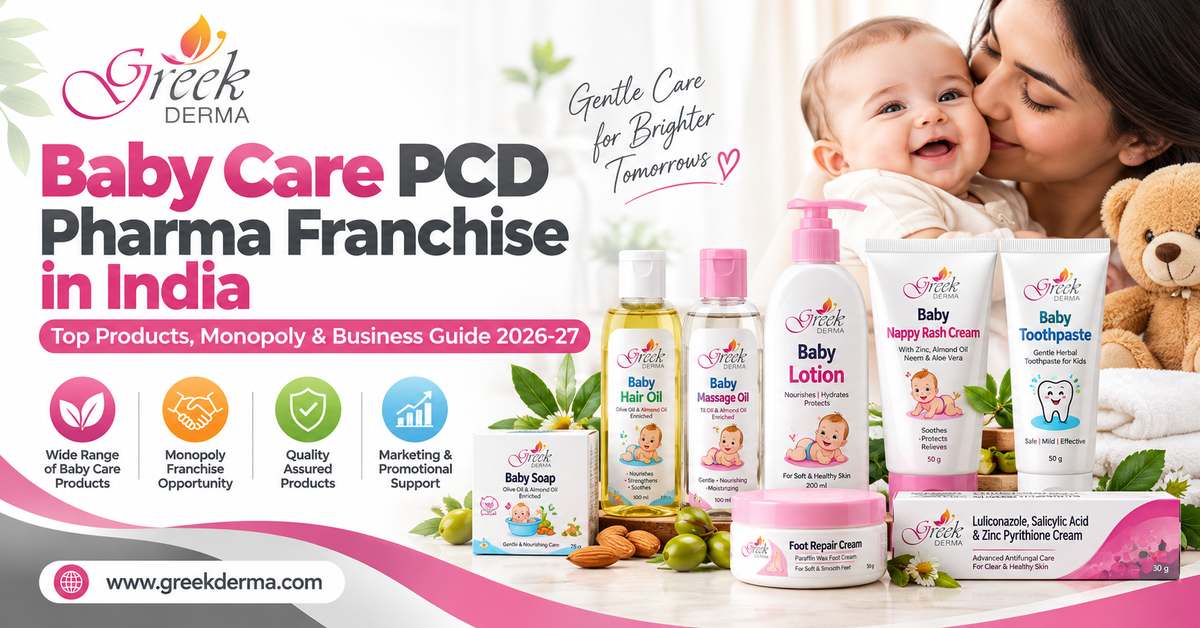
Baby Care Product Range by Greek Derma
Greek Derma includes baby care within its broader dermatology and skincare portfolio. Rather than presenting the range as a “Top 10” list when the available catalogue is smaller, it is more useful to evaluate the products individually according to category, formulation and market relevance.
1. Baby Hair Oil – Olive Oil & Almond Oil Enriched:
Baby Hair Oil provides a dedicated hair and scalp-care option within the baby-care portfolio.
An oil-based hair-care product can complement bathing, massage and moisturising products when building a broader daily-care range.
For franchise planning, compare the current ingredients, pack size, pricing, packaging and expected demand before deciding opening quantities.
2. Baby Massage Oil – Til Oil & Almond Oil Enriched:
Baby massage oil represents an important body-care category within a specialised baby portfolio.
Greek Derma’s product range includes a variant based around Til Oil and Almond Oil. When selecting massage oils for a franchise portfolio, compare formulation, product information, packaging and current commercial terms.
3. Baby Lotion:
A baby lotion adds a moisturising category to the range.
Lotions can complement cleansing and massage products, allowing a franchise associate to build a portfolio around multiple parts of the daily baby-care routine rather than relying on one product category.
The current product label and formulation should always be checked before making ingredient or performance claims.
4. Baby Nappy Rash Cream with Zinc, Almond Oil, Neem & Aloe Vera:
Nappy-area care represents a more specialised part of a baby skincare portfolio.
Greek Derma lists a Baby Nappy Rash Cream positioned around ingredients including Zinc, Almond Oil, Neem and Aloe Vera.
For products intended for delicate skin, franchise partners should rely on the latest approved product information and avoid unsupported safety or treatment claims.
5. Baby Soap – Olive Oil & Almond Oil Enriched:
Baby Soap adds a cleansing product to the portfolio.
A dedicated cleansing category can work alongside lotions, massage oils and hair-care products to create a more rounded baby-care range.
Product formulation, packaging, usage instructions and current pack presentation should be verified before marketing.
6. Baby Toothpaste – Gentle Herbal Toothpaste for Kids:
The range also extends beyond skin and hair care through a gentle herbal toothpaste for kids.
This gives a franchise portfolio an oral-care category alongside conventional baby skincare products.
As with any children’s product, current labelling, intended age/use information and directions should be followed rather than making assumptions based only on the product name.
7. Vitamin A, D & Olive Oil Baby Massage Oil:
Greek Derma also lists another baby massage-oil formulation positioned around Vitamin A, Vitamin D and olive oil.
Having more than one massage-oil option can provide portfolio variety, but a franchise partner should compare both formulations before stocking them heavily.
The goal should be to understand which variant has stronger demand within the target market.
Related Dermatology Products Listed Alongside the Range
Two additional product pages supplied for this range are Foot Repair Cream with Paraffin Wax and a Luliconazole, Salicylic Acid & Zinc Pyrithione formulation.
These should not automatically be marketed as baby-care products merely because they appear alongside the supplied product set. They are better treated as part of the wider dermatology portfolio unless their current approved product information specifically supports baby-care positioning.
This distinction is particularly important in a Baby Care PCD Pharma Franchise because product categorisation and intended-use information should remain accurate.
How to Select Baby Care Products for a PCD Franchise
A new franchise partner does not necessarily need to purchase the same quantity of every product.
A better process is:
Market Research → Category Selection → Product Comparison → Opening Stock → Sales Tracking → Reordering
First identify the baby-care categories for which demand exists within the target territory.
Then compare individual products based on formulation, pricing, pack presentation, competition and supply.
After launching, use actual sales and repeat-order data to determine which products deserve higher inventory.
Building a Balanced Baby Care Portfolio
A focused portfolio can be divided according to product purpose.
| Product Category | Portfolio Role |
| Baby Hair Oil | Hair & scalp care |
| Baby Massage Oil | Massage & body care |
| Baby Lotion | Moisturising |
| Baby Nappy Rash Cream | Nappy-area skincare |
| Baby Soap | Daily cleansing |
| Baby Toothpaste | Kids’ oral care |
| Vitamin A, D & Olive Oil Baby Massage Oil | Massage & body care |
This approach makes it easier to identify gaps and prevents unnecessary duplication.
What is a Baby Care Monopoly PCD Pharma Franchise?
A baby care monopoly PCD Pharma franchise generally means that a franchise partner receives agreed marketing or distribution rights for specified products within a defined geographical territory.
The important words are agreed upon and defined.
A monopoly arrangement should not be interpreted as permanent exclusivity across an entire city, district or state unless the written agreement specifically provides those rights.
Greek Derma states that it offers monopoly-based PCD franchise opportunities in selected locations. Exact availability and terms therefore need to be confirmed for the intended territory.
How Do Monopoly Rights Work?
Monopoly arrangements can differ significantly between companies.
A franchise agreement should clearly explain:
Territory: The exact geographical area allocated to the franchise partner.
Products: Whether rights cover the complete range or only selected products.
Duration: How long the arrangement remains valid.
Purchase Conditions: Whether minimum purchases or sales targets apply.
Renewal: Requirements for continuing the territory.
Direct Supply Policy: How enquiries from other distributors in the same territory are handled.
Termination Conditions: Circumstances under which monopoly rights can be withdrawn.
Getting these conditions in writing helps reduce future misunderstandings.
City-Based vs District-Based Monopoly
Entrepreneurs should also understand the difference between different territory structures.
A city-based monopoly may provide rights only within specified city limits.
A district-based monopoly can cover a larger geographical market if the company’s policy and current availability allow it.
A state-level territory can be significantly larger and may require more working capital, inventory and distribution capacity.
Bigger territory does not automatically mean a better business opportunity. Select an area that can realistically be developed.
Benefits of Focused Baby Care Monopoly Franchise
Where the territory and conditions are clearly defined, a focused monopoly arrangement can help with:
- Territory-specific business planning
- Local distribution development
- Product-focused promotion
- Inventory planning
- Building retailer and professional networks
- Reducing internal channel conflict
- Developing consistent brand presence
However, monopoly rights themselves do not guarantee sales or profitability.
Actual business performance still depends on demand, product selection, pricing, competition, supply and execution.
What to Check Before Selecting Baby Care Products
Baby-care products require careful evaluation.
Before ordering, check the current:
Product Name – Confirm the correct brand and variant.
Ingredients/Formulation – Use current product information.
Pack Size – Verify the latest presentation.
Batch Details – Check the supplied batch information.
Shelf Life – Evaluate remaining shelf life before accepting significant inventory.
Storage Instructions – Follow the label requirements.
Usage Information – Marketing communication should remain consistent with approved information.
Packaging – Check container quality, sealing and label clarity.
Avoid claims such as “100% safe”, “no side effects” or guaranteed results unless they are appropriately substantiated.
Importance of Packaging in Baby Care Products
Packaging has particular importance in the baby-care segment.
It should provide clear information while remaining convenient for the intended product type.
Important points include:
- Clear ingredient/formulation information
- Readable directions
- Batch and expiry details
- Proper sealing
- Storage information
- Professional presentation
- Consistent branding
Visual appeal can improve shelf presentation, but accurate information should remain the priority.
Investment for Baby Care PCD Pharma Franchise in India
There is no fixed investment applicable to every Baby Care PCD Pharma Franchise in India.
Initial working capital can depend on:
- Number of products selected
- Quantity per SKU
- Product pricing
- MOQ
- Freight
- Promotional expenditure
- Territory size
- Business documentation
- Distribution expenses
- Credit offered in the market
- Reorder cycle
Instead of starting with the maximum possible range, calculate the investment product by product.
Opening Stock Planning:
Suppose seven clearly baby/kids-oriented products are selected initially.
There is no requirement to purchase identical quantities of all seven.
The opening portfolio can be divided into:
Core Products: Products for which stronger demand has already been identified.
Supporting Products: Complementary products maintained at moderate quantities.
Test Products: Products initially stocked in smaller quantities while market response is evaluated.
After a few sales cycles, actual movement can guide future purchases.
MOQ & Working Capital
Minimum Order Quantity can significantly influence the amount of capital required.
Before starting, ask whether MOQ applies:
- Per product
- Per box
- Per case
- Per invoice
- Per total order value
Also ask whether the opening-order MOQ differs from repeat orders.
Lower purchase prices are not always beneficial if the required quantity causes excessive stock holding.
Stock & Expiry Management
Inventory management becomes important even with a relatively compact baby-care portfolio.
Maintain records such as:
Brand → Batch → Purchase Date → Quantity → Sales → Closing Stock → Expiry → Reorder Level
Where applicable, FEFO (First Expiry, First Out) can help prioritise valid stock with earlier expiry dates.
Regularly identify fast-moving, moderate-moving and slow-moving products.
How to Market a Baby Care PCD Franchise
Marketing should focus on accurate product information rather than exaggerated claims.
Depending on the nature and regulatory classification of individual products, relevant channels may include suitable retail, distribution, professional and digital networks.
Digital visibility can also be developed through:
- Product category pages
- Informative blogs
- Local SEO
- Product-focused content
- Educational social media content
- Business profile optimisation
The messaging should clearly distinguish routine baby-care products from dermatological or medicated formulations.
Promotional Support for Franchise Partners
Promotional support can help franchise partners introduce a new portfolio within their territory.
Greek Derma states that its franchise support can include product brochures, visual aids, MR bags, sample kits and branding materials. The exact package available to a Baby Care franchise partner should be confirmed at the time of enquiry.
How to Start a Baby Care PCD Pharma Franchise in India
Step 1 – Select Your Territory
Choose a city, district or other manageable geographical market.
Step 2 – Research Product Demand
Study existing baby-care products, competition, pricing and distribution channels.
Step 3 – Evaluate the Product Portfolio
Compare formulations, packaging, pricing and product positioning.
Step 4 – Verify Company Information
Review applicable manufacturing and quality documentation instead of relying only on promotional claims.
Step 5 – Check Monopoly Availability
Confirm whether the desired territory is currently available.
Step 6 – Understand Commercial Terms
Discuss price lists, MOQ, freight, payment terms, supply and promotional support.
Step 7 – Review the Agreement
Read territory, product coverage, sales conditions, renewal and termination clauses carefully.
Step 8 – Place a Controlled Opening Order
Select quantities according to realistic demand.
Step 9 – Develop Your Market
Build the relevant local distribution and professional network.
Step 10 – Track Performance
Use sales and inventory records to improve future purchasing decisions.
Common Mistakes to Avoid
One of the biggest mistakes is assuming that every product listed near a Baby Care category is automatically suitable for babies.
Also avoid:
- Ordering excessive opening inventory
- Choosing products only because they are inexpensive
- Ignoring shelf life
- Assuming verbal monopoly rights are sufficient
- Ignoring territory boundaries
- Stocking multiple similar products without demand
- Making unsupported safety claims
- Not tracking slow-moving stock
- Offering excessive market credit
- Ignoring repeat-order patterns
A smaller, carefully selected portfolio can be commercially more manageable than an unnecessarily large range.
About Greek Derma:
Greek Derma is a dermatology-focused company offering skincare, hair-care, baby-care and related derma products. Its official website currently lists categories including sunscreen, soap, shampoo, ointment, lotion, hair care, face wash and Baby Care.
The company also promotes monopoly-based PCD franchise opportunities and states that franchise partners can receive marketing and promotional support. Its broader franchise content advises evaluating product range, territory, documentation, pricing, stock availability and supply conditions when considering a derma franchise arrangement.
For someone specifically exploring a Baby Care PCD Franchise Company in India, Greek Derma can therefore be evaluated on the strength of its current baby-care range as well as its wider dermatology portfolio.
Why Evaluate Greek Derma for Baby Care PCD Franchise?
Specialised Dermatology Portfolio:
Baby Care sits alongside Greek Derma’s wider skin and hair-care categories rather than being isolated from the company’s core dermatology focus.
Multiple Baby Care Categories:
The supplied product range covers massage, hair care, moisturising, cleansing, nappy-area care and children’s oral care.
Monopoly Franchise Opportunities:
Greek Derma publicly states that monopoly-based opportunities are available in selected locations, subject to current territory availability.
Wider Product Expansion Possibility:
A franchise partner beginning with baby-care products can separately evaluate complementary dermatology categories if relevant to the territory.
Promotional Support:
Greek Derma states that it provides franchise partners with promotional and marketing support.
Future Scope of Baby Care PCD Pharma Franchise in India
A specialised Baby Care PCD business gives entrepreneurs the ability to build around complementary daily-care categories rather than depending on a single product.
The portfolio can also be expanded gradually.
Instead of purchasing a large number of products at the beginning, franchise partners can first establish demand for massage oils, lotion, cleansing, nappy care and other core categories.
New products can then be introduced according to actual territory requirements.
This demand-led approach can help control inventory and working capital while creating a more structured franchise business.
Conclusion:
A Baby Care PCD Pharma Franchise in India can be developed as a focused business around baby skincare, massage, cleansing, hair care, nappy care and related categories.
However, successful portfolio planning requires more than simply collecting products under a Baby Care label.
Entrepreneurs should evaluate individual products, ingredients or compositions, packaging, pricing, MOQ, shelf life, supply consistency and local demand. For a Baby Care Monopoly PCD Pharma Franchise, territory boundaries and commercial conditions should also be documented clearly.
Greek Derma currently includes Baby Care within its wider dermatology portfolio and promotes monopoly-based franchise opportunities subject to territory availability.
Its baby-oriented range provides several complementary categories that prospective franchise partners can evaluate when planning a specialised portfolio for 2026-27.
Frequently Asked Questions:
Q.1 What is a Baby Care PCD Pharma Franchise?
Ans. It is a franchise business model focused on the marketing and distribution of baby-care products within an agreed territory and under defined commercial terms.
Q.2 Which Baby Care products does Greek Derma offer?
Ans. The supplied range includes Baby Hair Oil, Baby Massage Oil, Baby Lotion, Baby Nappy Rash Cream, Baby Soap, Baby Toothpaste and Vitamin A, D & Olive Oil Baby Massage Oil.
Q.3 Does Greek Derma offer Baby Care PCD Pharma Franchise opportunities?
Ans. Greek Derma operates a dermatology-focused PCD franchise model and includes Baby Care among its product categories. Its website states that monopoly-based franchise opportunities are available in selected locations. Exact product and territory availability should be confirmed before proceeding.
Q.4 What is a Baby Care Monopoly PCD Pharma Franchise?
Ans. It generally refers to agreed marketing or distribution rights for specified baby-care products within a defined geographical territory, subject to the company’s written terms.
Q.5 How much investment is required for a Baby Care PCD Franchise?
Ans. There is no single fixed amount. Investment depends on the number of products, opening quantities, pricing, MOQ, territory size, freight, marketing costs and working-capital requirements.
Q.6 Which products should I select first?
Ans. Start with products that have identifiable demand within your territory. Compare massage, cleansing, moisturising, hair care, nappy care and other categories before deciding opening quantities.
Q.7 Should all nine supplied Greek Derma products be promoted as Baby Care?
Ans. Not automatically. The Foot Repair Cream and Luliconazole/Salicylic Acid/Zinc Pyrithione product should remain under their appropriate dermatology positioning unless current approved product information specifically supports baby-care use.
Q.8 Does a monopoly franchise guarantee business success?
Ans. No. Monopoly rights define agreed territory conditions but do not guarantee sales or profit. Results depend on product demand, pricing, competition, supply, inventory management and business execution.
Q.9 What should I verify before taking the franchise?
Ans. Verify the latest product list, pricing, pack sizes, MOQ, applicable quality documentation, shelf life, supply terms, promotional support and written monopoly conditions.
Q.10 Can the portfolio later be expanded into other derma categories?
Ans. Yes, where commercially relevant and available. Greek Derma’s broader portfolio includes several skincare, hair-care and dermatology categories that can be evaluated separately.